I build digital threads: system architecture, requirements, CAD geometry and test data joined in one traceable model, plus the Python that keeps it current. I build and verify hardware too: electric powertrains for legacy vehicles, a fire-gutted motorcycle rebuilt as a road-legal EV with my own motor controller, BMS and charger, and the release-control platform for a seven-country fleet of medical-device laptops.
Current
Integrated Solutions Engineer Contec Americas · Embedded systems
Education
B.S. Aerospace Engineering B.S. Aeronautical Engineering Florida Institute of Technology, 2022
Focus
Requirements & traceability, V&V, configuration management, digital twins Regulated change control: ISO 13485, EU CRA
Rather than claim a fit, here is the trace. Each qualification from the posting links to evidence on this page, with the verification method and an honest status. Select a requirement to read its evidence; on a wider screen, select an evidence column to trace it back.
tracedInspection check the recordDemonstration public code or artifact
02
Selected work
E1 · E2Contec Americas2025 – present
A digital thread for embedded systems
Python digital twin models that tie system architecture, CAD geometry and operational telemetry into one traceable engineering repository.
Problem
System architecture, CAD, test data and configuration records lived in separate systems, and keeping them consistent took manual reconciliation.
What I built
Digital twin models in Python that connect architecture, geometry and telemetry. Automated pipelines and REST API connectors between engineering repositories, test data and configuration management. Data contracts and interface specifications agreed with mechanical, electrical and software teams. The AI side is full stack, from research and development through to the software that ships, and much of the role has been R&D.
Verification
Requirements, their verification and their traceability managed in the Altium 365 Requirements & Systems Portal, alongside Altium Designer. Traceability matrices that run from system requirements through sub-system interfaces and design decisions to test cases and acceptance evidence. V&V planning coordinated across system boundaries. Code written with AI assistance is verified independently.
Outcome
Automated pipelines replaced manual data reconciliation, and design revisions stay under configuration control.
Python · REST APIs · Full-stack AI · R&D · Digital twin · Traceability · Configuration managementProprietary work, described in general terms.
E11Contec Americas2025 – present
Release control for a regulated fleet in seven countries
The master control platform for the regional hubs that provision the laptops paired with intraoral scanners made by one of the world’s largest dental-technology companies, best known for clear aligners. The hubs set up 200 to 1,000 laptops a month. The platform runs software releases, sync, monitoring, security scanning and regulatory change control, with a portal the customer uses too, and all of it runs on a Raspberry Pi CM5.
Problem
Under ISO 13485, a country’s hub may only serve a software release once that country’s regulator has approved it. The hubs sit on networks that are reachable only part of the time. Approvals, releases and what each hub actually runs had to agree, with an audit trail anyone could inspect.
What I built
A change-control portal (Python, PostgreSQL) showing, per country, the release each hub runs and the one it’s scheduled for, next to its regulatory approval. A hub that serves, or is set to receive, an unapproved release is flagged red. The approval history is append-only, enforced by database triggers.
Deployments that must pass every gate before they run: the release is approved for that country, its frozen snapshot passes checksum and manifest checks, a dry run of the same deploy passed in the last 30 minutes, and the operator types the region code. One deploy runs at a time, and every one is logged.
Frozen, checksummed release snapshots, so one country can stay on an older approved release while others move ahead. Contec’s infrastructure layer is versioned separately from the customer’s release layer; I verified that combining them reproduces production byte for byte.
The master server itself and its command-line suite for version management and promotion from development to production, which I built on my own before I used any AI assistance, plus Ansible playbooks to provision hubs and push configuration.
Verification
A software bill of materials for each release, reconciled against the customer’s engineering change orders and exported as CycloneDX 1.5. Checking one 5.5 GB release package caught real defects in it before production: a 19 KB web page shipped in place of a 3.27 GB CUDA installer, and a mislabeled component.
Daily Syft and Grype scans of the host and every container, measured against a baseline so only new findings are reported, for EU Cyber Resilience Act vulnerability handling. The automated scan showed that an earlier hand-built SBOM had undercounted.
Operations
Every sync run records its result in PostgreSQL, and a Grafana dashboard shows each region’s health, late jobs and run times. It surfaced regions that had gone quiet and a nightly push job that had been failing silently.
Traced a fleet-wide outage from a drop in sync run time, 33 s to 1.4 s, to a boot race between NetworkManager and Tailscale that overwrote DNS, and wrote a repeatable fix.
Moved sync from one global sweep to per-region timers in each hub’s local business hours, using IANA time zones so schedules hold through daylight-saving changes. Decommissioned one regional hub.
Customer access
Cloudflare Access sign-in, validated on the server and failing closed, limited to an email-domain allow-list with separate admin and viewer roles. Customer viewers never see internal hostnames, paths or errors, and admins can preview exactly what they see. Provisioning and audit records are permanent: the database refuses updates and deletes, and backups run nightly.
Status
In daily use for release tracking, monitoring and scanning. Built but not yet switched on: one-click deploys from the portal, and hubs re-syncing themselves when they boot.
Product security and EU Cyber Resilience Act reporting
I run Contec Americas’ product security incident response team (PSIRT) and lead its readiness for Article 14 of the EU Cyber Resilience Act, which since September 11, 2026 requires manufacturers to report actively exploited vulnerabilities and severe incidents within 24 hours.
Problem
Contec Americas is a hardware integrator: it buys PC hardware, installs the operating system and customer software, and sells configured units, some of them medical devices. Most fixes come from suppliers, as BIOS, OS and third-party patches, so incident response is mostly supplier coordination, and the reporting clock still applies.
What I built
The PSIRT operating policy, adapted from the parent company’s IEC 62443-4-1 policy: four lean roles, CVSS and CWE severity ranking, coordination with the parent company’s PSIRT on shared components, and a CRA appendix with the 24-hour, 72-hour and final-report deadlines. Released in 2026.
Registration on ENISA’s Single Reporting Platform through the company’s EU branch, verified by the national CSIRT.
An incident-record design for the company’s ERP, taken in stages from design to field dictionary, JSON schema and HTML mockup. The legal clock starts at the moment of awareness, so every timestamp has a UTC copy, and submissions are kept as immutable records with SHA-256 hashes.
A field toolkit on a six-partition USB drive that collects firmware and software inventories from Contec products on Linux and Windows and converts them to CycloneDX 1.6 SBOMs. On medical devices it only reads, and it avoids Windows queries that would make installers reconfigure themselves.
Status
Policy released and the reporting platform registered. Next: a timed dry run of a 24-hour report, an on-call roster, and mapping products to the EU markets they ship to.
EU CRA · IEC 62443-4-1 · ENISA SRP · CVSS · CWE · CycloneDX 1.6 · Bash · PowerShell · PythonProprietary work, described in general terms.
Contec Americas2025 – 2026
Argus: edge AI and an OpenUSD twin of a warehouse
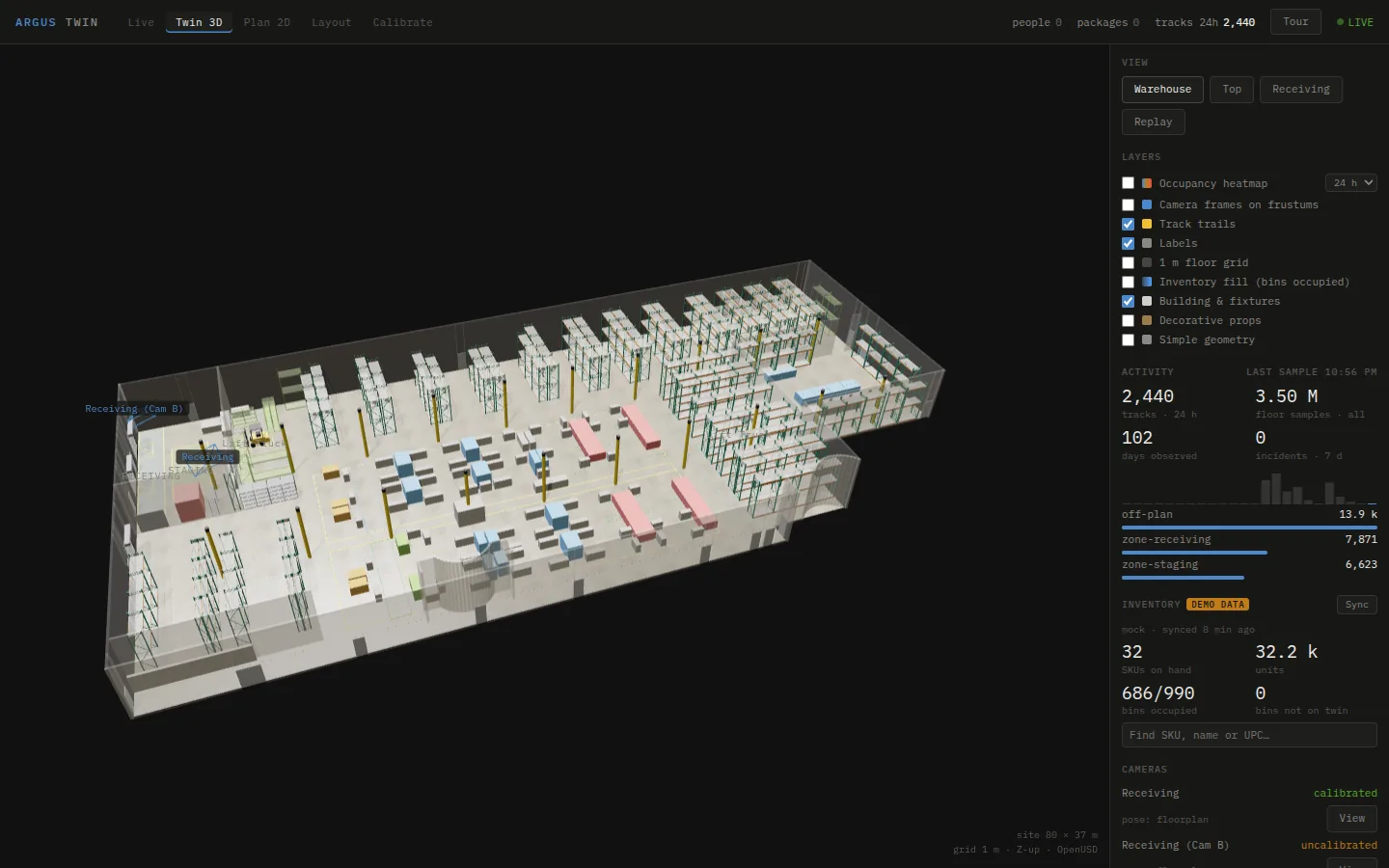
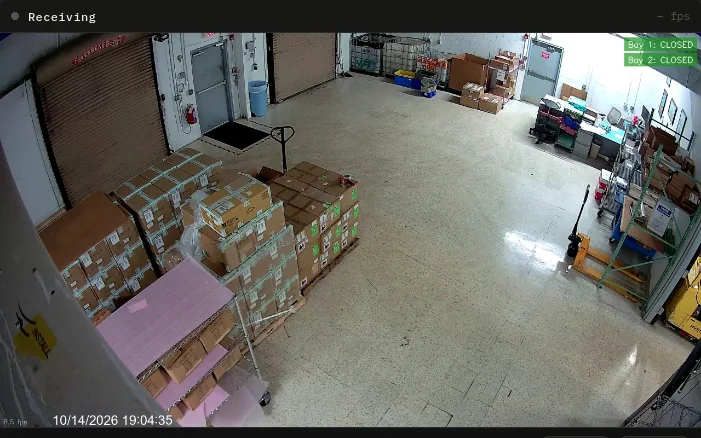
Packages that turn up damaged at a receiving dock, with nobody able to say whether they came off the truck that way. Argus puts vision on the dock with a fanless Contec PC and no NVIDIA GPU, so video never leaves the building, and writes what the cameras see into an OpenUSD stage of the whole warehouse. The browser and NVIDIA Omniverse render that same stage, live, once a second.
What I built
Edge inference: YOLOv8n with the backbone compiled for a MemryX accelerator and the detection head on the CPU (ONNX Runtime), about 37 ms a frame, on two 4K cameras covering the bay doors and the room interior. An IoU tracker gives detections stable IDs, and a per-camera homography, calibrated in a browser point-picker, puts each one on the floor in meters.
A layered OpenUSD stage: a live layer rewritten every second, a cameras layer with calibrated poses, a layout layer generated from the site CAD (building shell, 15 openings, 71 fixtures, floor markings), and an assets layer. Every prim carries argus:* attributes (class, track ID, camera, zone, door state, pose source) that the browser and Omniverse tools both read.
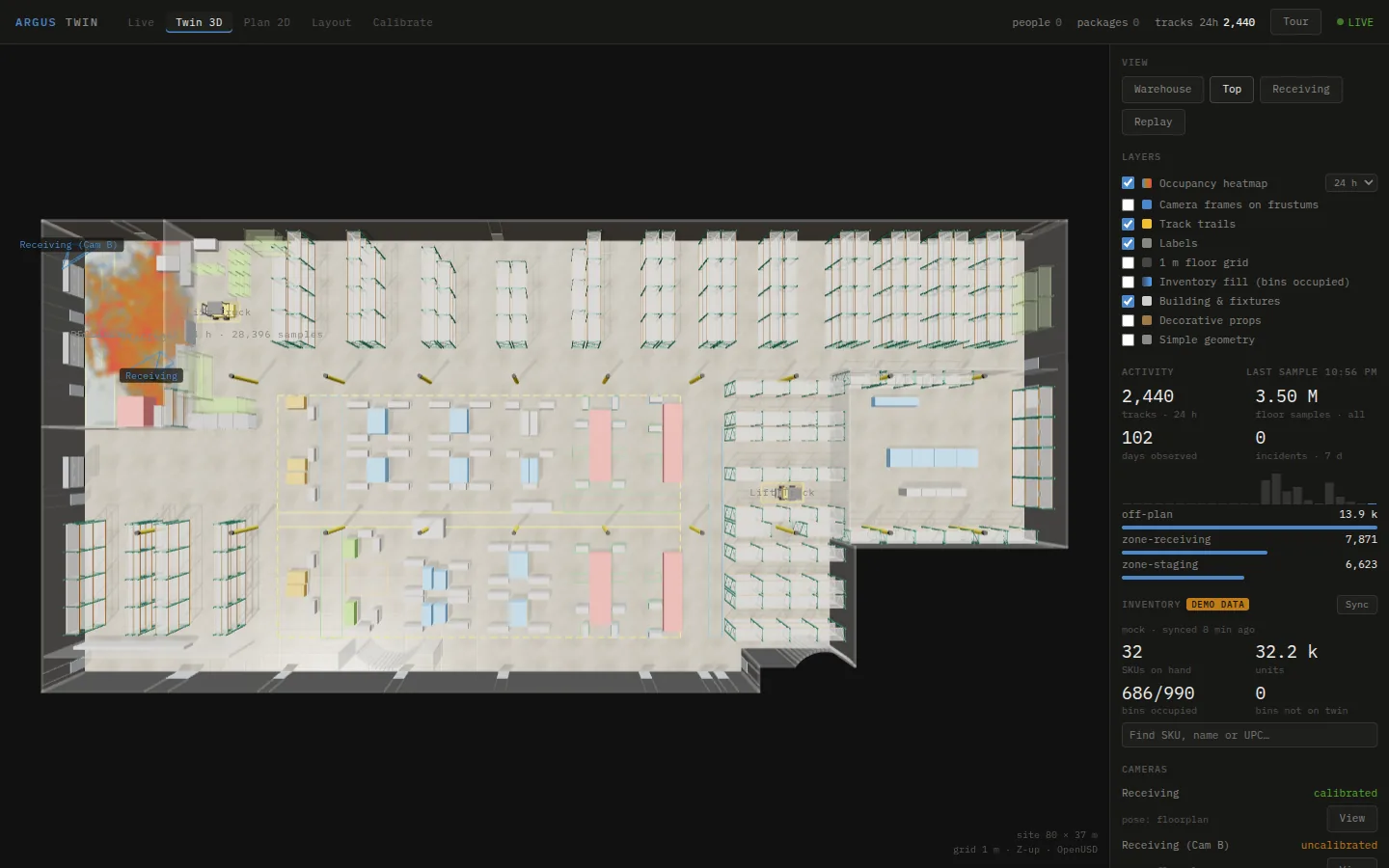
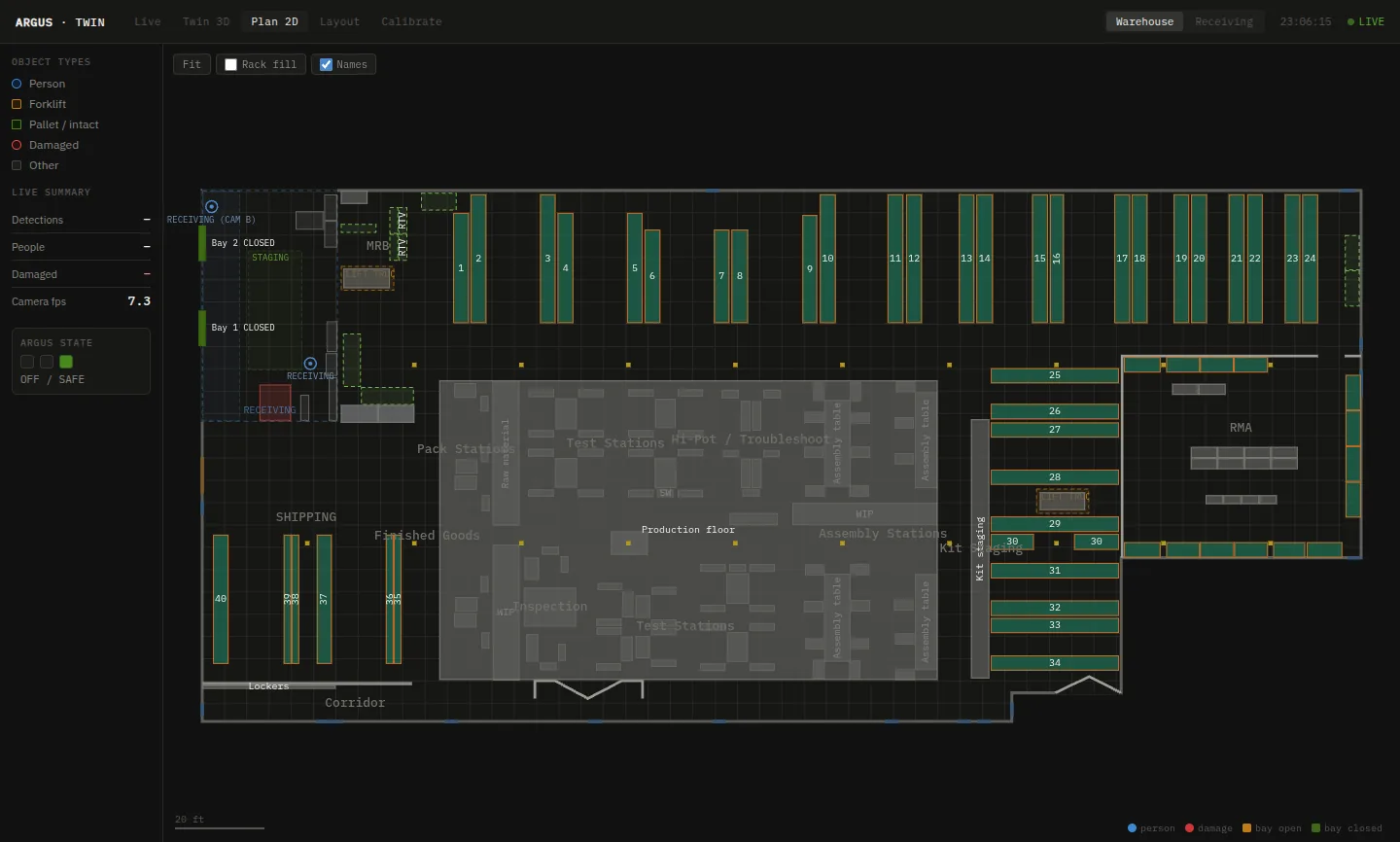
Views on that one stage: a three.js 3D twin and a 2D plan, a shared layout editor, an occupancy heatmap over any window from an hour to a month, and replay of up to 24 hours at up to 300×, drawn from 3.48 million logged floor positions over 102 days. An Omniverse Kit extension hot-swaps the live layer each second.
The first phase: an I/O daemon that is the only owner of the Modbus link to a Contec remote I/O unit driving a 12 V stack light, with MQTT/InfluxDB telemetry and an SVG floor plan of the docks.
What broke, and what changed
A heuristic damage scorer, run before any trained model existed, fired 678,044 incidents in 18 days, nearly all false. I muted it, archived the flood, and moved to a labeled dataset (1,605 images queued) for a trained detector. A detector that can’t say no is worse than none.
The twin segfaulted within seconds under 16 concurrent clients: one thread force-reloaded USD layers while another composed the stage. Now request threads never touch USD; one writer thread owns the stage and HTTP serves a cached scene. A stress run afterwards: 5,825 of 5,825 requests OK.
Two services opened the same accelerator and starved each other. Inference moved into one service, and the other became a health watchdog: one owner per device, enforced by the service layout. The same rule runs the Modbus link, where the I/O unit’s own watchdog returns every output to a safe state if Argus crashes.
At one write a second, layer files often change within one timestamp tick, so a plain reload skipped them and the twin froze. Layers now force-reload, and writes go through atomic rename so no reader sees half a stage.
Bay doors were first guessed at 3.66 m; the CAD said 2.44 m. Every dimension still unmeasured is a commented default in the config, and each camera prim records where its pose came from, so an estimate never passes for a measurement.
Status
Running around the clock as services with health checks: both cameras, detection, tracking, floor mapping, history, the 3D and 2D twins, layout editor and calibration tool. In progress: the custom damage detector (damage alerts stay muted until it ships, so today the cameras track people only) and the second camera’s calibration. The Kit extension’s layer hot-swap is verified in plain OpenUSD but hasn’t yet run inside Kit on the RTX workstation. Next: Omniverse Replicator on the same stage to synthesize labeled frames of damage the real footage rarely shows.
3D twin · whole warehouseOccupancy heatmap · 24 h2D plan · live door stateReceiving camera · live
A rack-mount AI server that watches dealership CCTV in real time for vehicles and people, designed for a video-analytics partner under a fixed per-unit cost ceiling.
Method
Constraints first, in order: chassis, then GPU class, then power budget, then cooling. Each open item tracked as either a blocker or an optimization, in a workbook with a live-formula BOM, three configurations compared, site infrastructure, and power and thermal budgets.
What the constraints decided
Consumer GPU licenses forbid commercial fleet use, so only professional data-center GPUs qualify: a passive, slot-powered card.
A Contec motherboard as the anchor, with an integrated GPU kept for decoding many video streams and the CPU power-capped to stay within its temperature limit in a 2U chassis with the chosen cooler.
Surveillance-rated drives and a pure sine-wave UPS, which the server’s active-PFC power supply needs.
Status
The BOM is within 1% of the target. Two blockers remain before any purchase order: the camera count and frame rate, which decide whether a GPU is needed at all, and written confirmation from the board vendor that the x16 slot delivers its full 75 W.
Trade studies · BOM · Power & thermal budgets · NVIDIA data-center GPUs · UbuntuProprietary work; the customer isn’t named.
Contec Americas2025 – present
Other Contec work
Seismic sensor nodePrototype
A full-stack sensor node for a government customer that locates sources of ground vibration: geophone or accelerometer into a 24-bit ADC, GNSS-disciplined timing so an array of nodes can locate sources by time difference of arrival, STA/LTA event triggering, LTE Cat-M1 backhaul, and LiFePO4 with solar power, for Florida heat, humidity and a high water table.
AI-ready small-form-factor desktops
I lead a three-tier line of compact AI desktops (Standard, Pro, Max), managed in Arena PLM.
AI over KVMIn progress
KVM-over-IP on a Raspberry Pi CM4 or CM5 with an HDMI-to-CSI capture board, built around an agent loop: it captures the screen as JPEG frames, an AI model decides, and the device types and clicks.
Isolated engineering lab
A private-subnet lab for CI/CD, embedded and IoT work, self-hosted services and network R&D, with its own internal DNS zone, subdomain routing behind a reverse proxy, and an 18U rolling rack laid out unit by unit.
Embedded World North America 2026
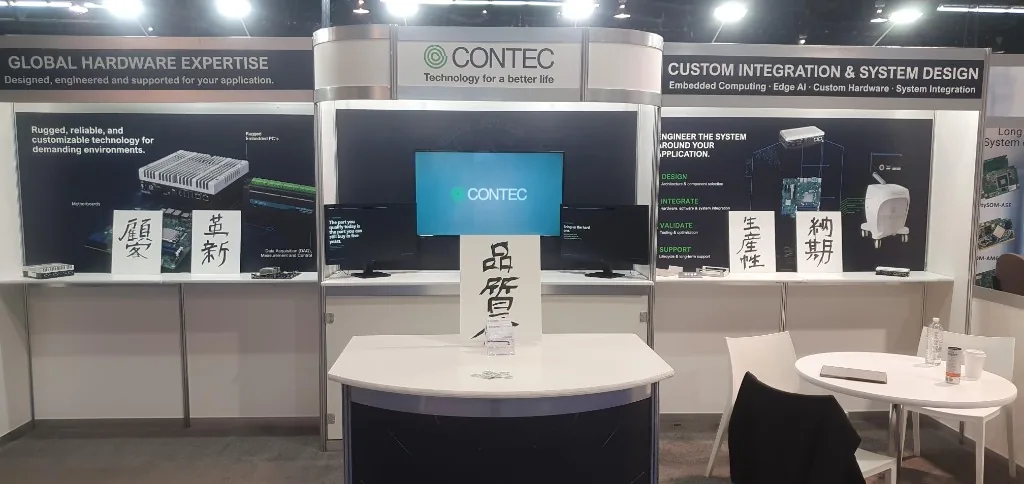
The two kiosk screens on Contec’s booth in Anaheim, plus a site for the team. Each kiosk is one self-contained HTML page that needs no network, because show Wi-Fi can’t be trusted. The two run at different speeds and start 4.2 seconds apart, so they never show their call to action at the same moment.
EWNA 2026 booth · AnaheimKiosk A · long-life by design
Proprietary work, described in general terms.
E4Phoenix Motors · Founder2022 – 2024
Electric powertrains for legacy vehicles
A small business I started after college, converting vehicles from many manufacturers and decades to road-legal electric powertrains.
Problem
Each platform was a different integration problem: a different manufacturer, a different decade, and the same requirement to be road-legal when finished.
Platforms
1990 Honda Transalp, a dual-sport motorcycle
1992 Jeep
2011 Volvo XC60
Electric office trailer: a working office built into a trailer, with the battery bank under the floor, inverters, HVAC, and a generator to back it up
What I did
Defined the electrical architecture, powertrain interface specifications and compliance requirements. Integrated battery systems, motor controllers and the vehicle CAN networks.
Verification
Wrote the powertrain validation test procedures and coordinated field testing for performance, safety and compliance.
Why I started it
To pay off my student loans after graduating, using what my degrees taught me on real vehicles. It became my most hands-on integration work.
Electrical architecture · Interface specs · CAN · Battery & motor control · Inverters & HVAC · Test procedures · Compliance
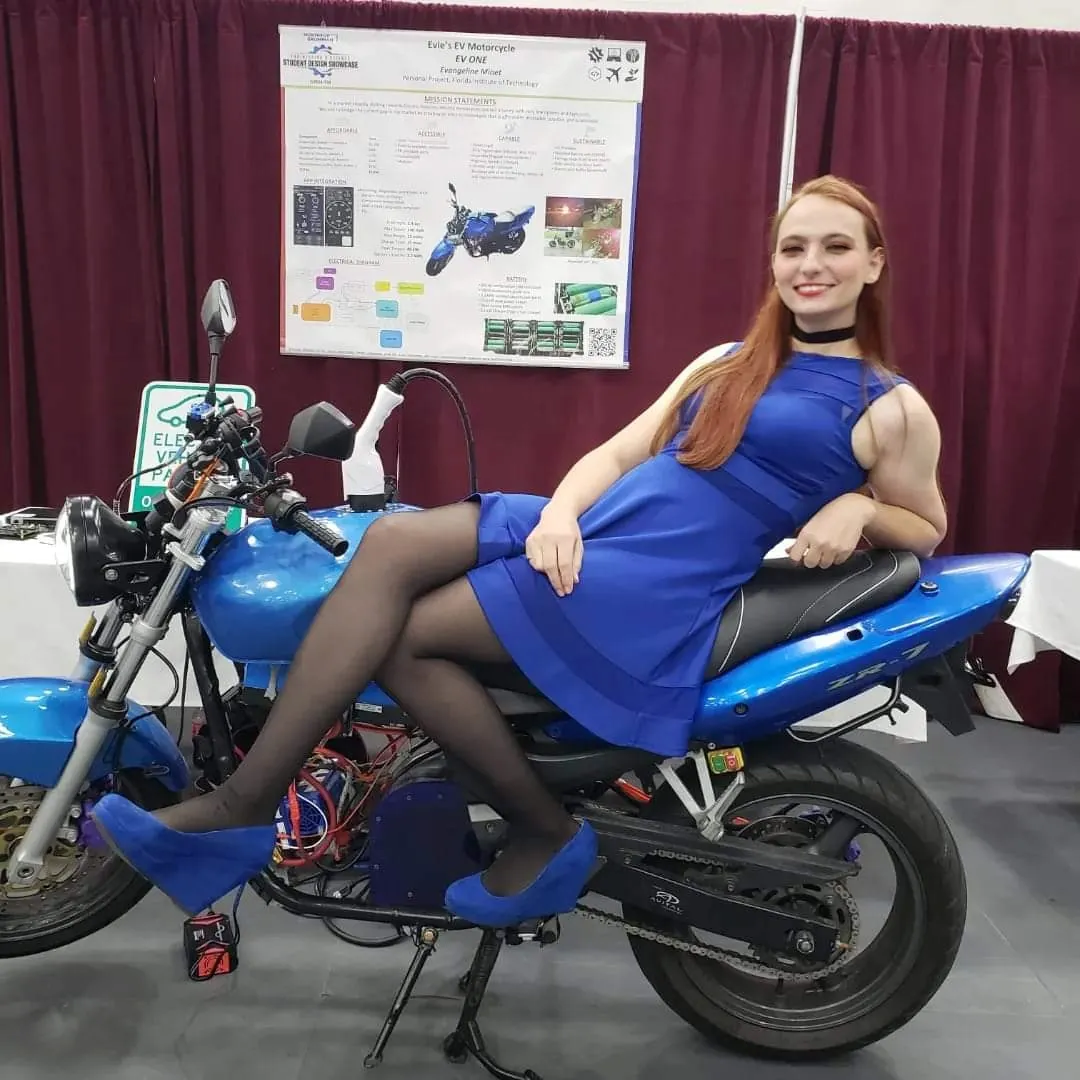
E9Personal project2000 Kawasaki ZR-750F
From ashes: an electric motorcycle
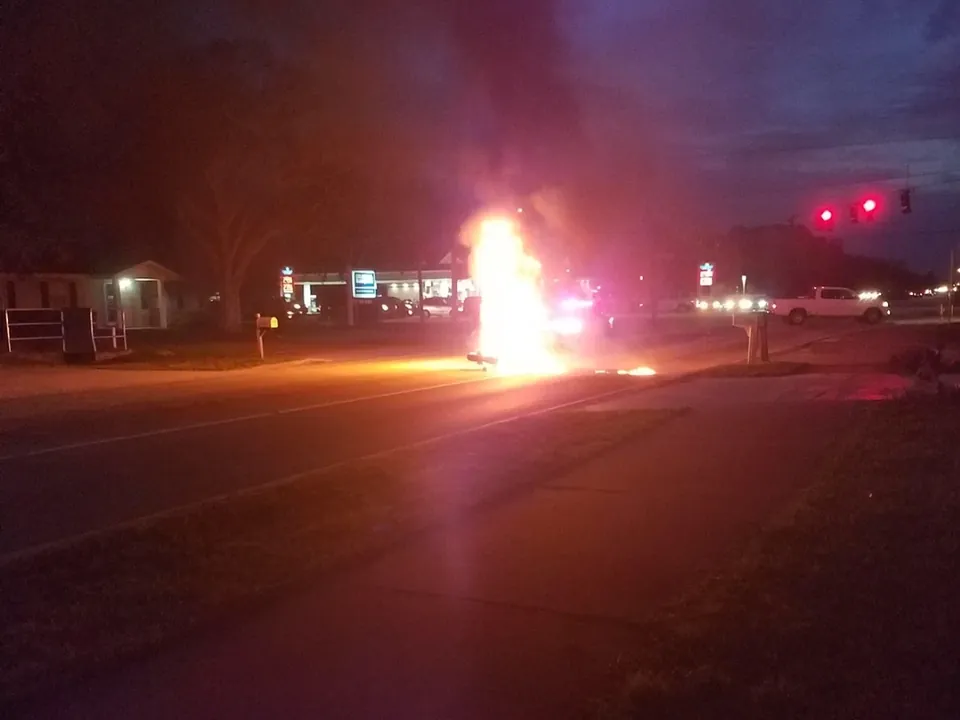
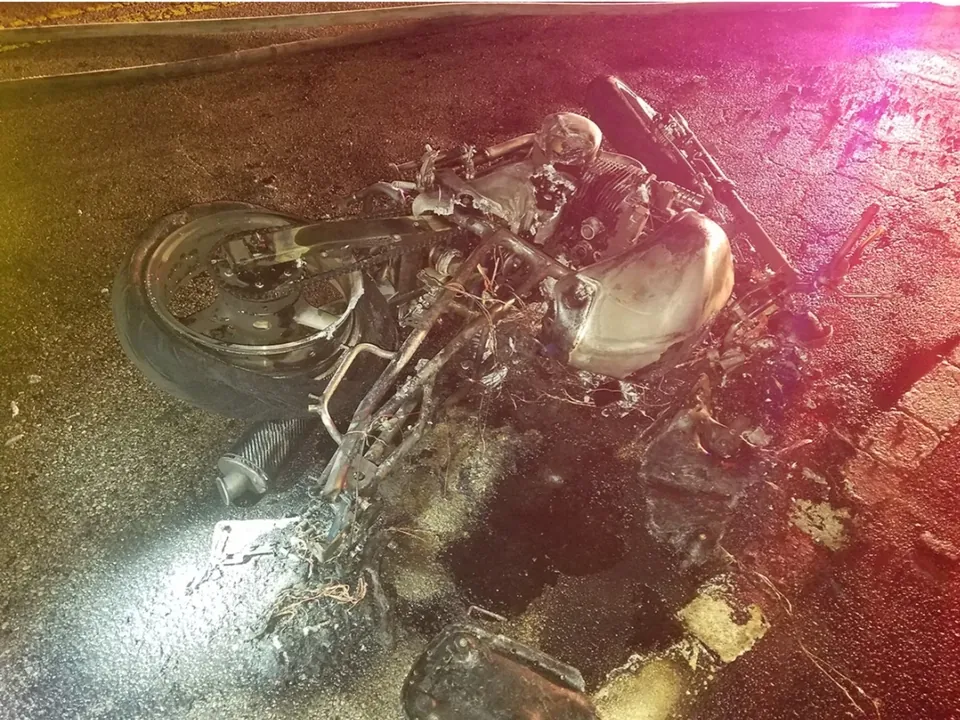
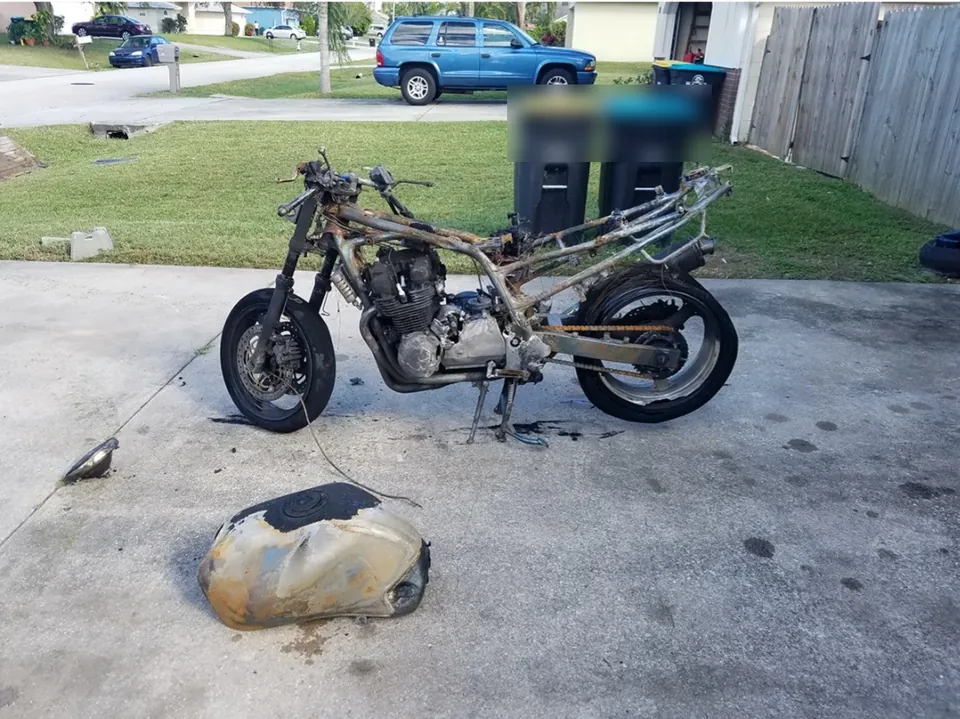
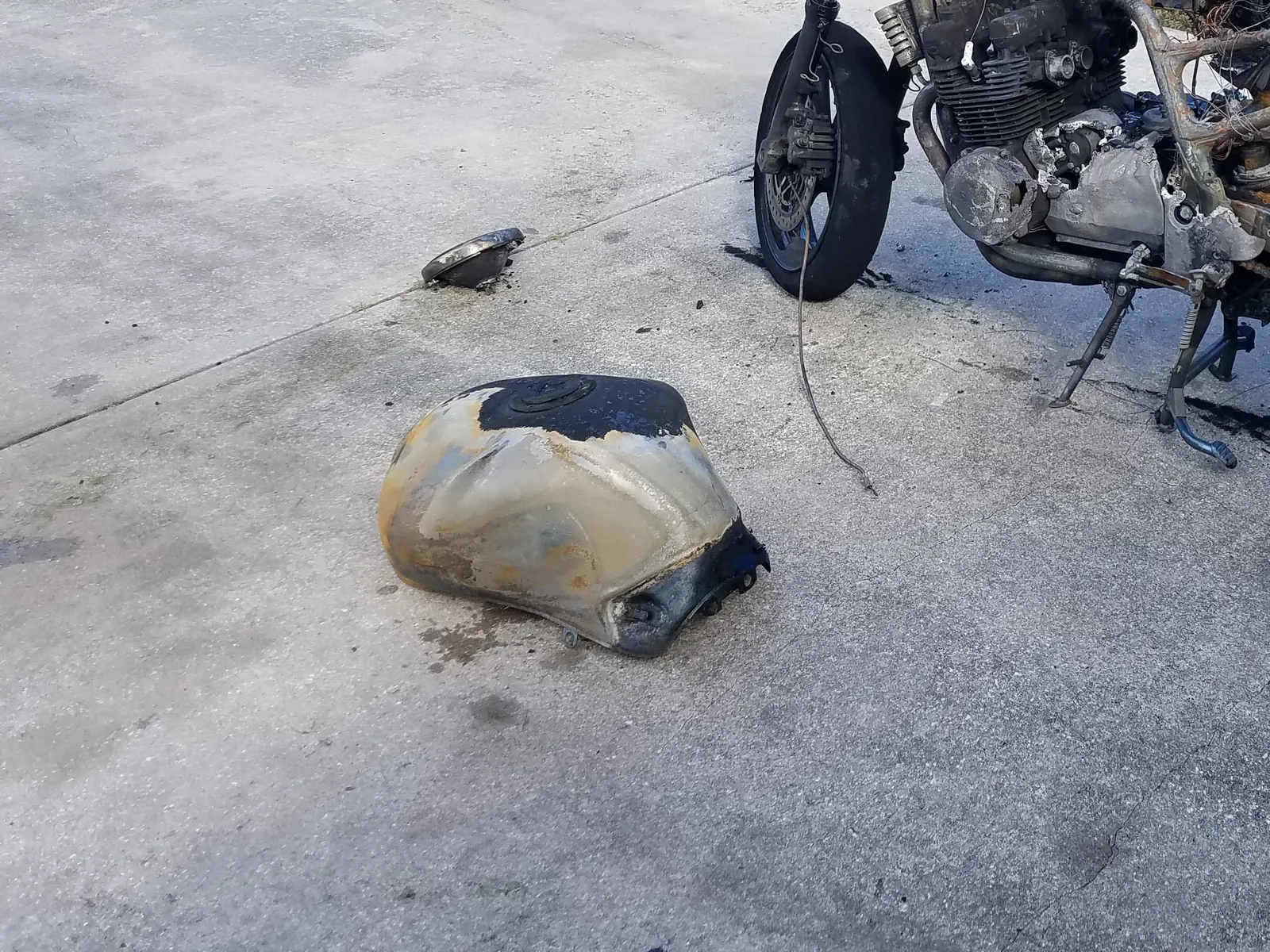
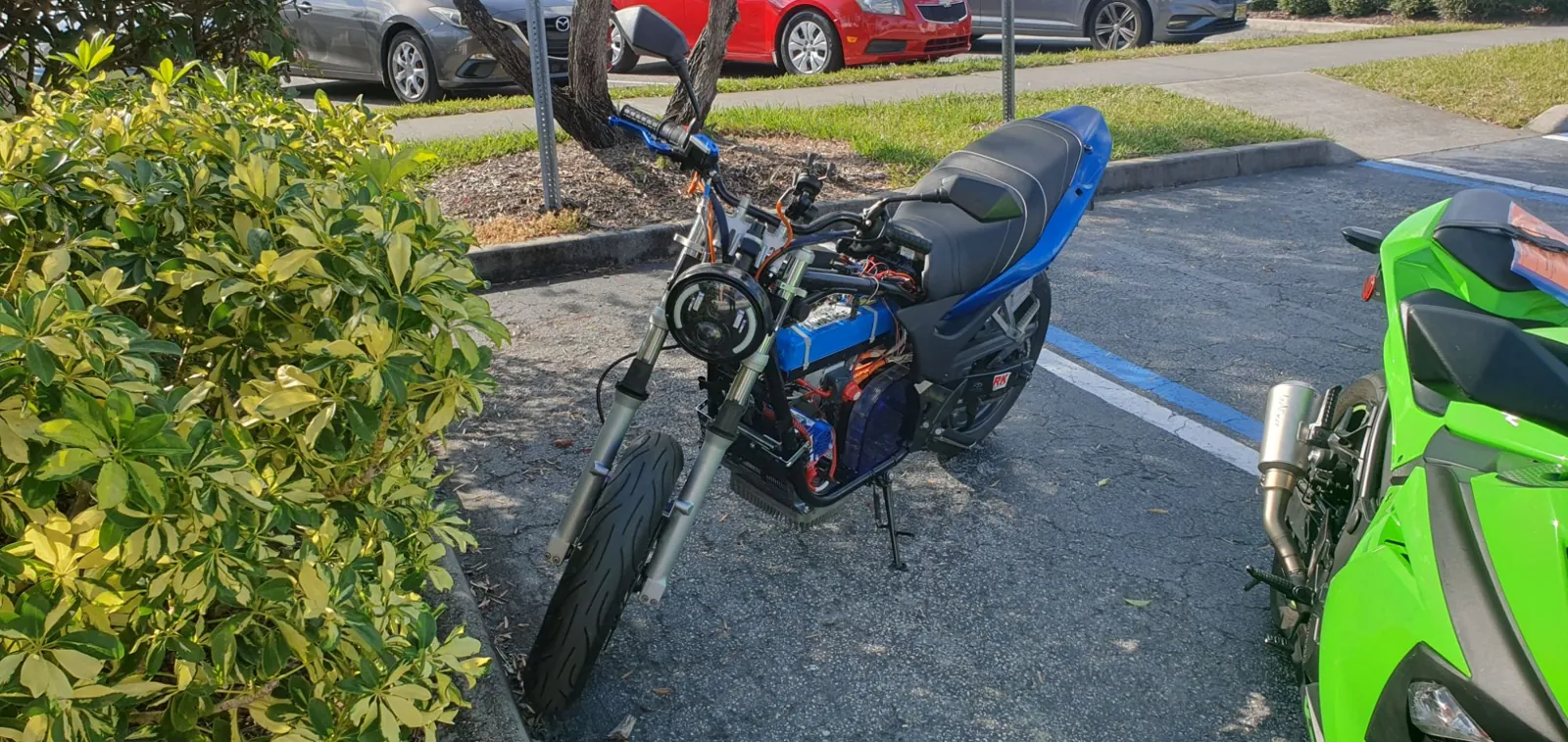
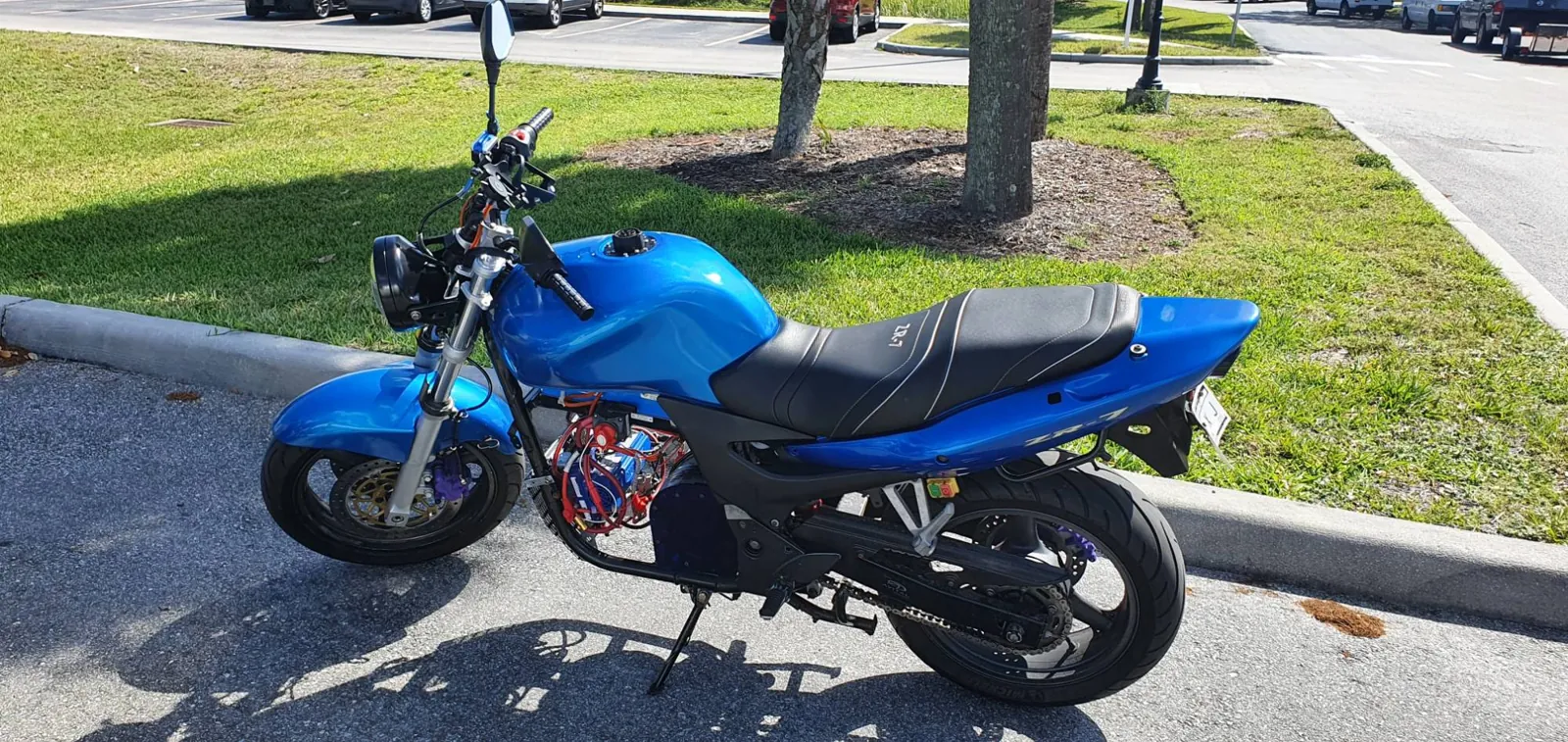
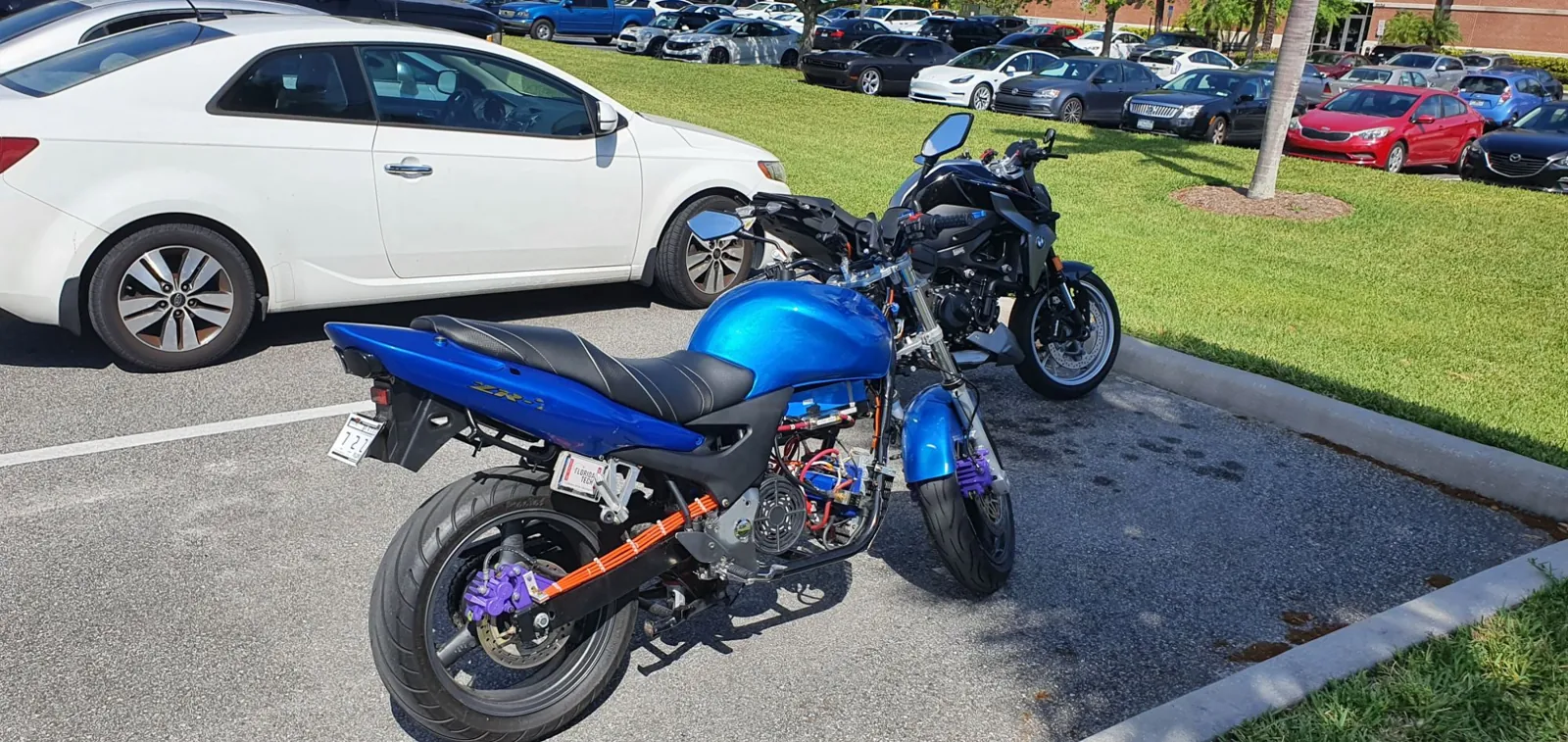
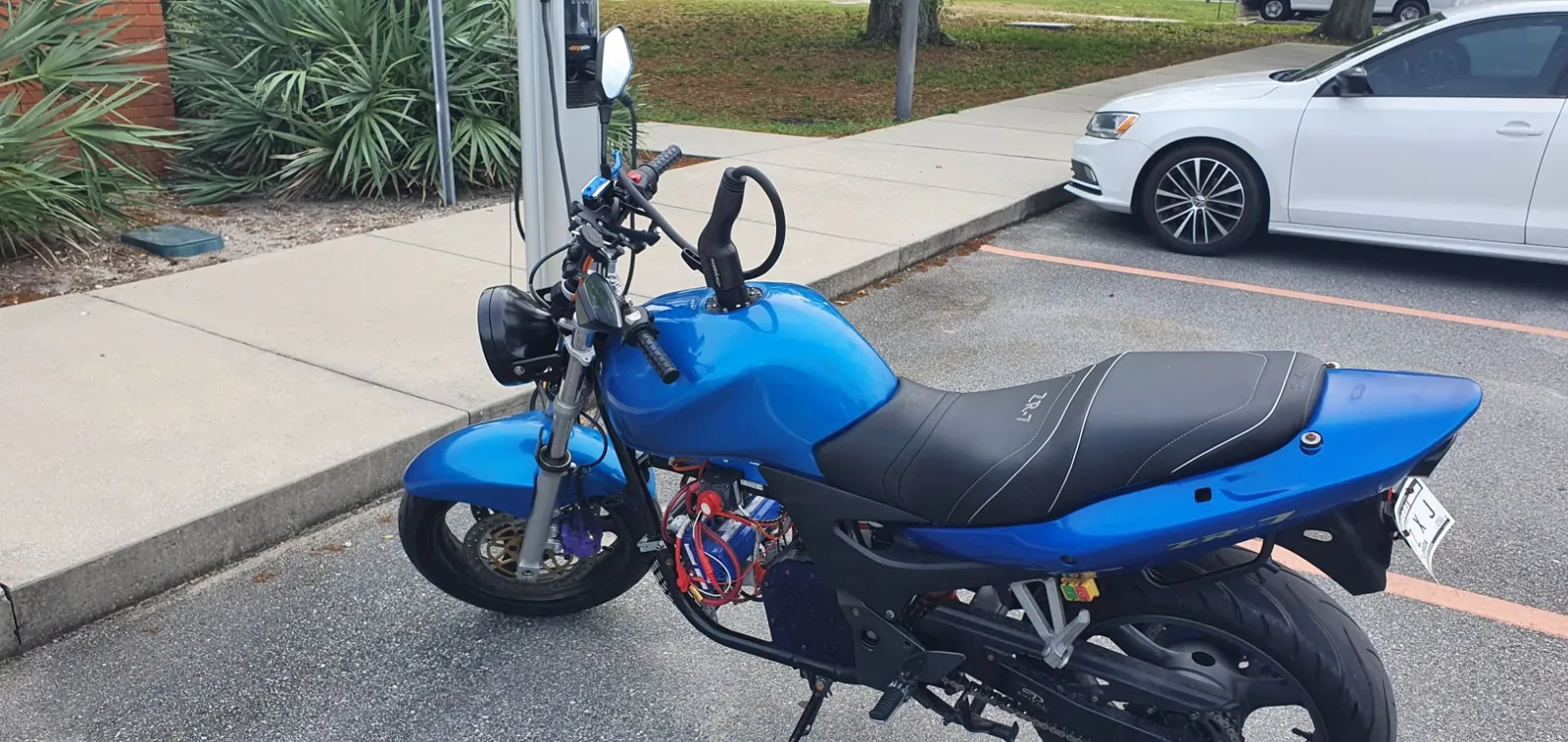
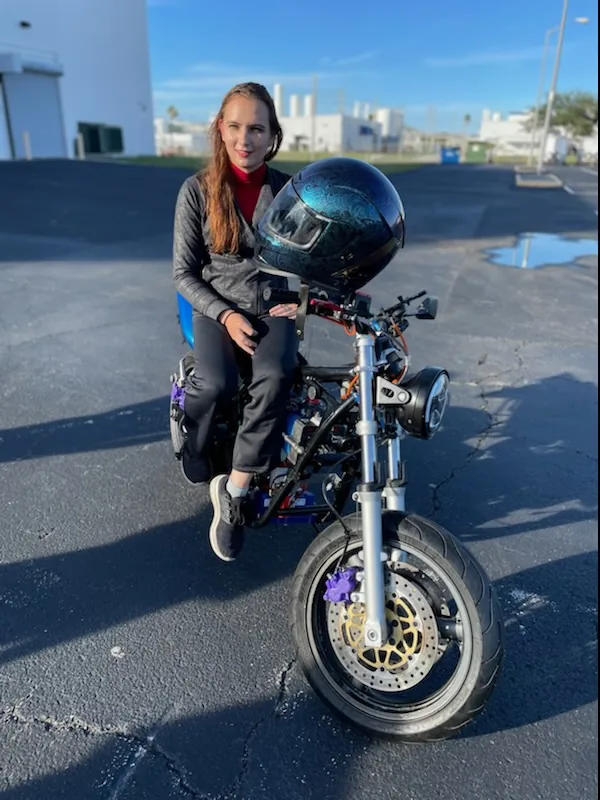
My 2000 Kawasaki ZR-750F caught fire and burned down to the frame. Instead of scrapping it, I stripped what was left and rebuilt it as an electric motorcycle. It's now registered, insured and road-legal.
Problem
Turn a fire-gutted motorcycle into a road-legal electric one, with every electronic system on it new.
What I built
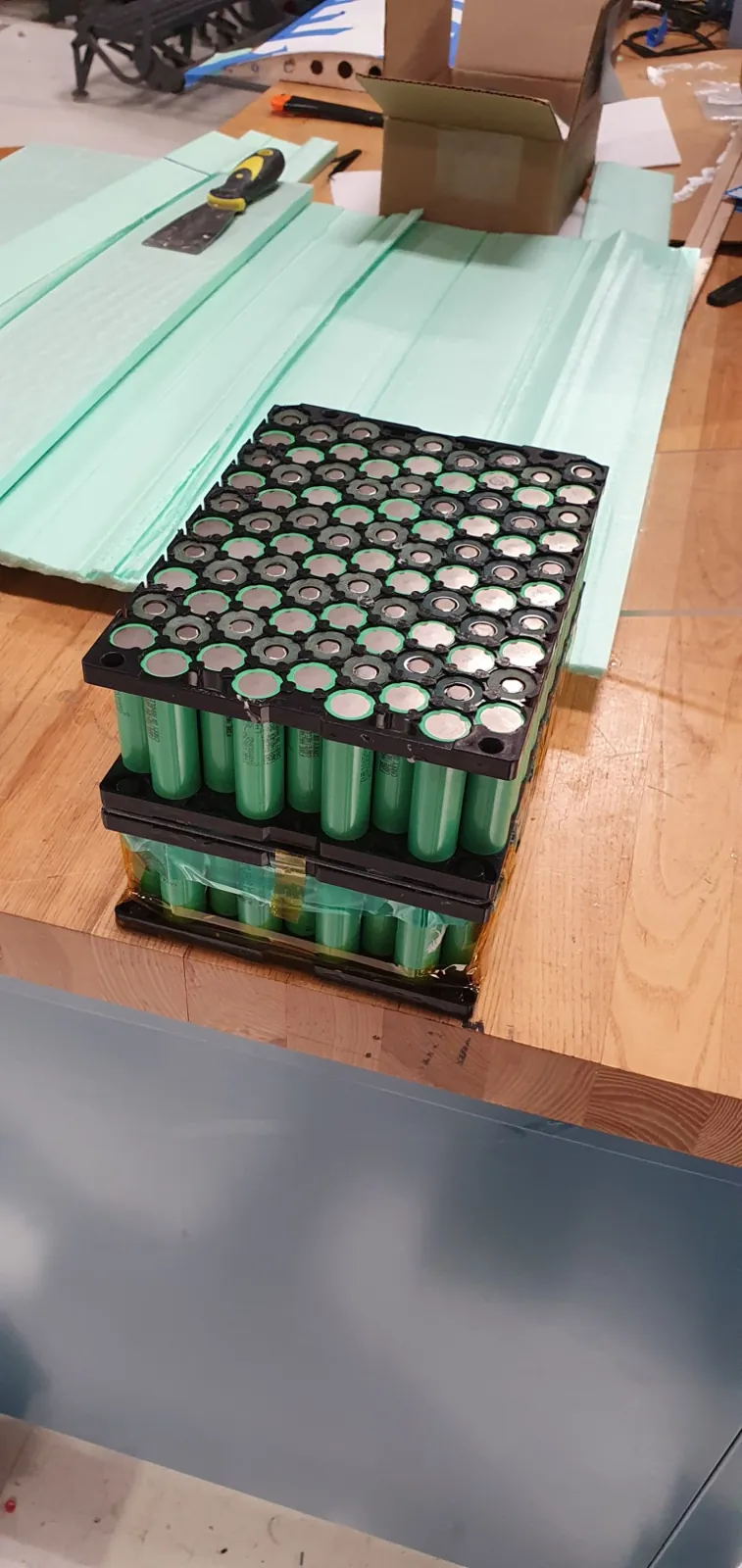
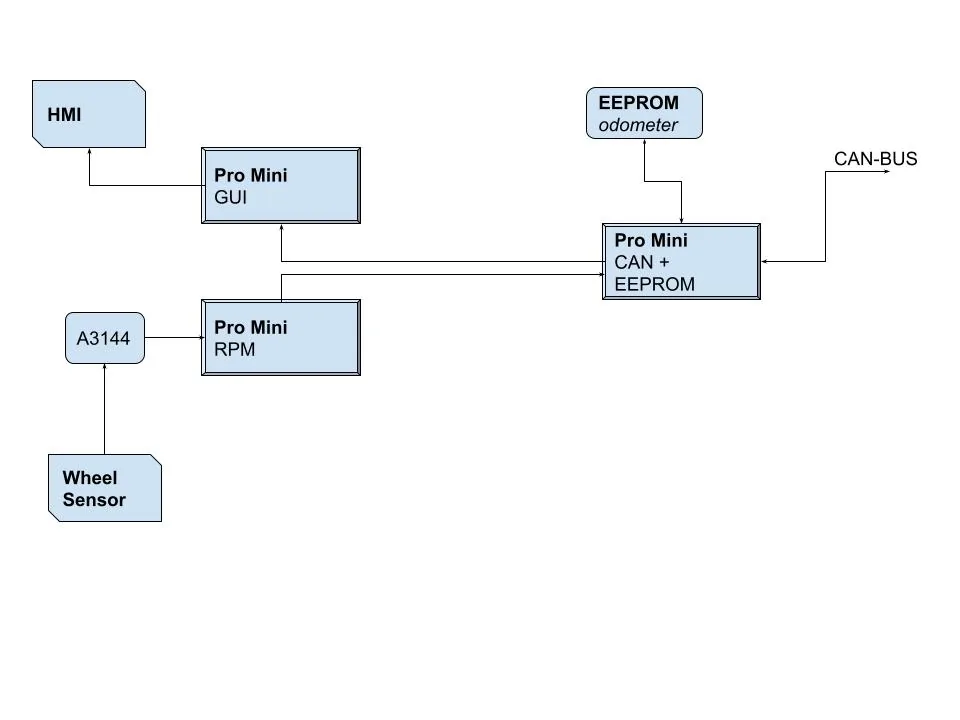
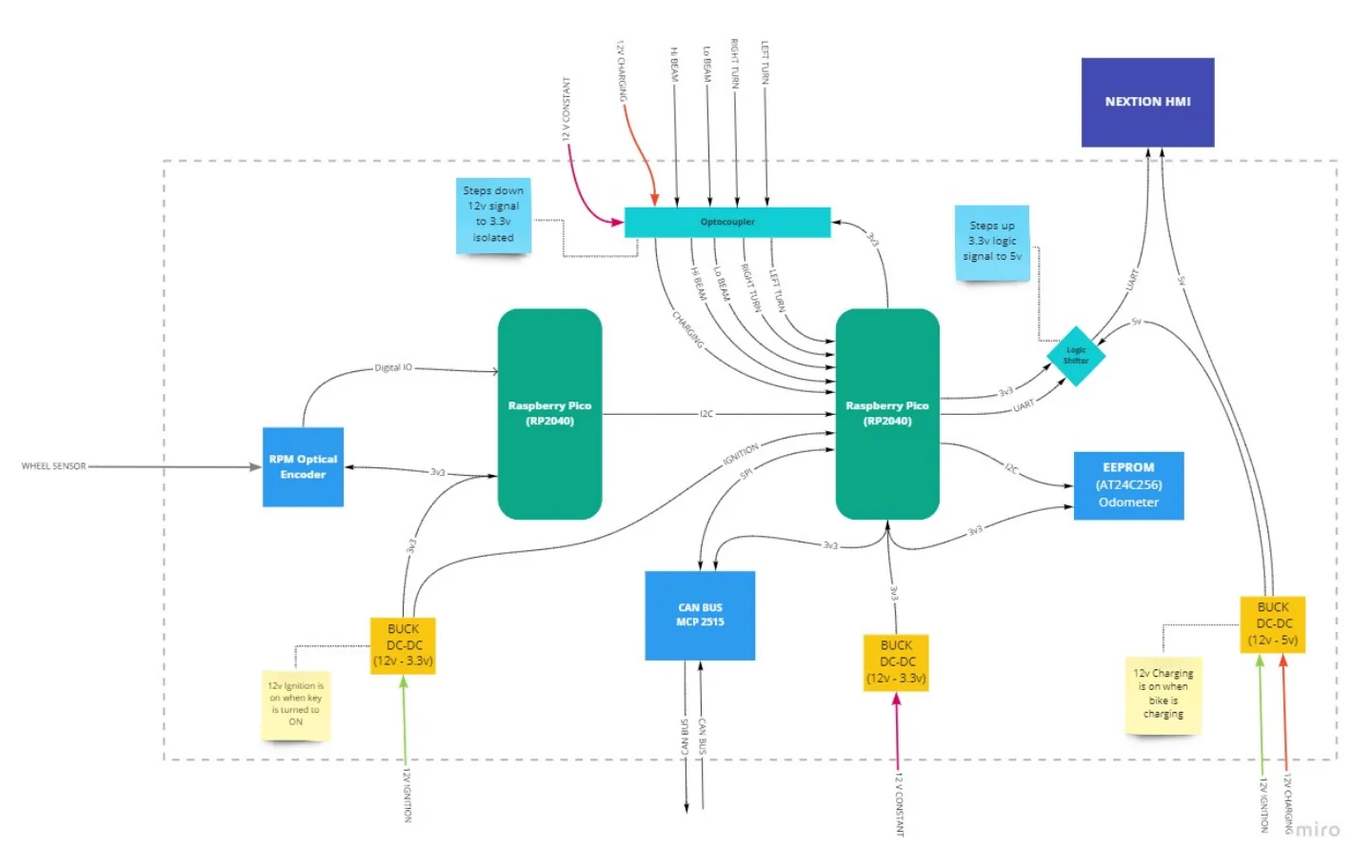
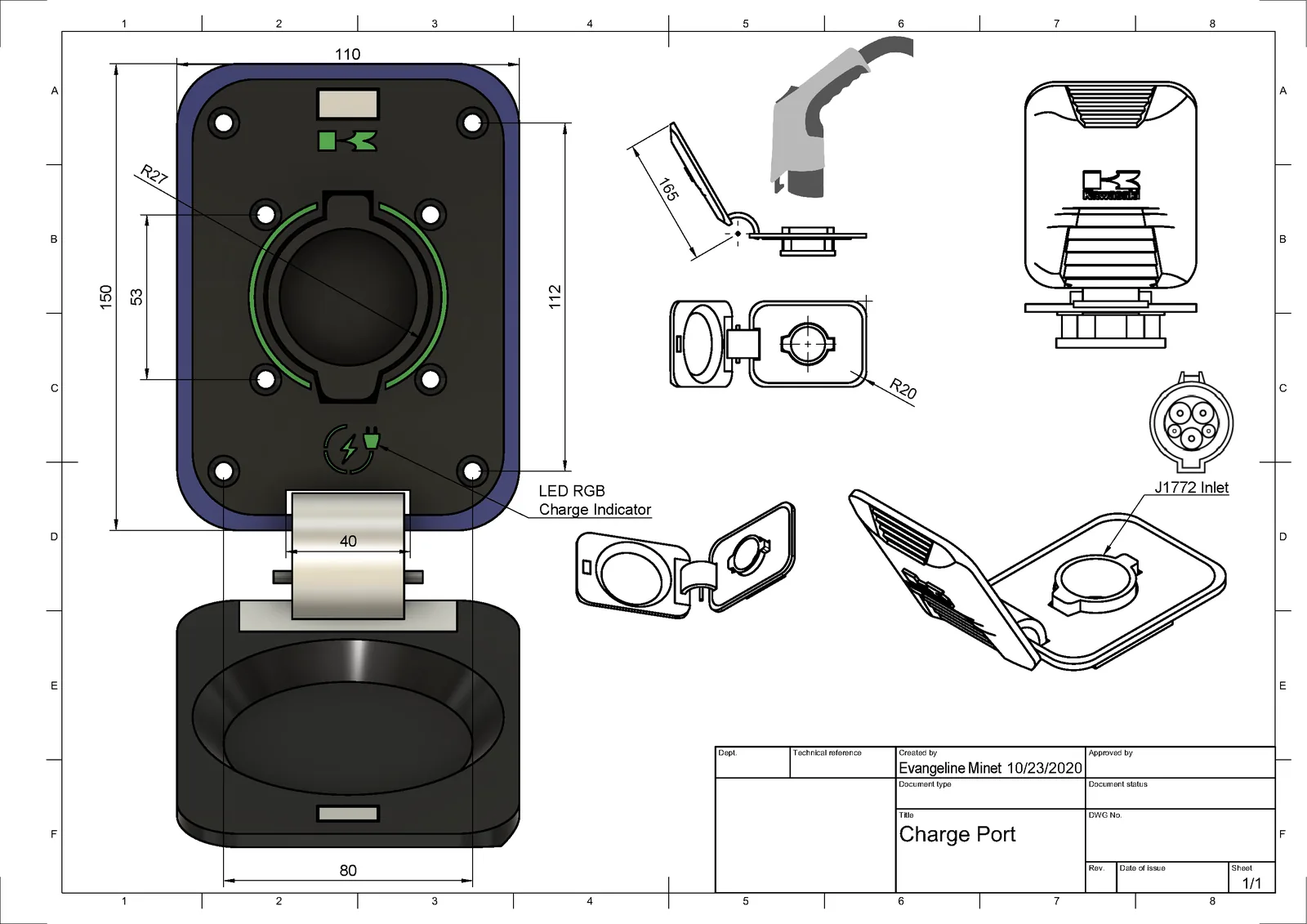
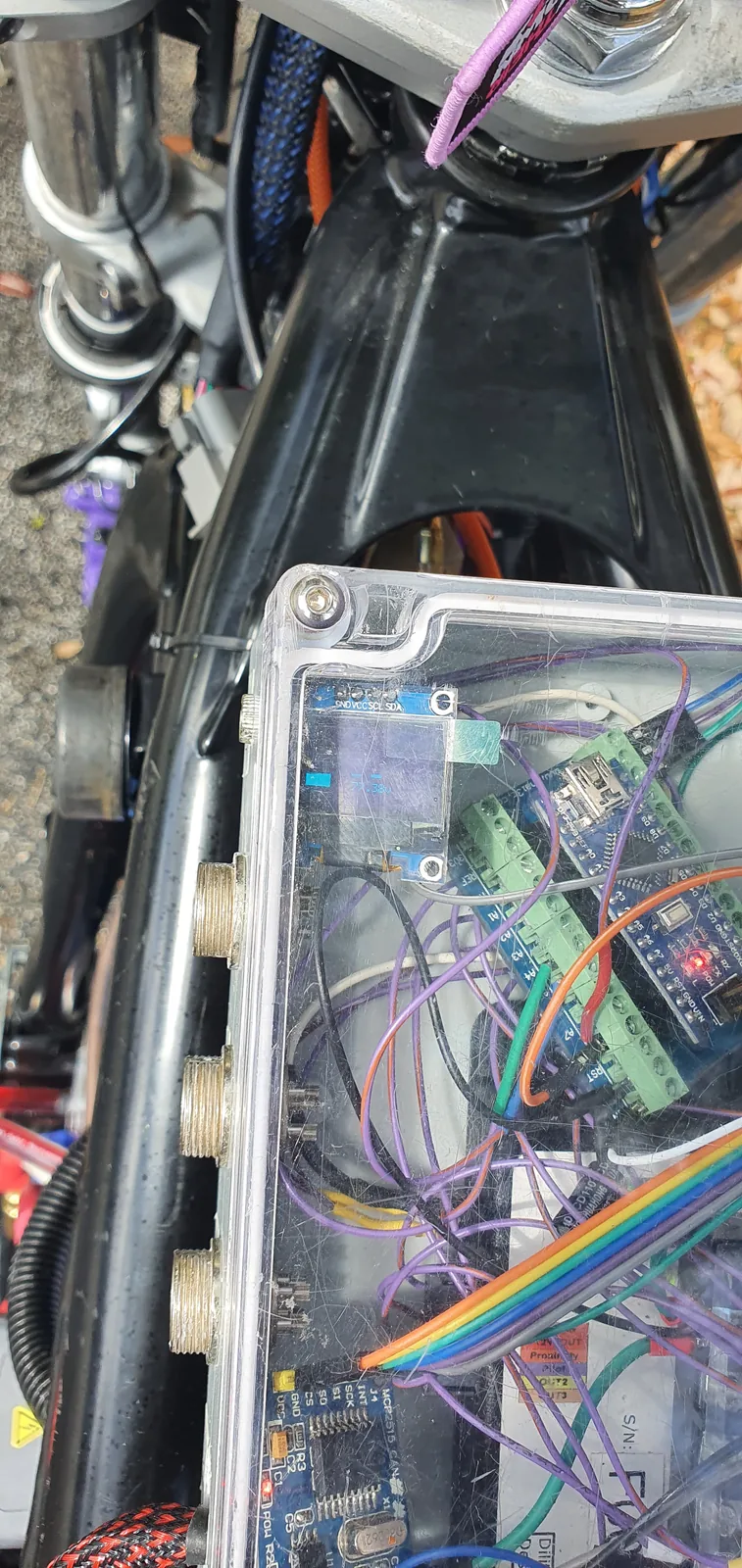
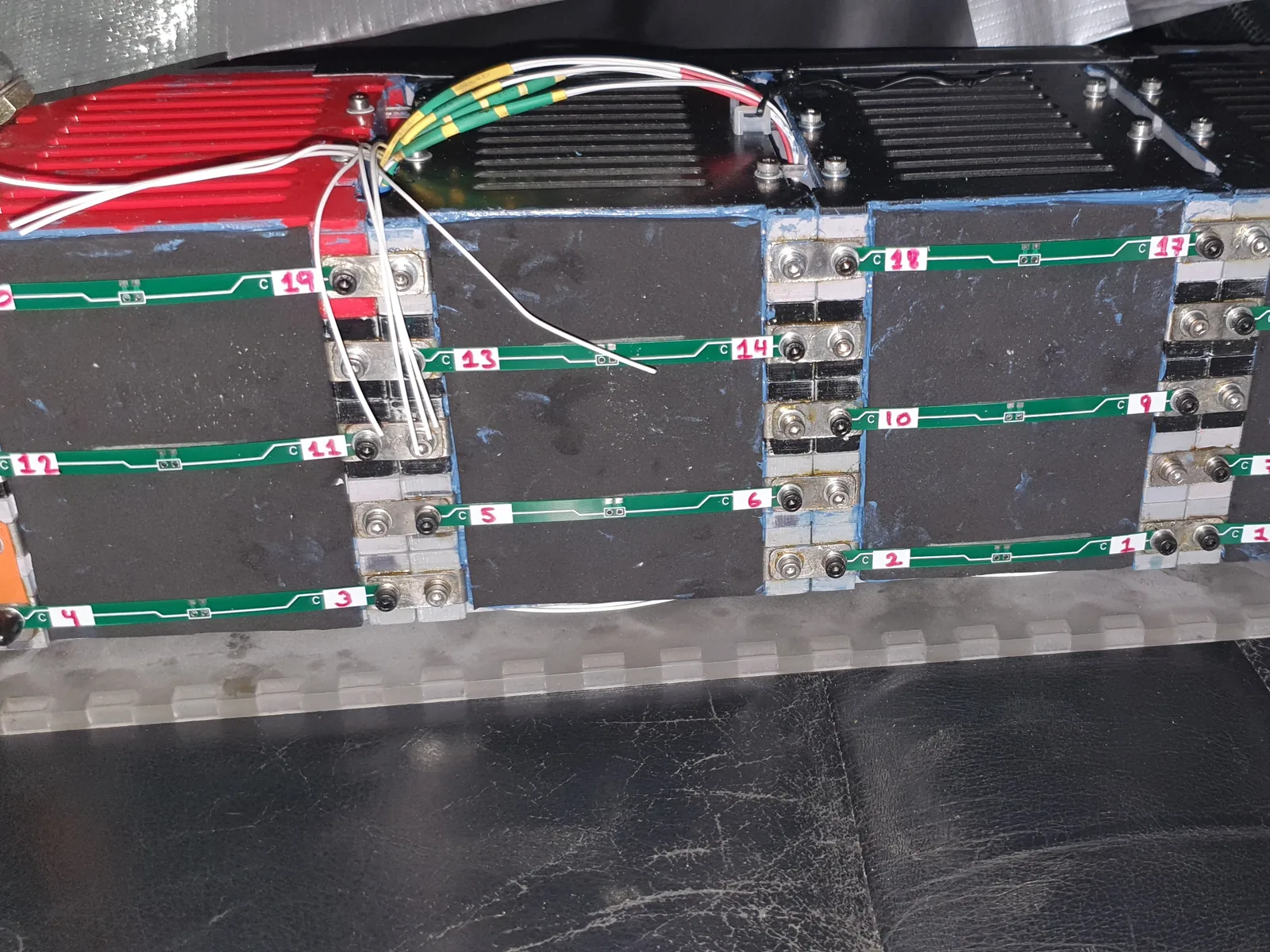
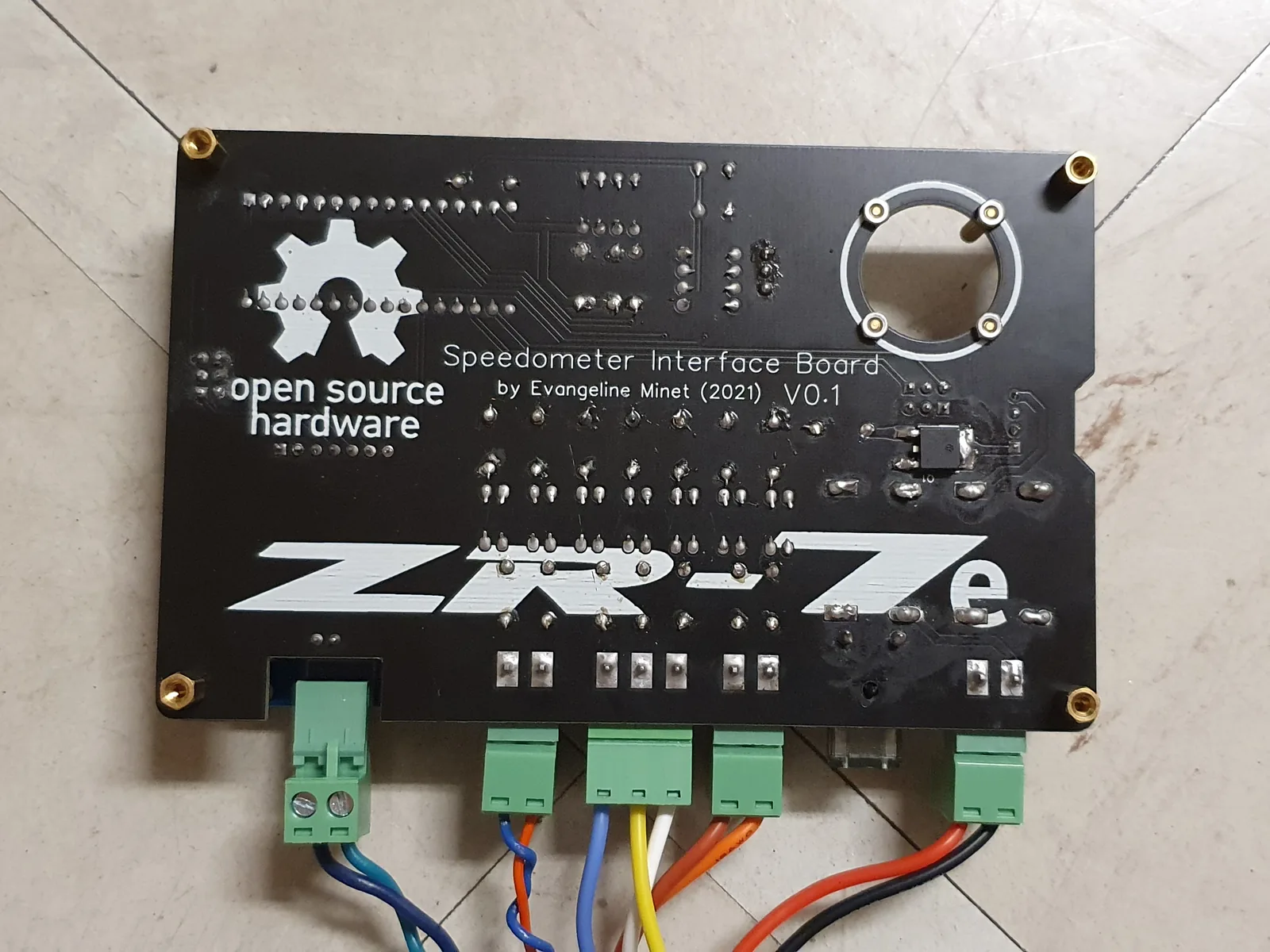
A 30 kW-peak BLDC hub motor on a 96 V-class controller, fed by an approximately 10 kWh pack of large prismatic lithium-ion cells in a 24S1P configuration (about 86 V nominal, 100.8 V full). An earlier pack of 18650 cells, 20S20P and about 3.6 kWh, was good for about 12 miles. The first version, my college proof of concept, ran a brushed DC motor on a bought controller and a 20S pack. After graduation I rebuilt it and designed the motor controller, battery management system, charger, CAN network and speedometer myself. It charges over J1772 and DC fast-charges over CCS1: DC fast chargers can't go as low as the pack's voltage, so an isolated step-down stage takes the station's output (up to 400 V) down to the pack's 100.8 V. A full CCS1 charge has worked at a public ChargePoint station.
Outcome
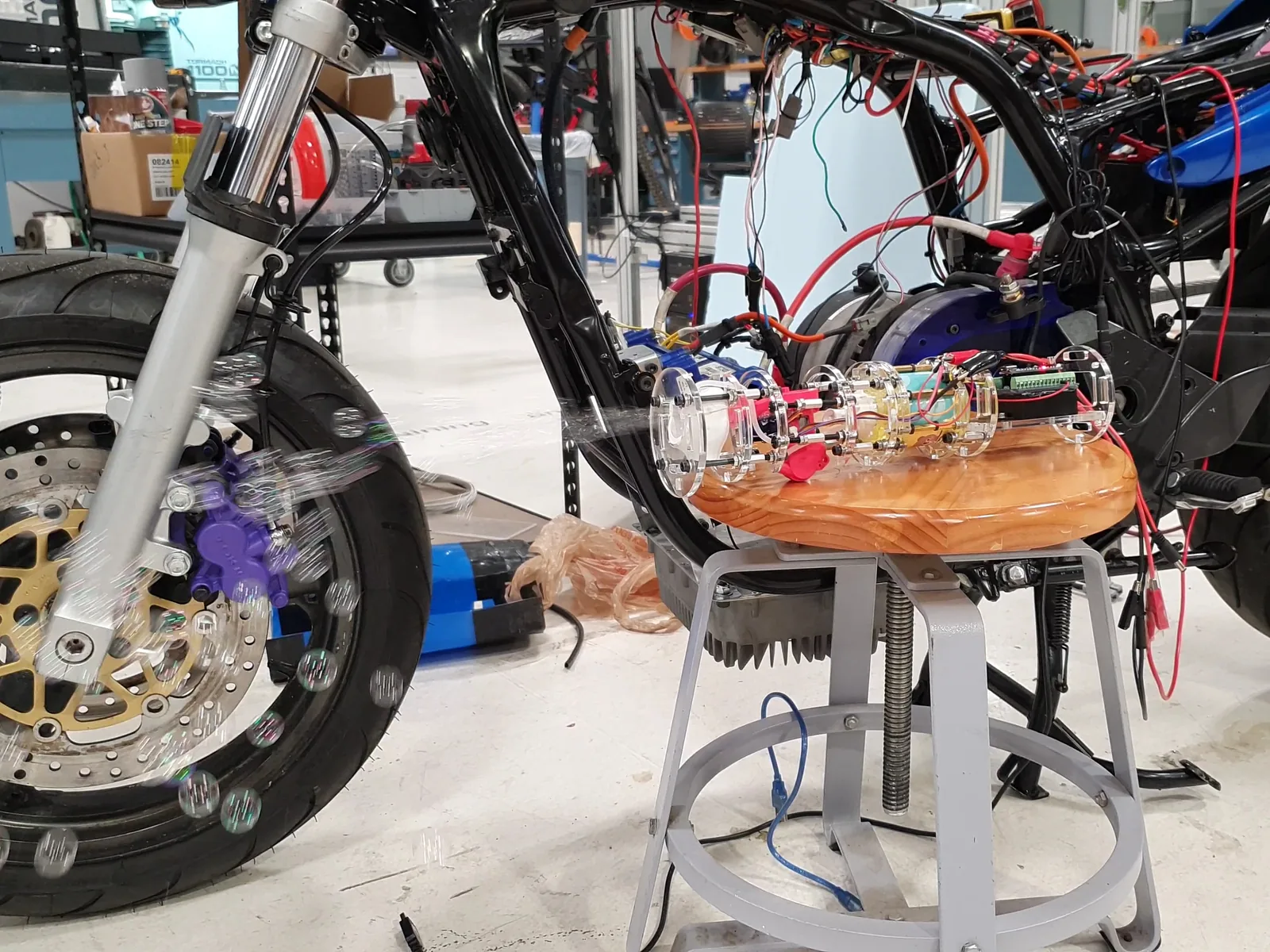
Measured top speed around 180 km/h (about 110 mph) and roughly 60 miles of range, depending on riding. Registered, insured and road-legal. Since an EV has no use for an exhaust pipe, mine blows bubbles instead: a bubble machine I designed, now patent pending.
Why it burned
A fuel leak on the original gasoline engine, most likely ignited at a cracked intake manifold. The fire had nothing to do with the conversion, which came after.
Verification
The bike’s requirements are under change control in Doorstop, each with a verification method and traced to its evidence. Closed and open, as they stand:
Top speed and range, measured on the road: about 180 km/h against a 113 km/h (70 mph) requirement, and about 60 miles against 50.
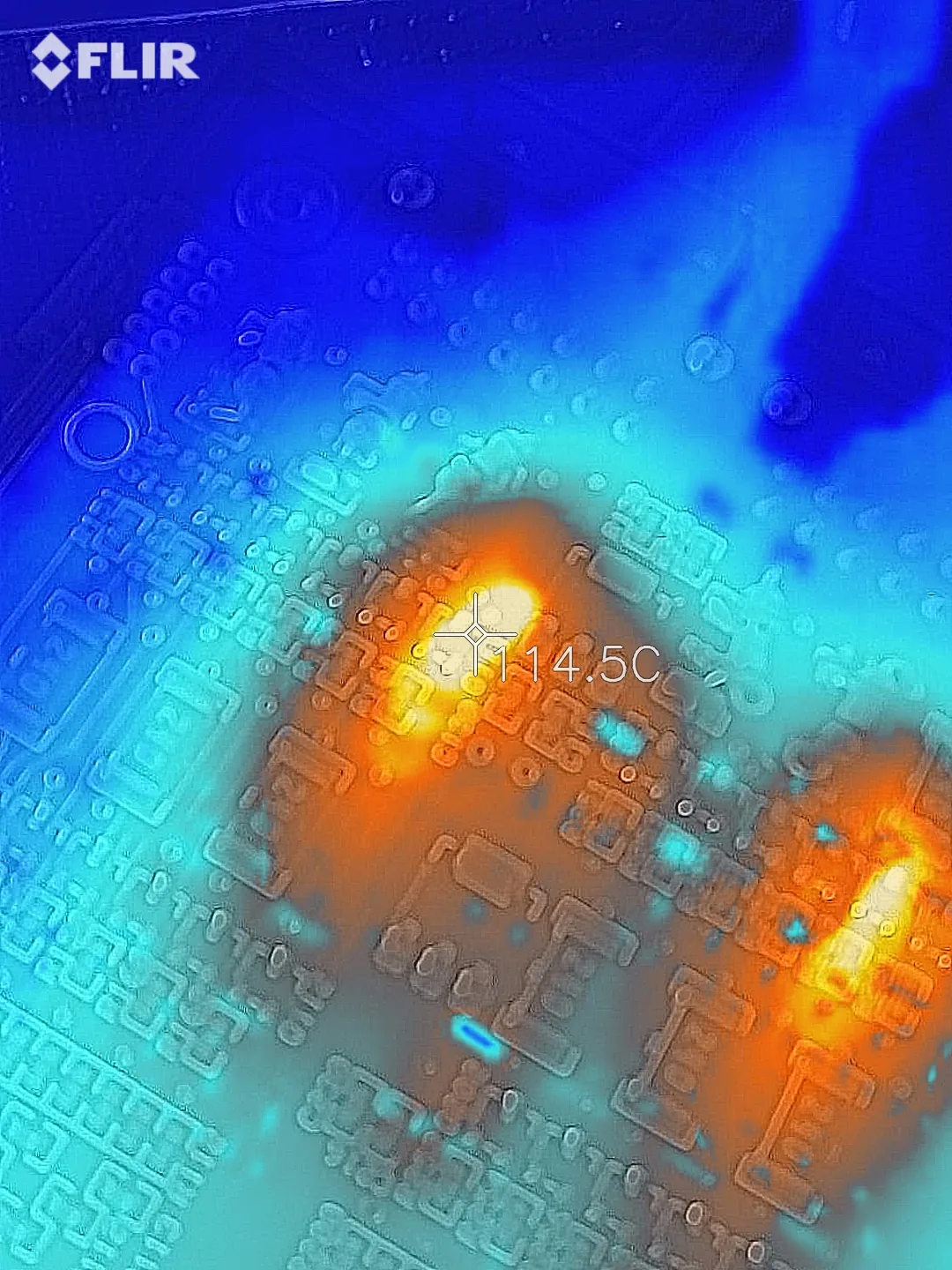
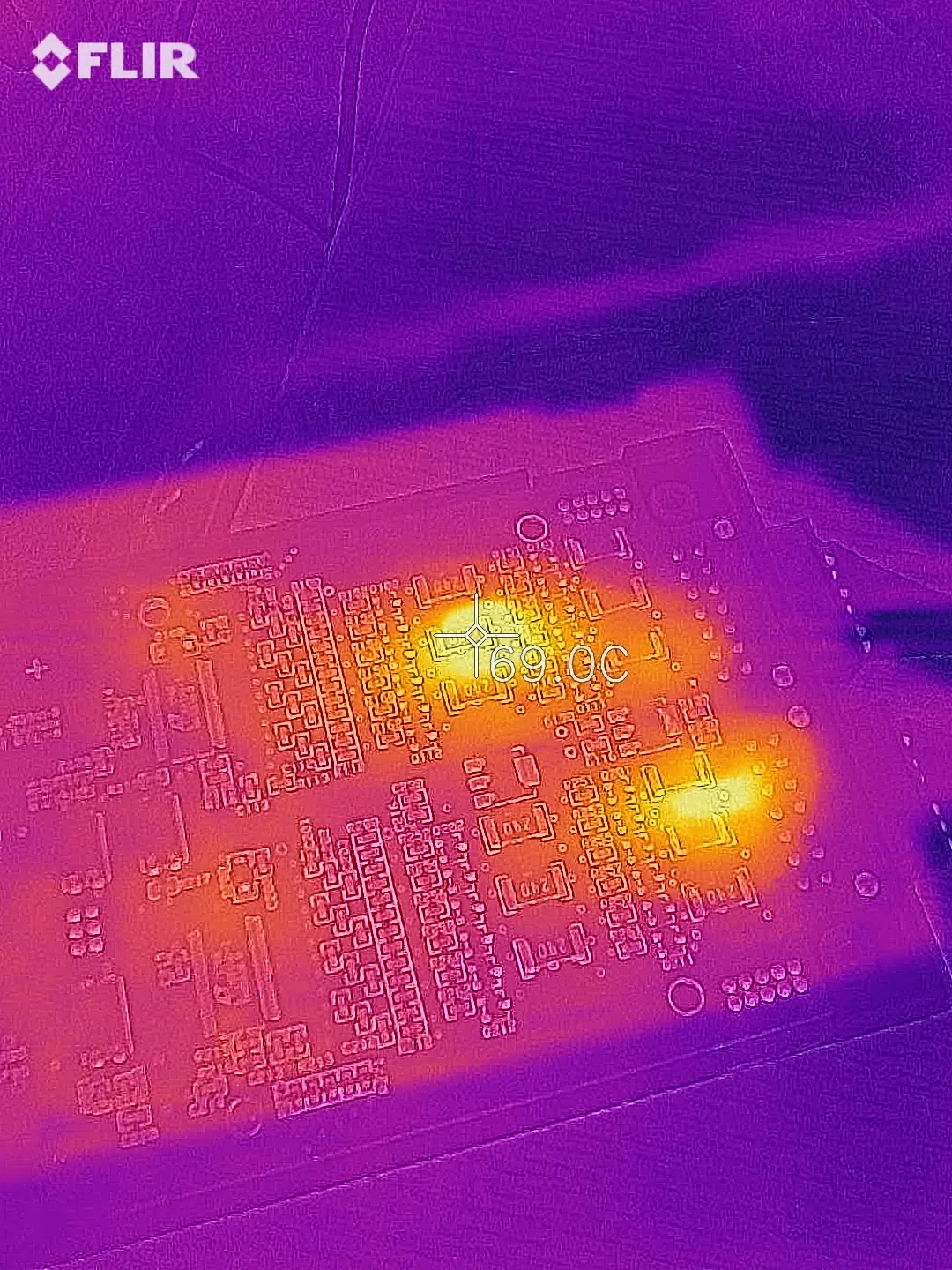
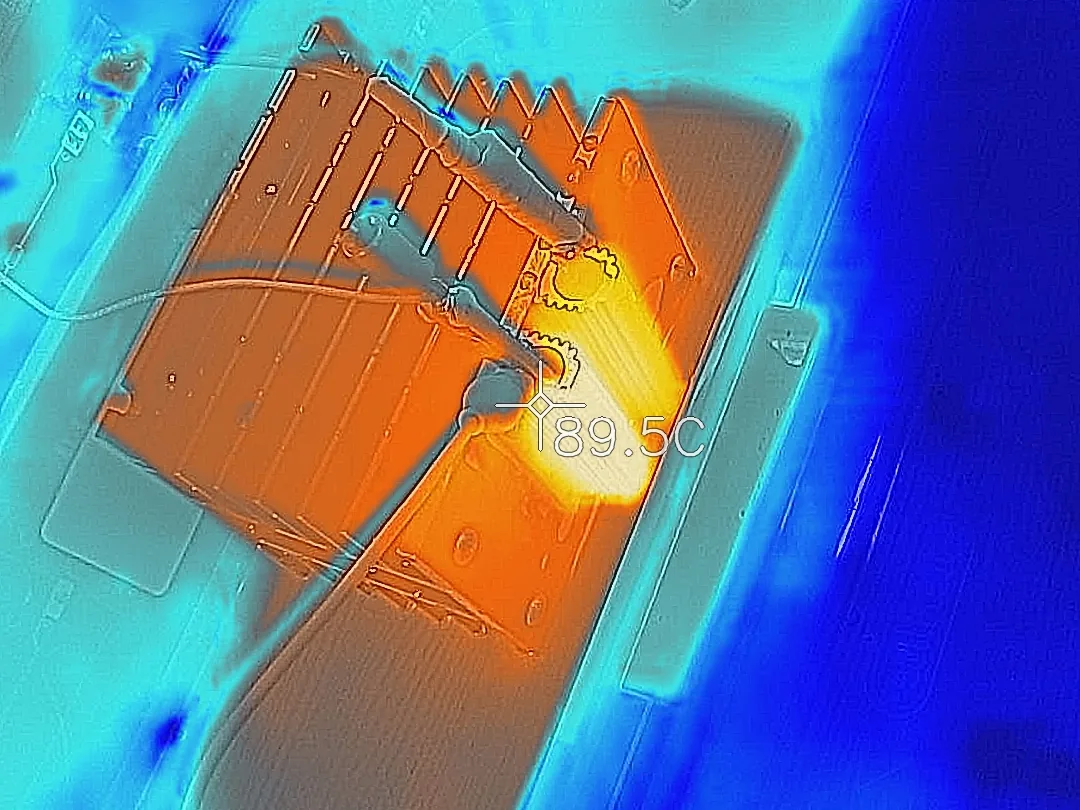
BMS balance resistors read 114.5 °C on a thermal camera against an 85 °C limit. I logged it as a nonconformance, reworked the board and re-tested it at 69 °C.
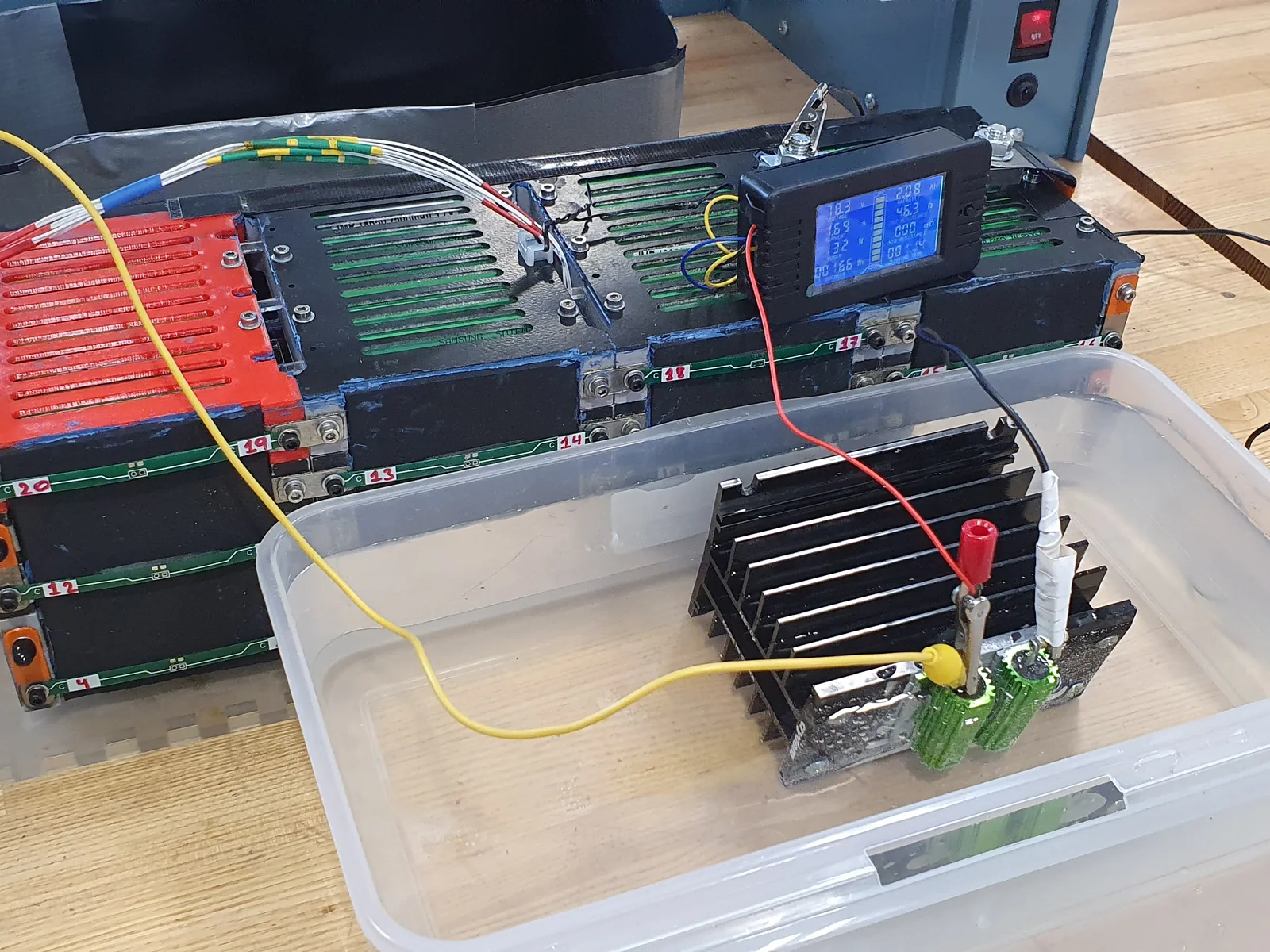
A load test into a finned resistor bank with an E-stop in the loop, on the earlier 18650 pack.
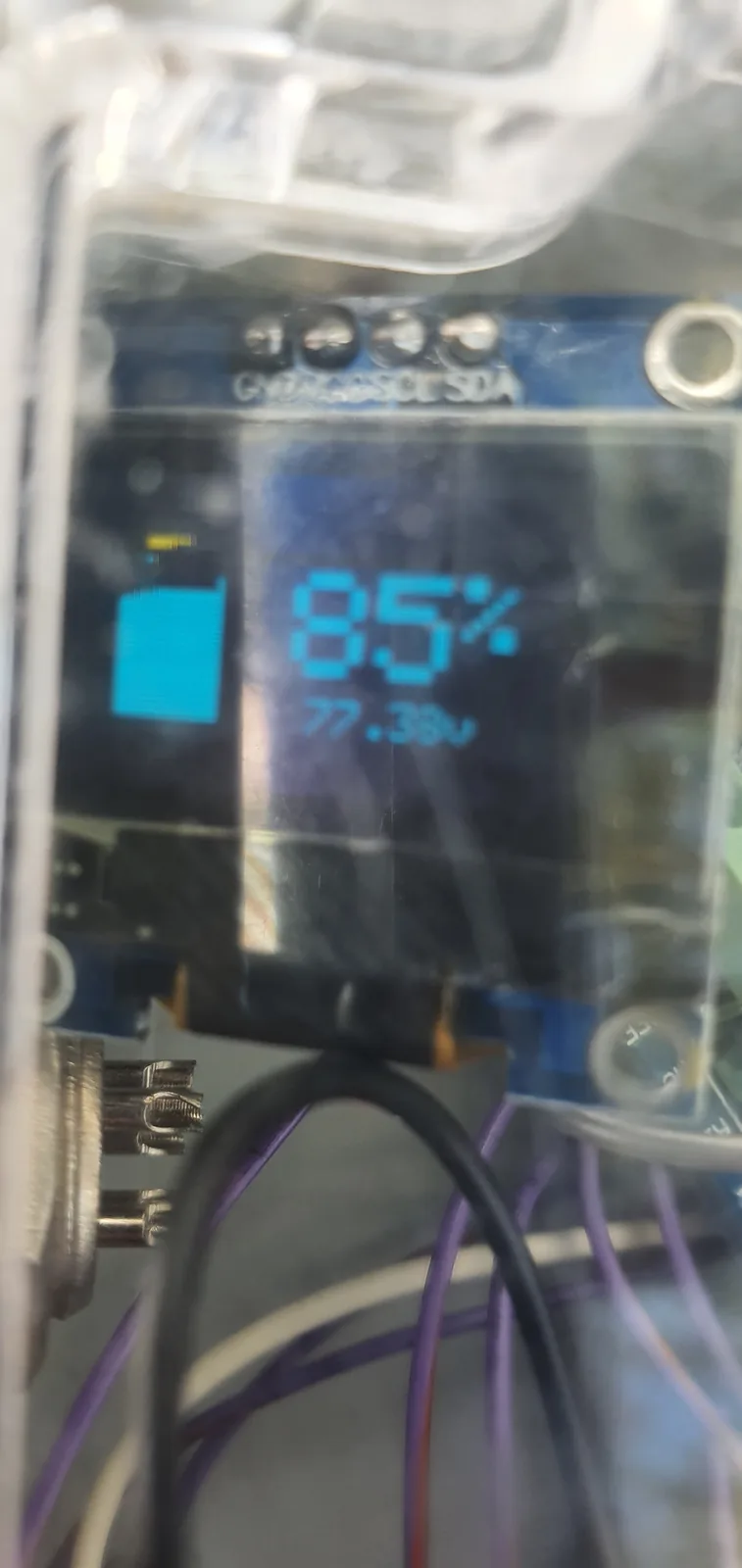
Open: the dash takes 28 s from key-on to live speed against a 3 s requirement, so it stays an open nonconformance until it’s reworked.
Open: the move to the 24S1P pack means its balancing and load tests have to be re-run, and the CCS1 charge needs a filed record before it counts as verified.
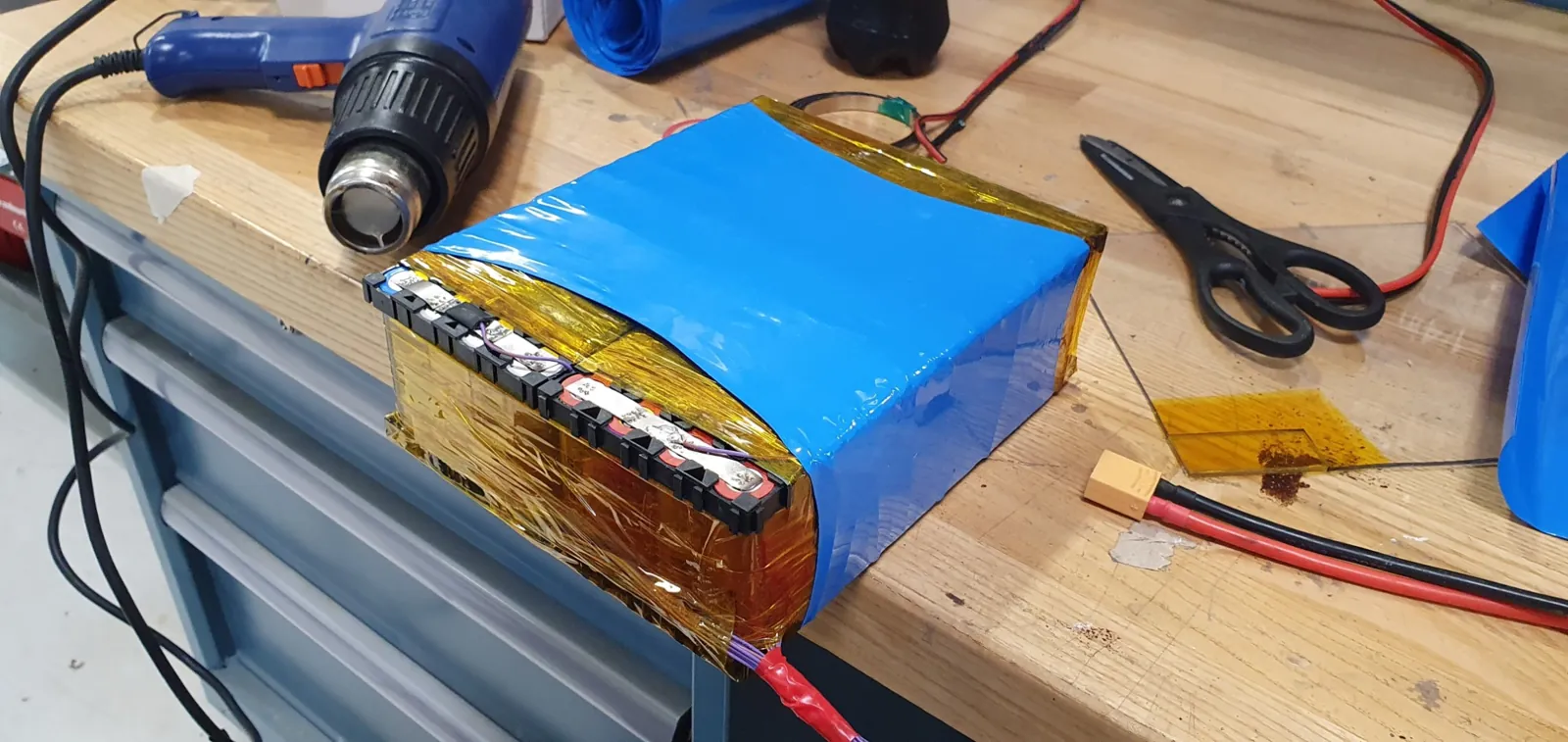
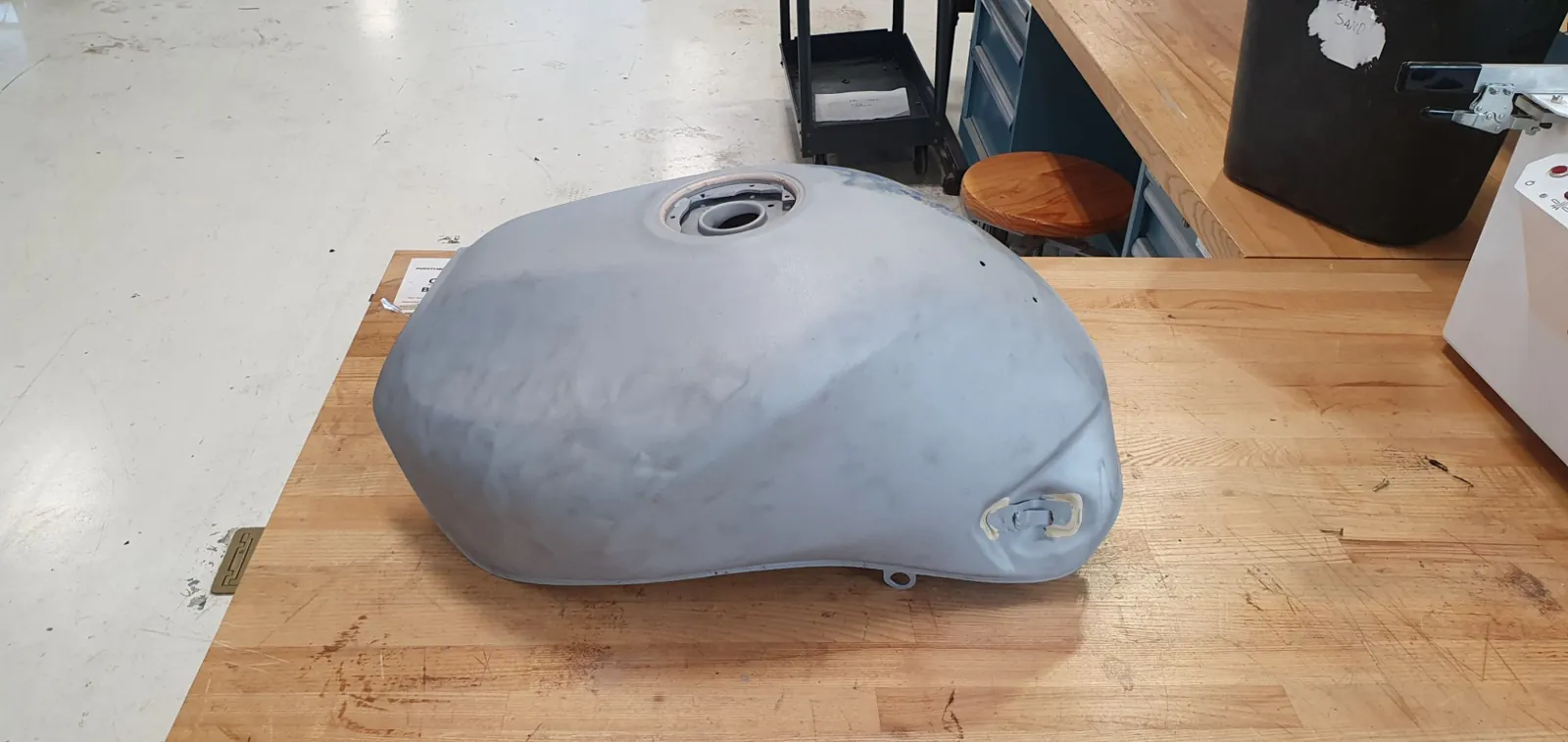
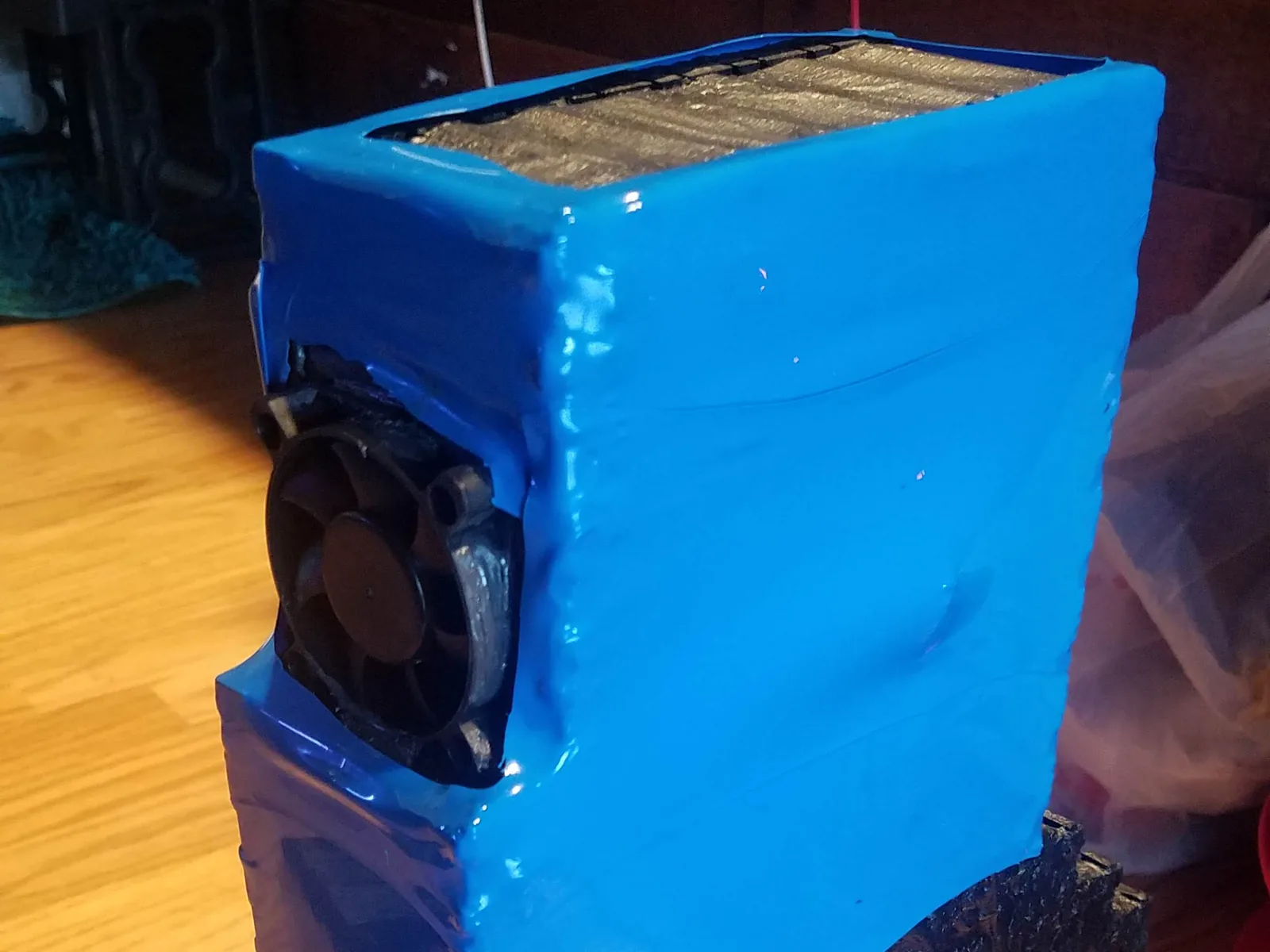
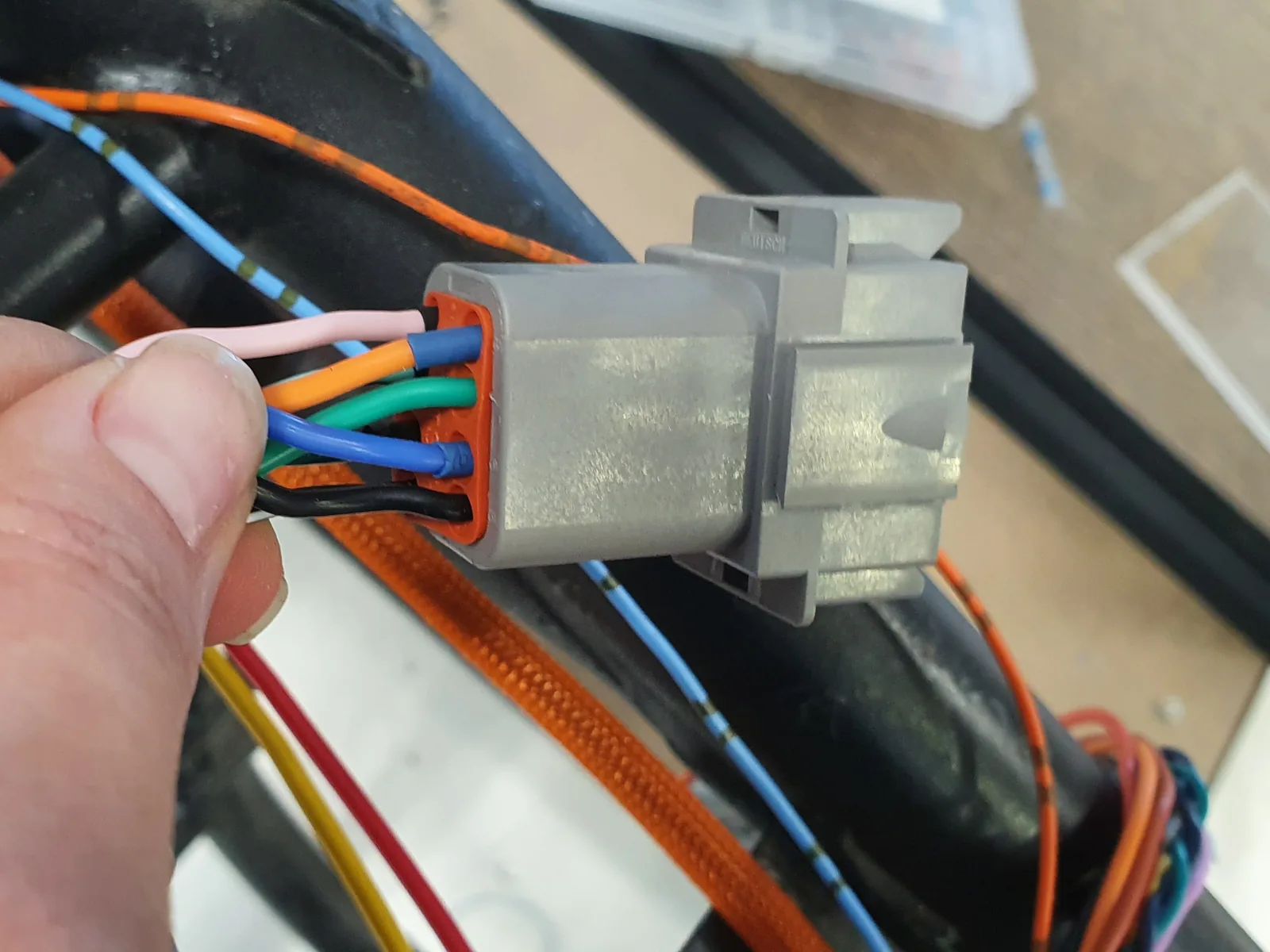
The fireThat nightStripped to the frameWhat the fire left of the tankBuilding an earlier 18650 packInsulating a moduleTank stripped and primedBefore the bodywork went onRebuiltHigh-voltage runPublic chargingCollege proof of concept, Florida Tech showcase
College build, 2018–2022: design work
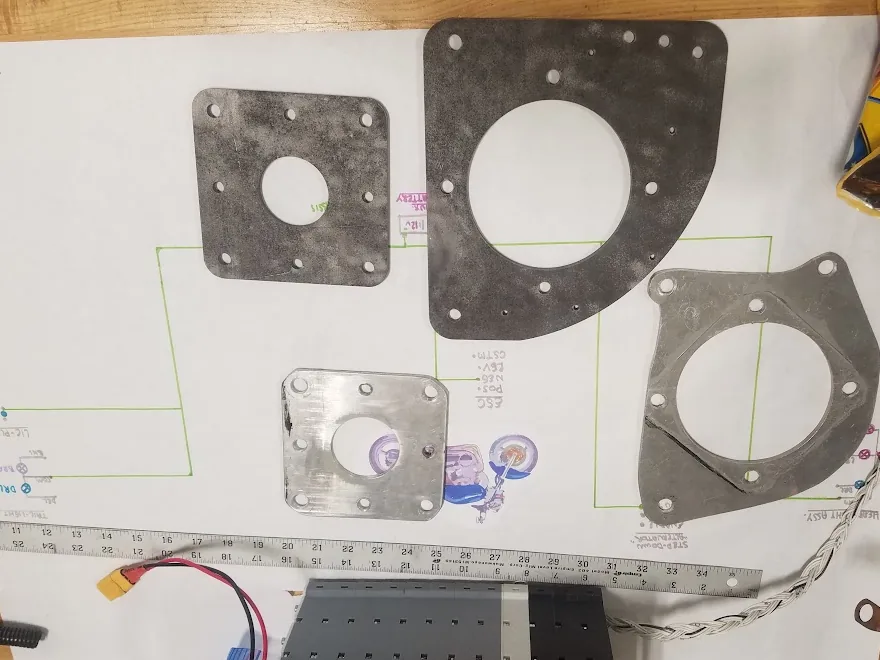
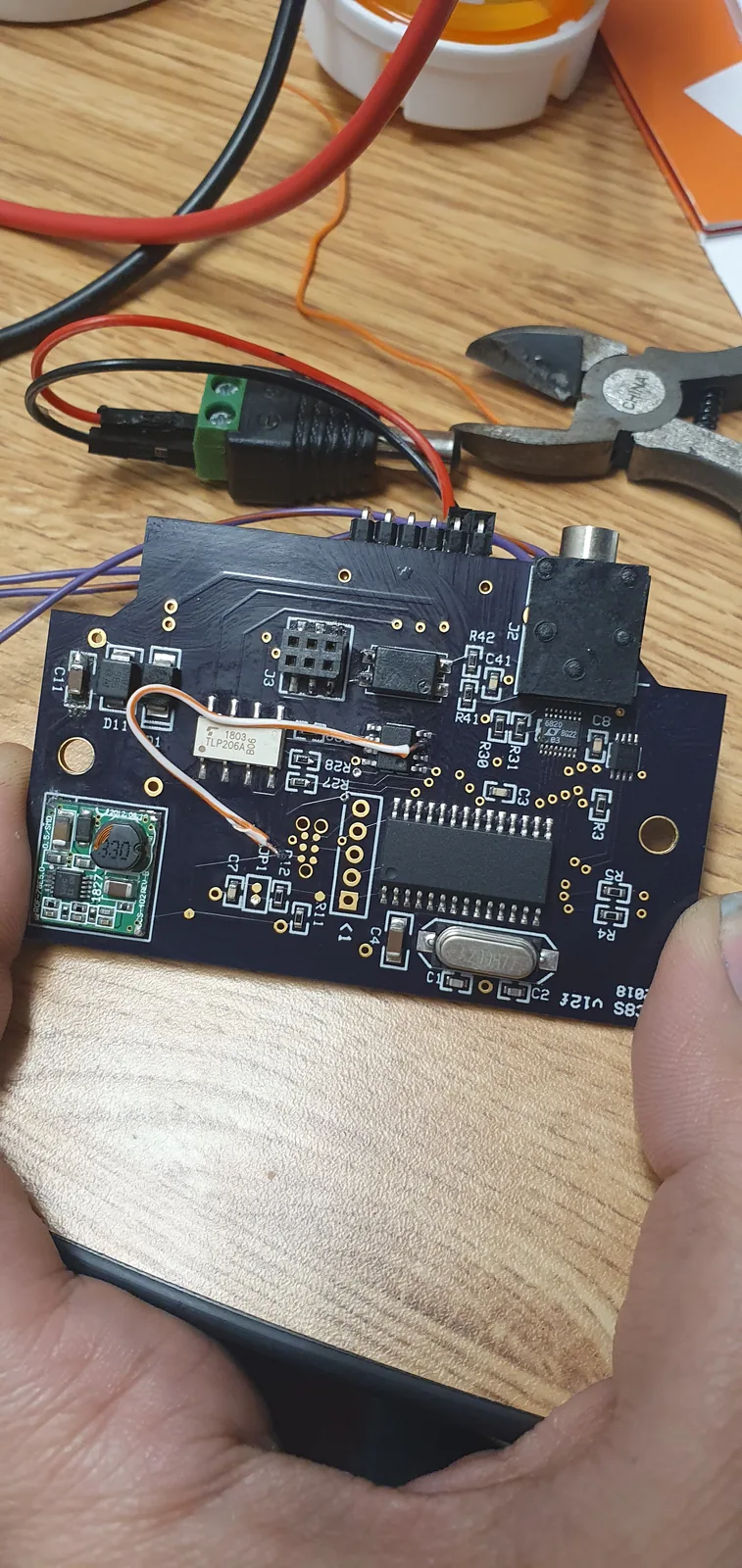
Speedometer v1: 3× Pro MiniSpeedometer v2: 2× RP2040Charge port drawingJan 2020: mounting plates on the wiring diagramBMS balancing: 114.5 °CAfter my fix: 69 °CReworking a PCBController boxCharge display
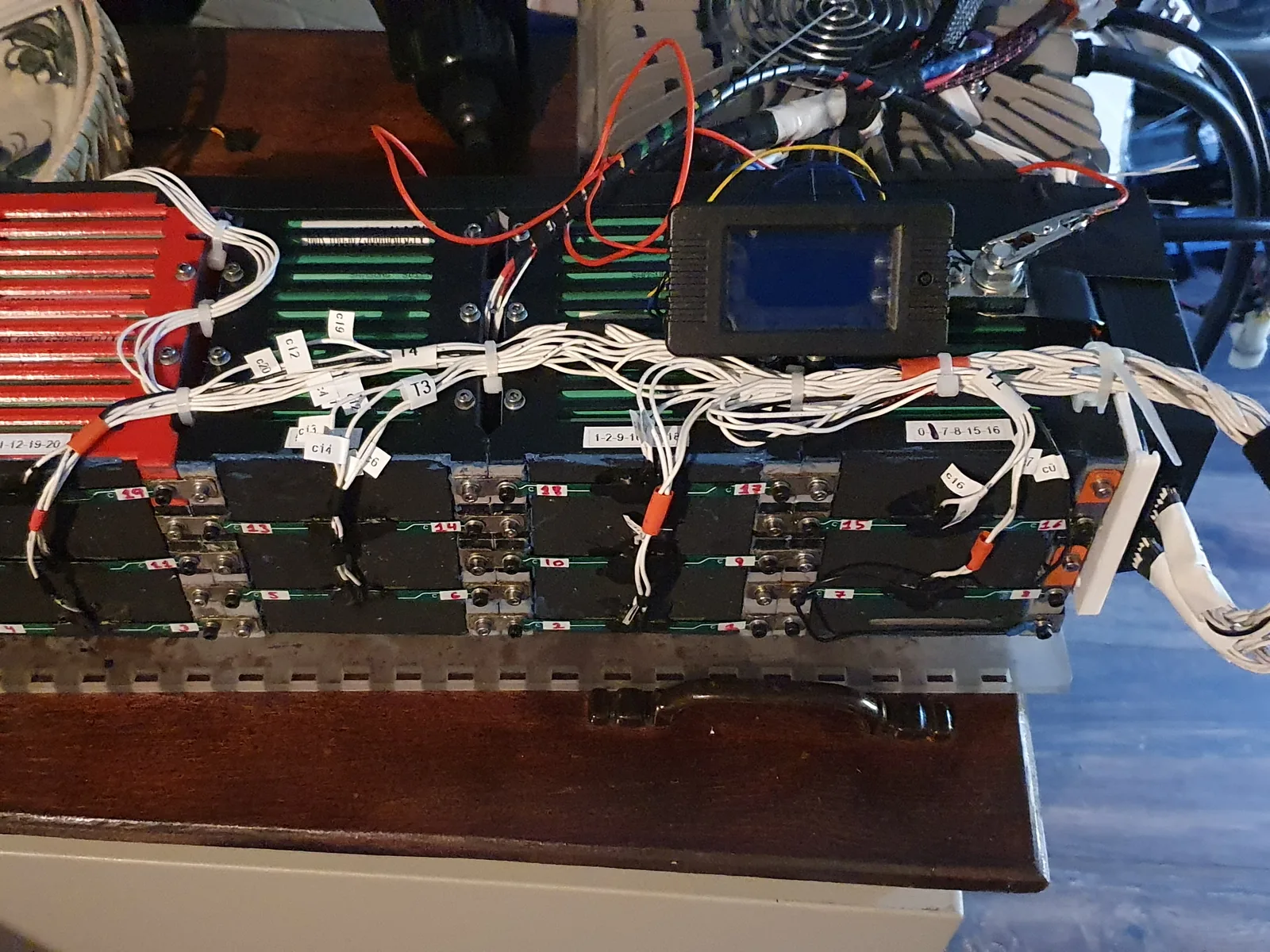
College build: how the pack evolved, 2019–2022
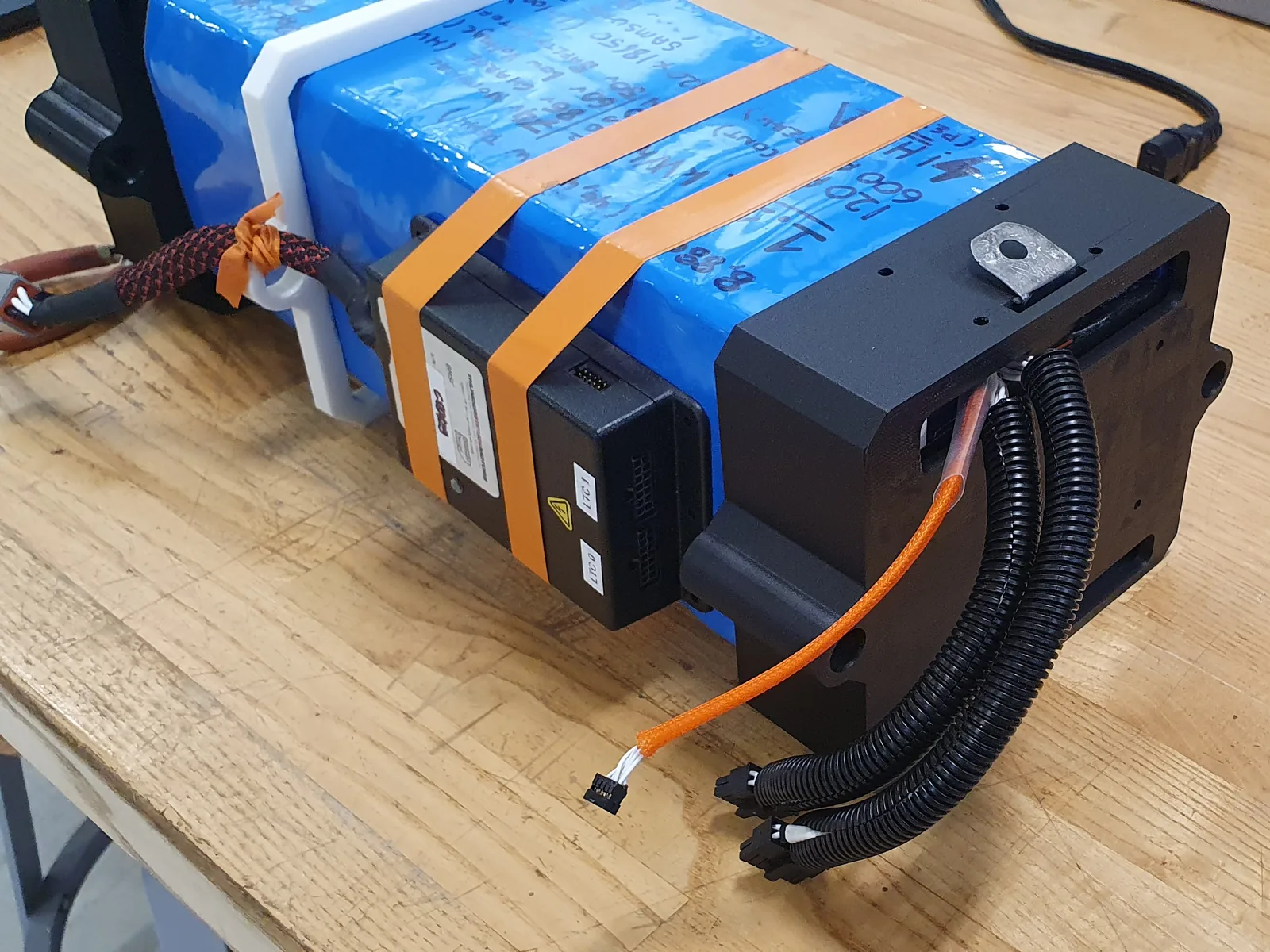
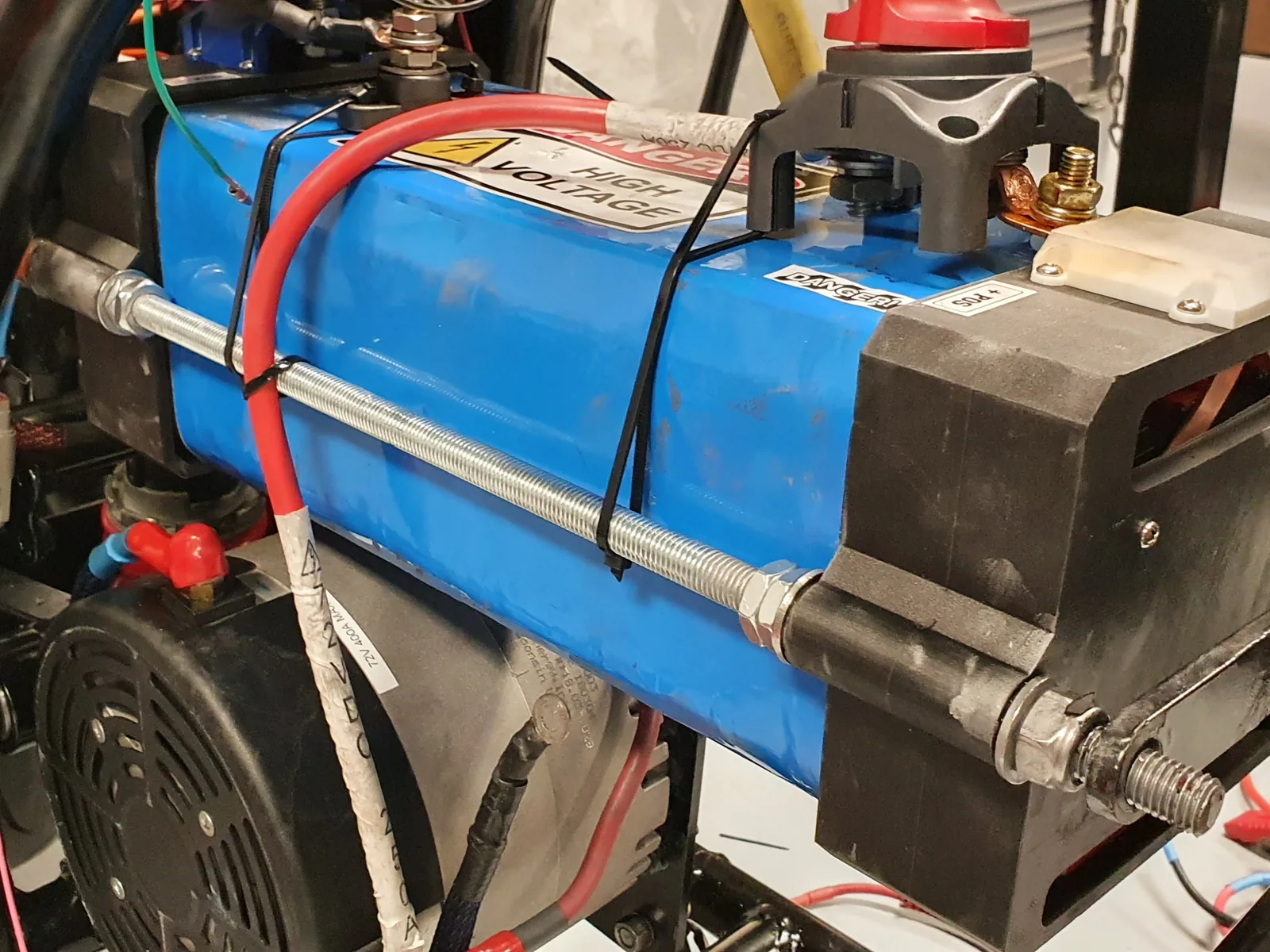
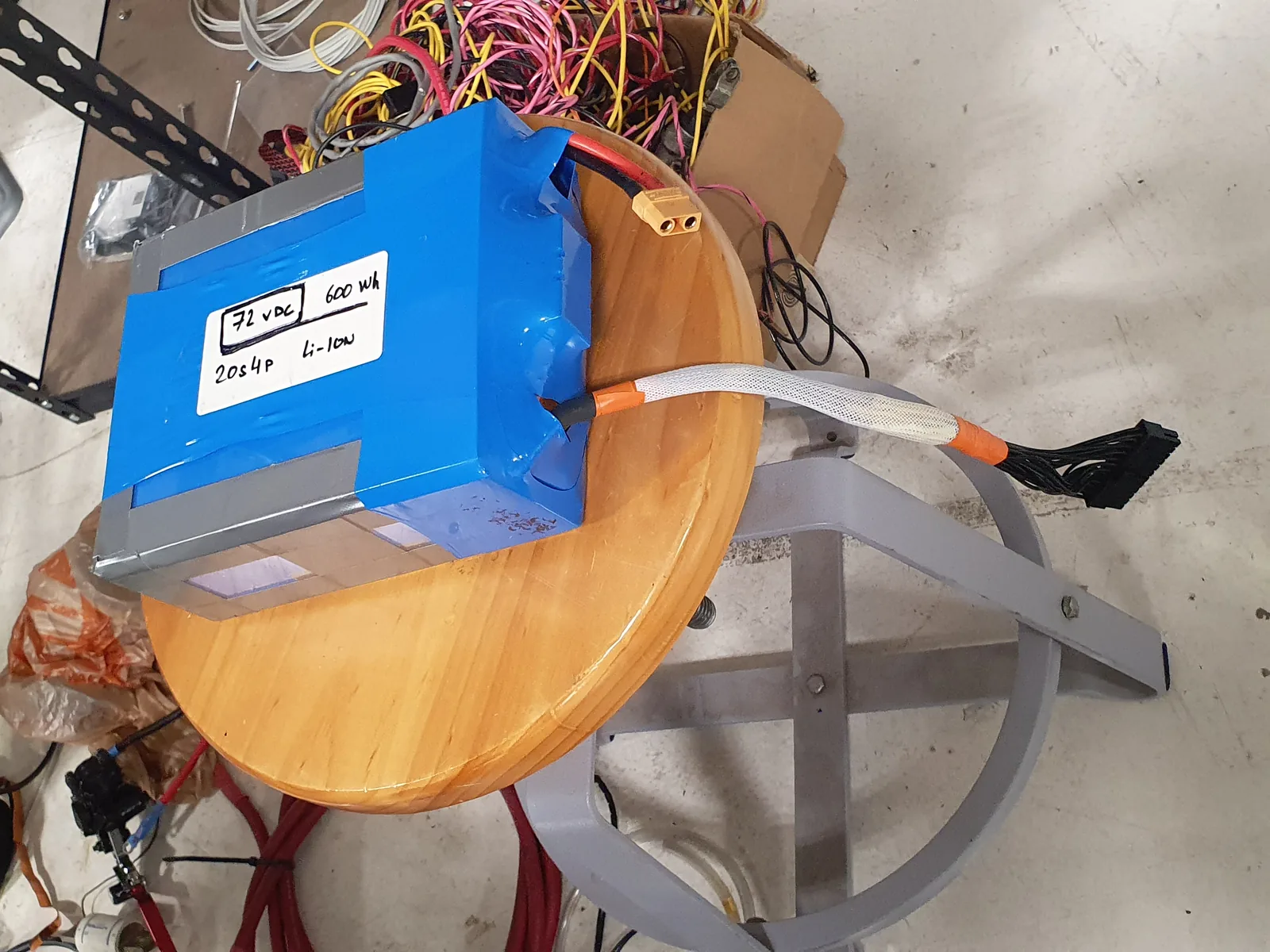
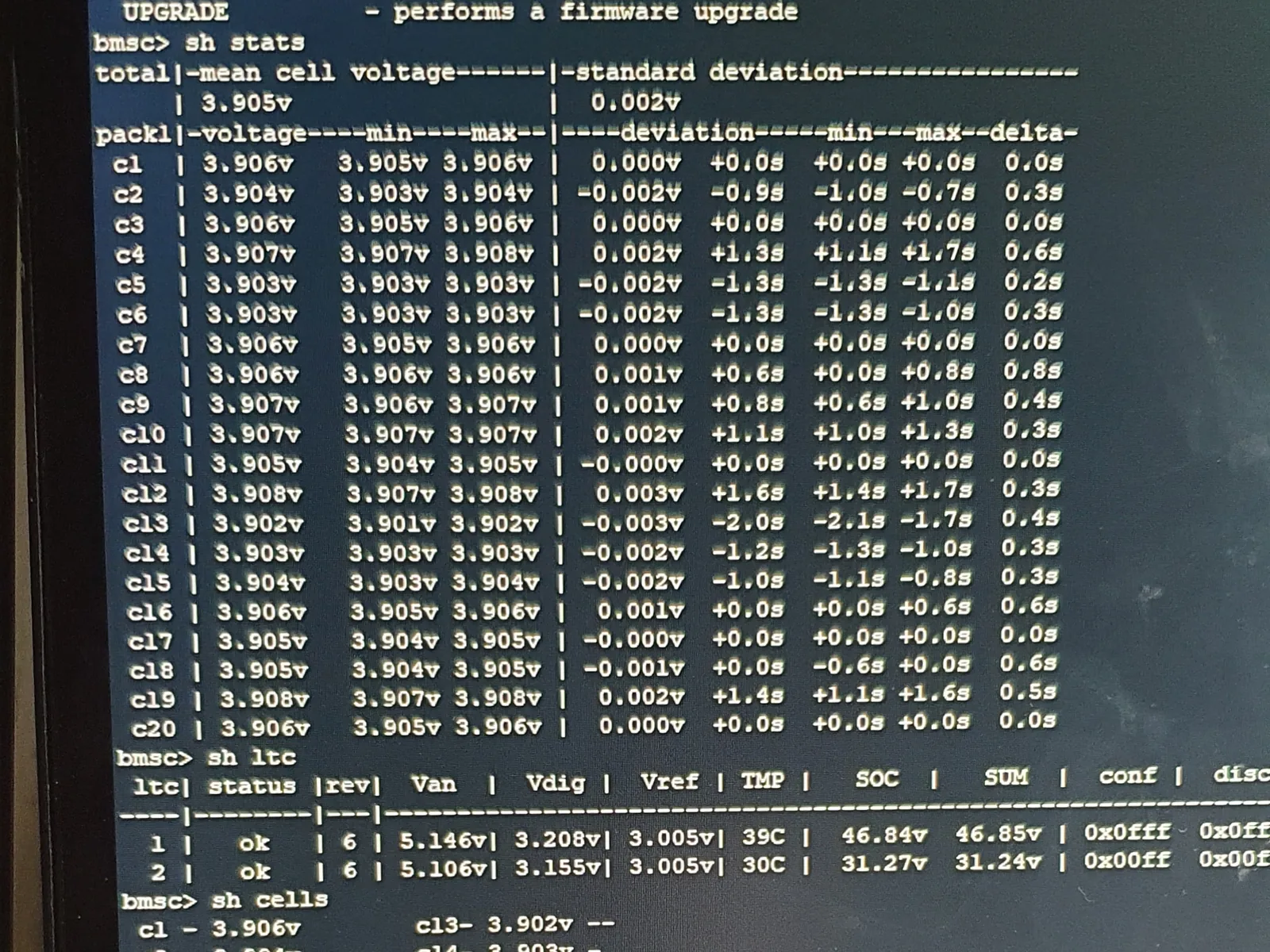
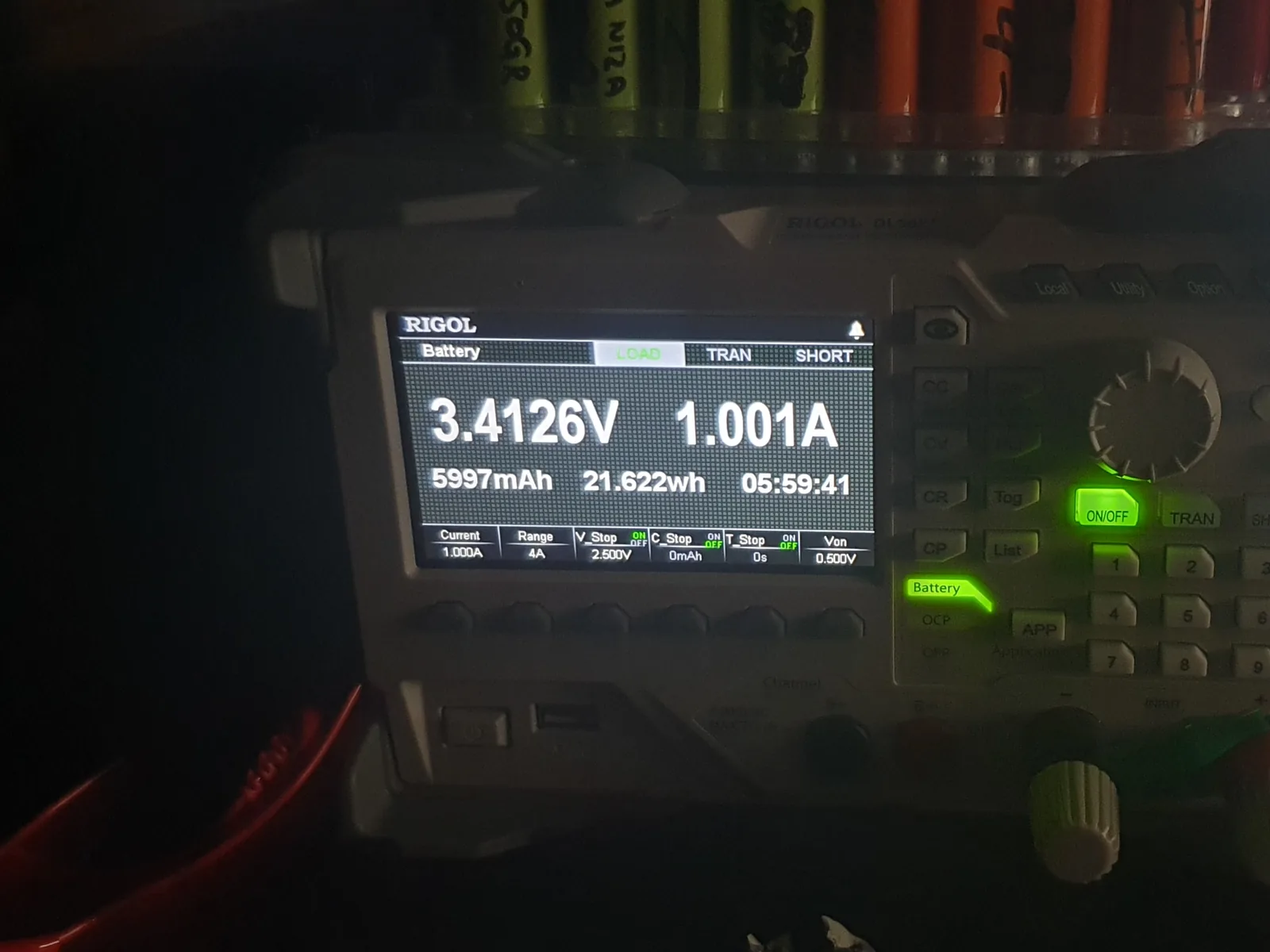
2019: first pack, fan-cooled2021: 20S, numbered sense taps2021: wrapped, printed end caps2021: clamped and installed2022: 20S4P, 72 V, 600 WhLoad test with E-stopLoad resistor at 89.5 °CBMS: 20 cells within 0.002 V
Electronics, harness and busbars
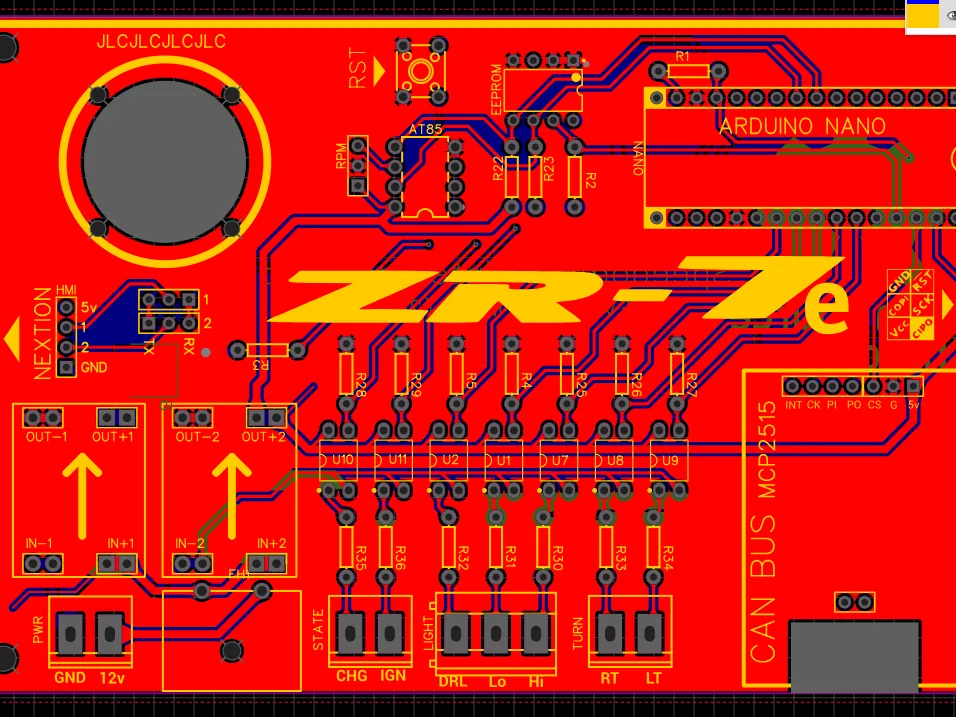
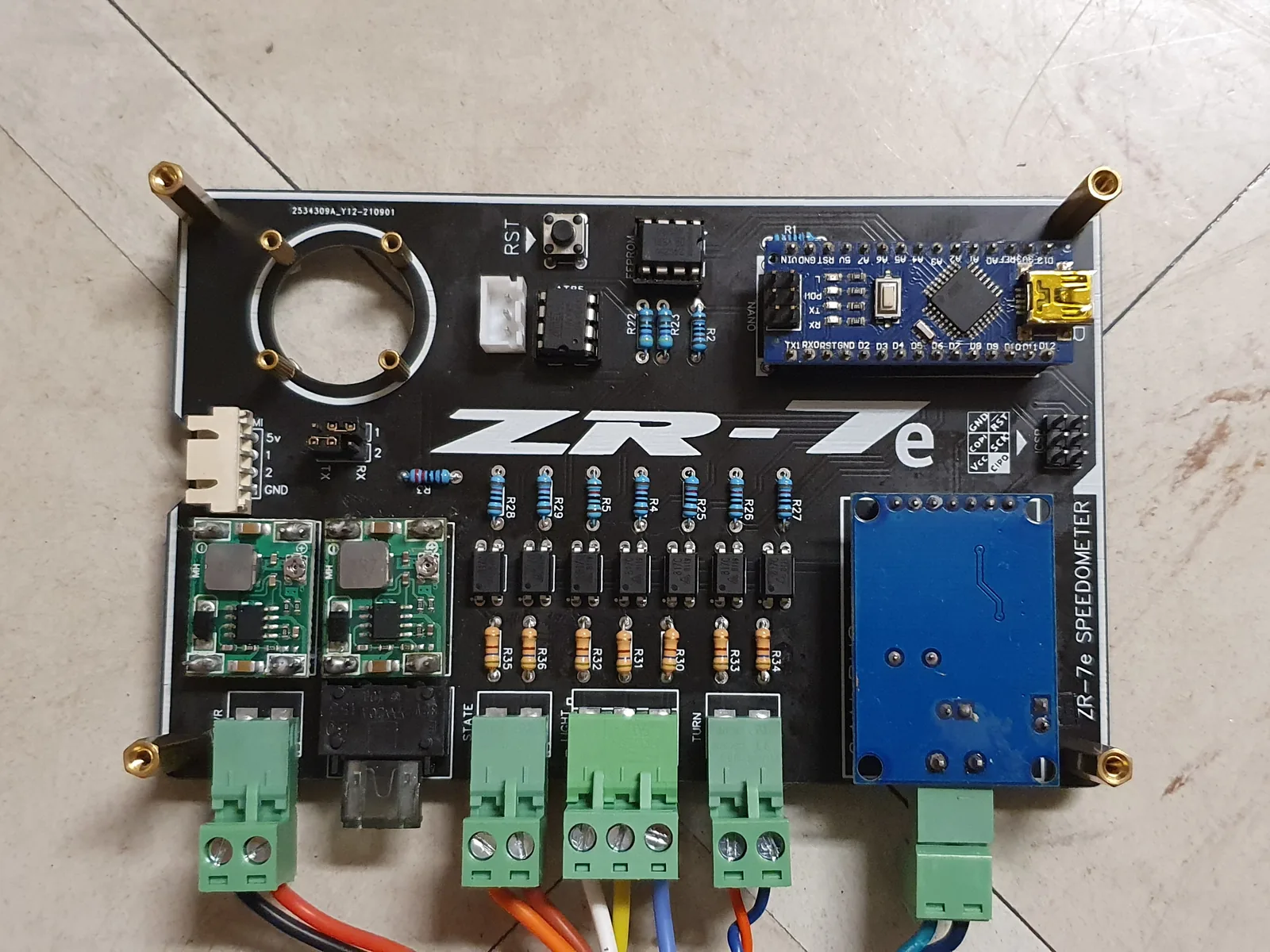
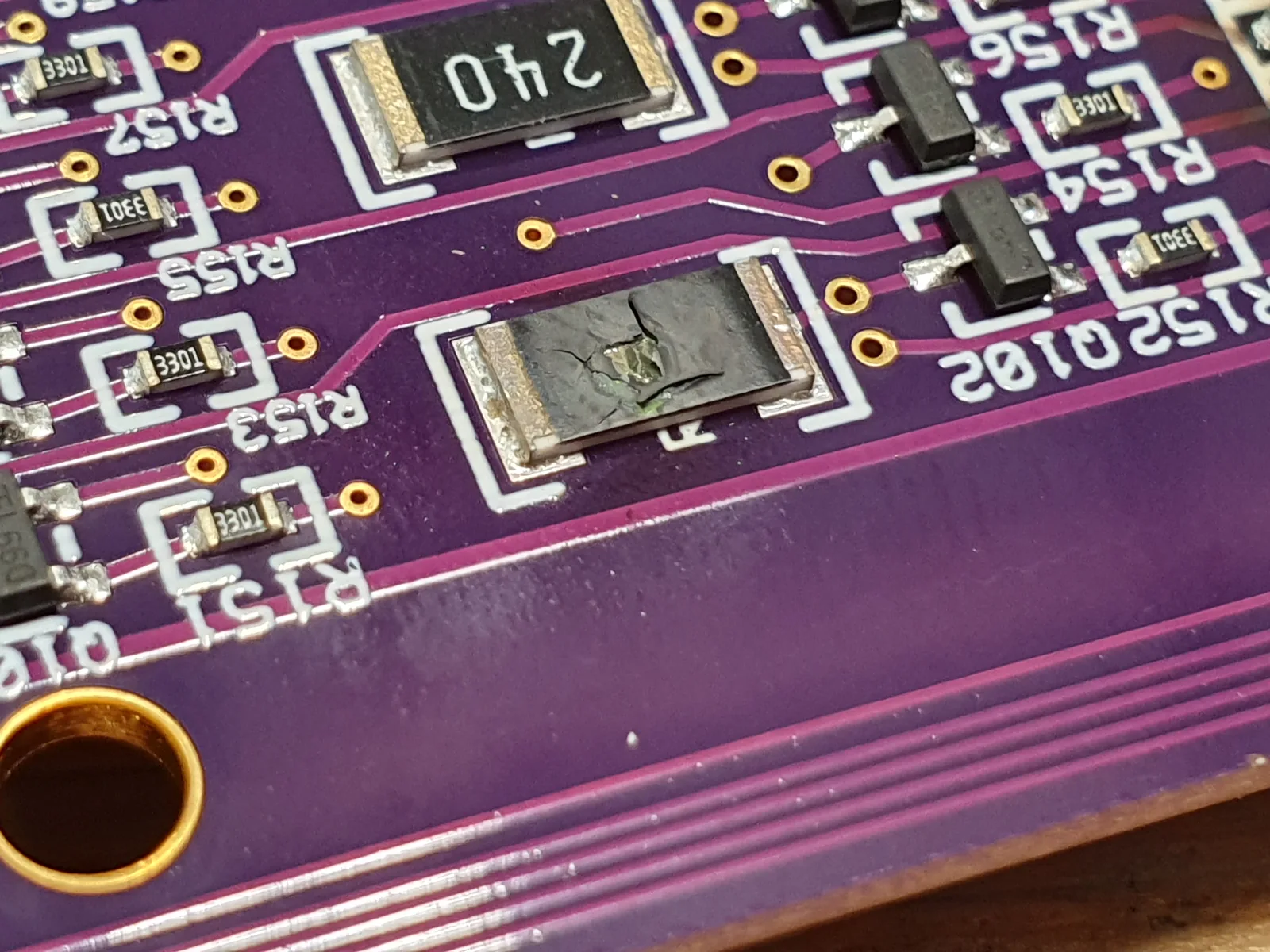
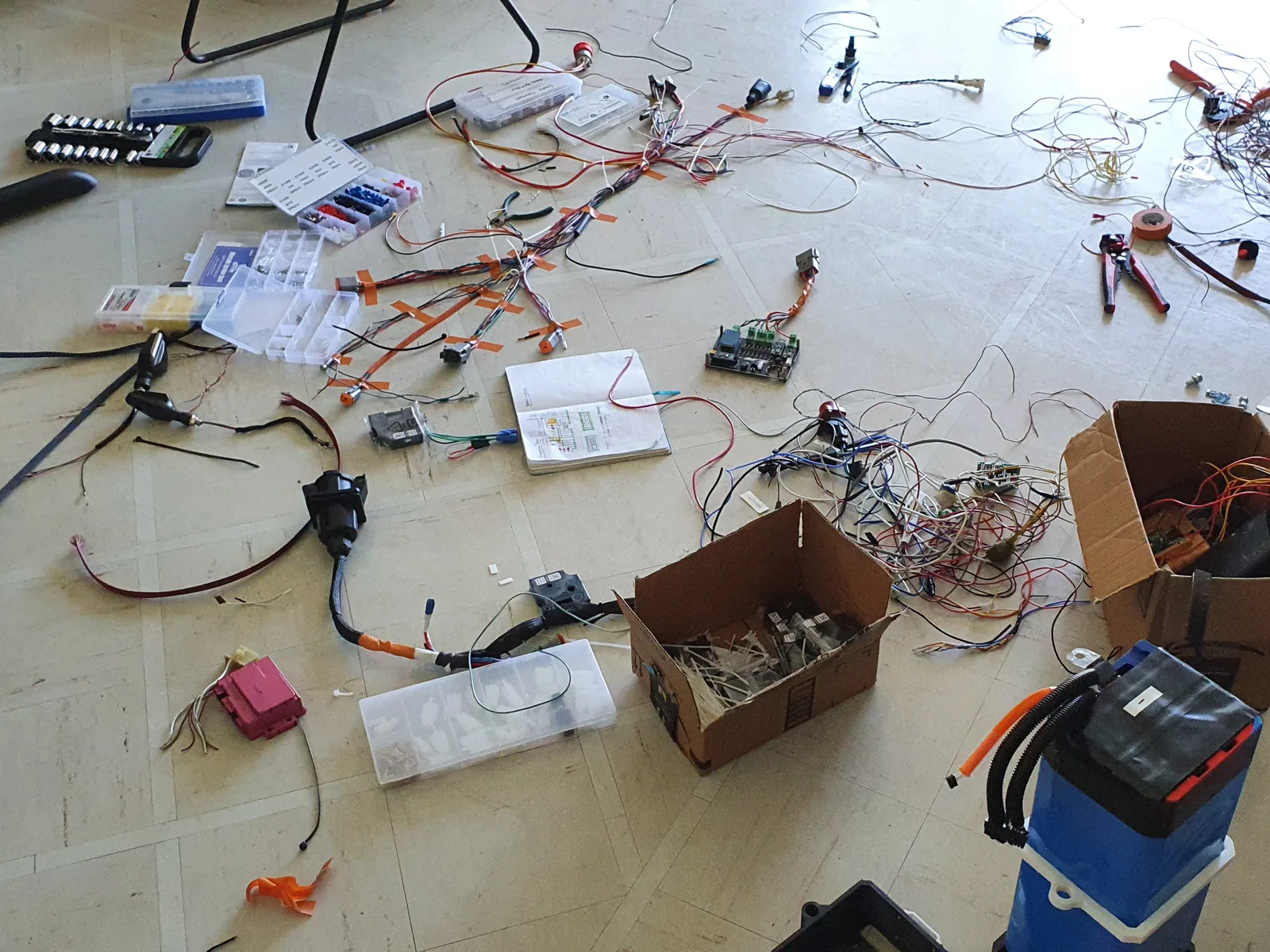
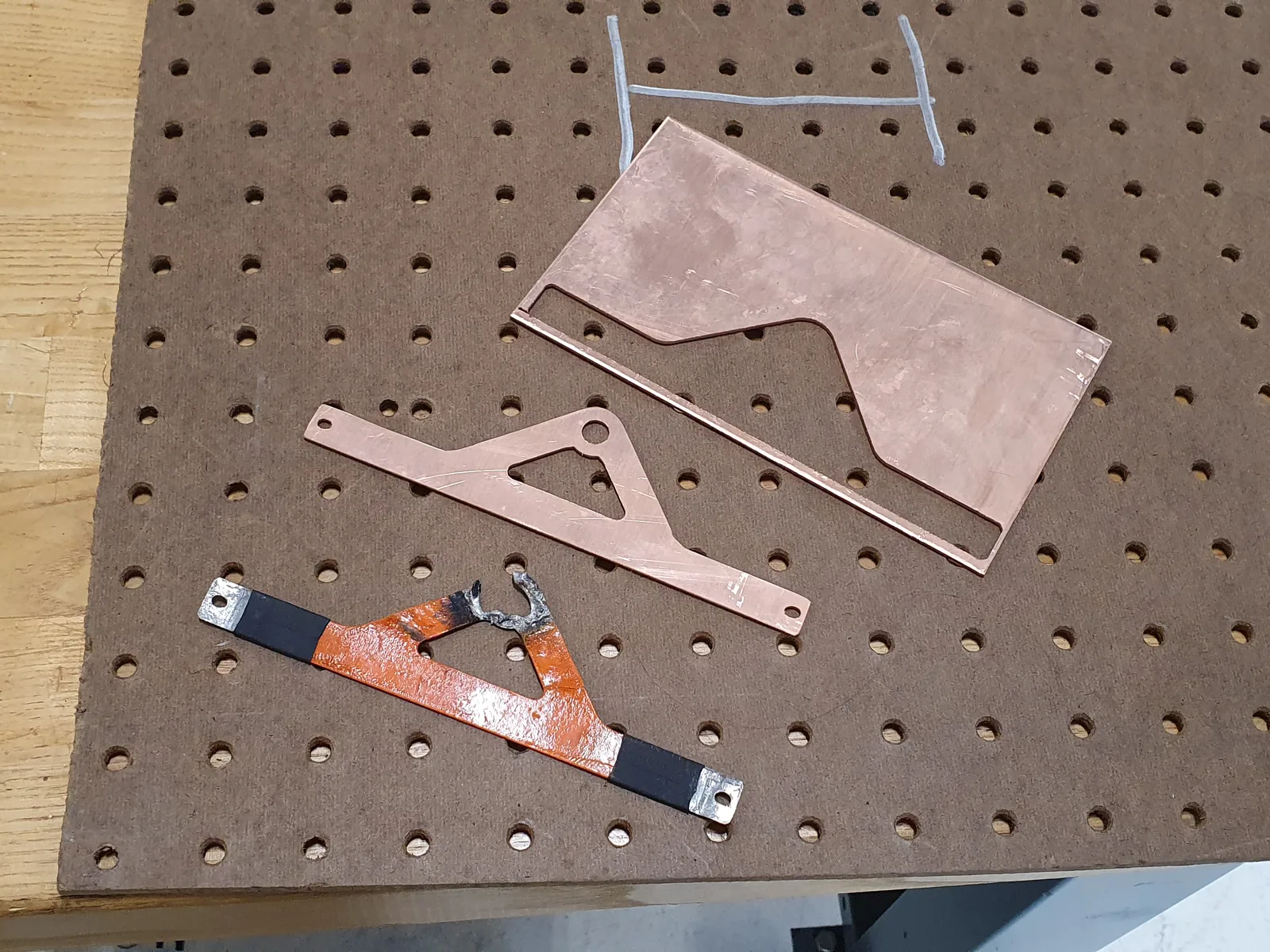
Speedometer board layoutAssembled boardSigned, open-source hardwareFailure analysis: cracked resistorLaying out the harnessLabeled sense harnessPinning a sealed connectorWaterjet-cut copper busbars
On the road, and the bubble exhaust (patent pending)
On the finished bikeBubble exhaust, first prototypeSecond generationLater: cell capacity testing
Speedometer booting on the bench (28 s)Bubble exhaust running (5 s)
E3Open source · AGPL-3.02026
Shell:B, a local-first multi-agent workstation
A multi-agent AI environment that runs on your own hardware: local models through Ollama, code in a sealed sandbox, and a memory the owner can audit. Cloud models are opt-in, never the default.
ShellB-App/Shell-Bpublic-release · AGPL-3.0
commits
265
days
19
tests
1063
agents
18
tools
100
apps
30
Commits per day, Oct 5–23, 2026
Oct 5Oct 23
Languages
Python 51%
TypeScript 46%
CSS 3%
Other <1%
Commits with an AI author or co-author
249 of 265 (94%). I direct and review; the agents, Shell:B included, write most of the code.
From the public git history, updated Oct 24, 2026. Work started a few days before the first public commit.
Problem
Agents that write and run code and read untrusted web pages are a containment problem. The goal: a capable workstation where nothing leaves the machine unless the owner turns it on.
Containment
Code runs in a Docker container with no network, every Linux capability dropped, a read-only root, resource limits and a hard time limit. Each conversation gets its own working folder.
Text from web pages, email, feeds and webhooks is fenced off as untrusted data, and web fetches can’t reach local or private addresses, checked again on every redirect.
Agents use stored secrets by name without ever seeing them: encrypted, limited to allowed hosts, approved per use and logged.
The scouting agent that scrapes pages can’t search past conversations, so an injected prompt has less to reach.
Reversible by design
Shell:B can change its own code, but only on a copy: checks run, I approve the diff, and a failed restart rolls back automatically.
Memory learns only from the owner’s own words, can wait for review, and a correction retires the old entry instead of deleting it. Long chats get summarized, but nothing is deleted.
Risky actions wait on an approval card; plan mode is read-only, enforced at the tool level.
Sharing safely
Each guest gets their own network-isolated container behind a separate gateway, signing in with a password plus TOTP or a passkey.
A public API and MCP server use hashed keys with per-key rate limits and daily quotas, and token use is metered per agent and model.
Model calls can overflow to other machines I own; incognito and guest traffic stays local.
How it’s built
Python 3.12 and FastAPI on the back end, React 19 and TypeScript on the front, SQLite with full-text search over past chats and embeddings for memory. Written largely with AI coding agents, including Shell:B’s own; I review and verify what they produce.
Why it’s here
It’s where I practice AI-assisted engineering in public, and the design follows the same ideas as a hazard control: contain what can fail, give each part only the access it needs, keep changes reversible.
How the parts connect. Everything on the right runs on the same machine.
Python · FastAPI · TypeScript · React · Vite · Tailwind · Docker · Ollama · SQLiteSource on GitHub ↗
E5Florida Institute of Technology
Two Best in Show competition entries
Two student team projects, each named Best in Show for Aerospace Engineering at Florida Tech’s Northrop Grumman Engineering & Science Student Design Showcase.
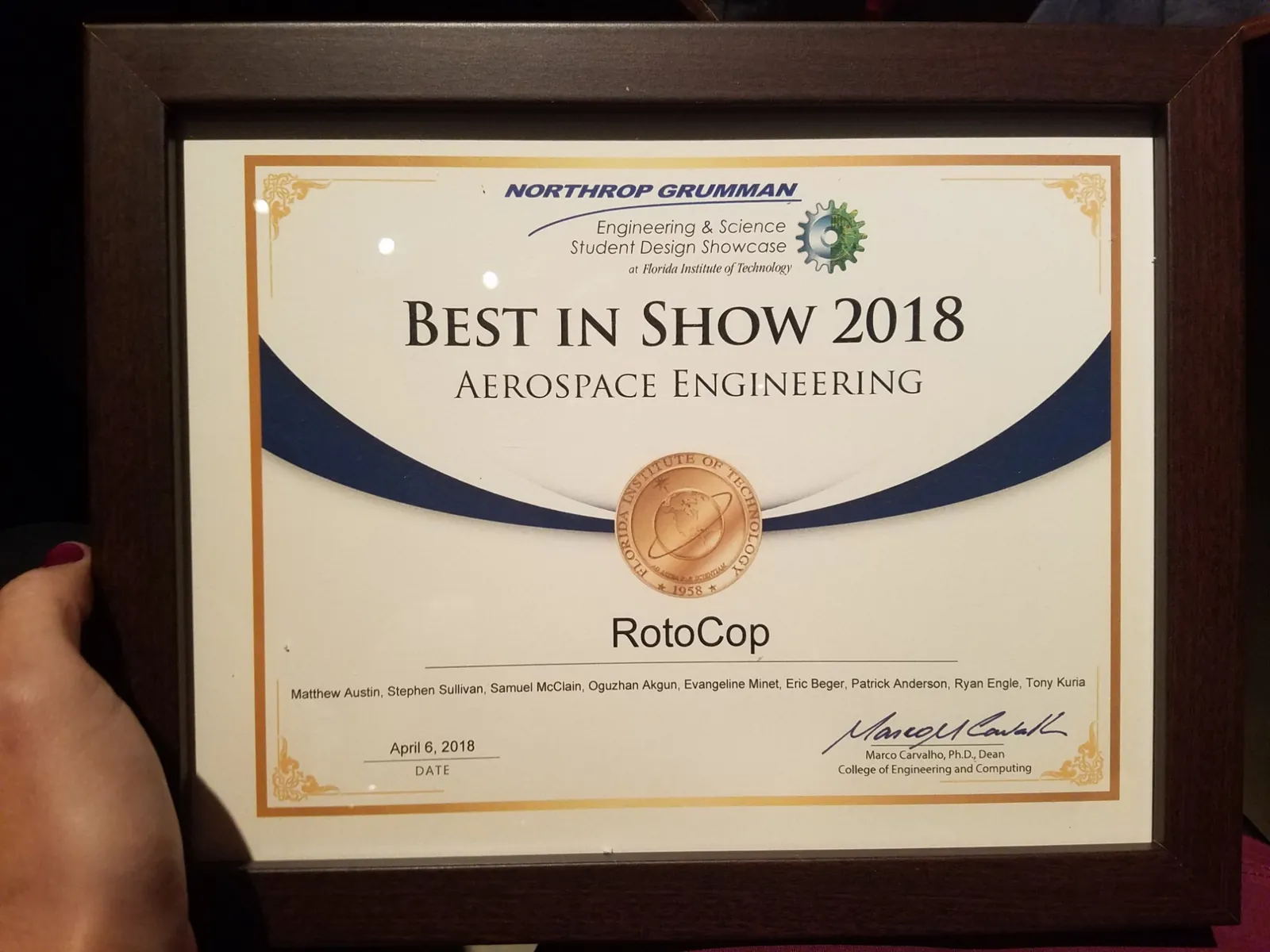
RotoCopBest in Show 2018
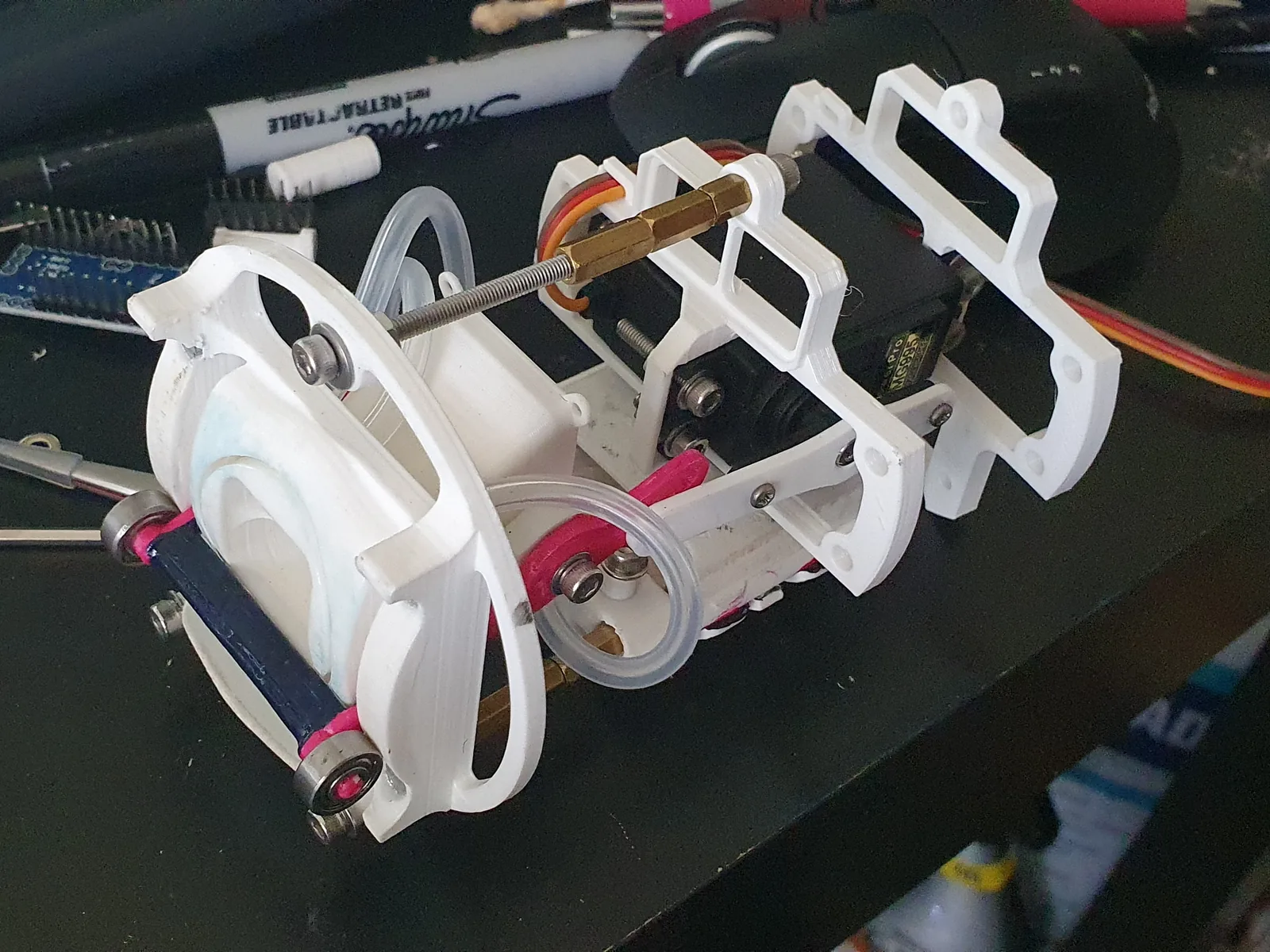
Northrop Grumman RotoCop Counter-Criminal Design Competition. Our entry was a hexacopter for aerial surveillance, powered from the ground through a tether so its flight time wasn’t limited by a battery. I was the team’s automation lead and built the entire ground station: it fed power up the tether, received the video feed, and ran the drone’s automation. One small part of it is public on GitHub: the touchscreen controller, Arduino firmware that turns a TFT touch panel into a USB keyboard with configurable on-screen buttons, a small graphics library for it (C/C++), and a C# desktop editor for the button layouts.
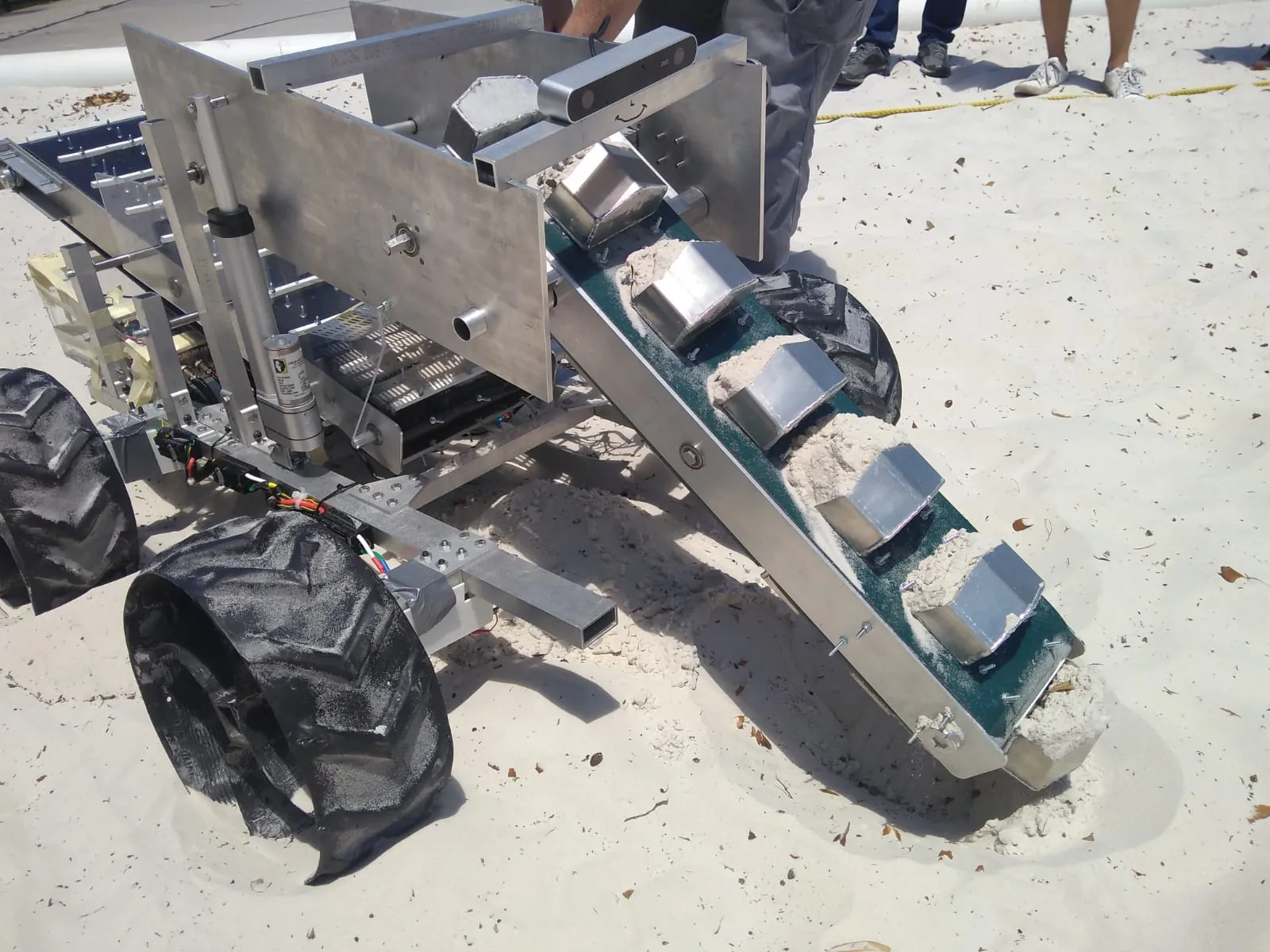
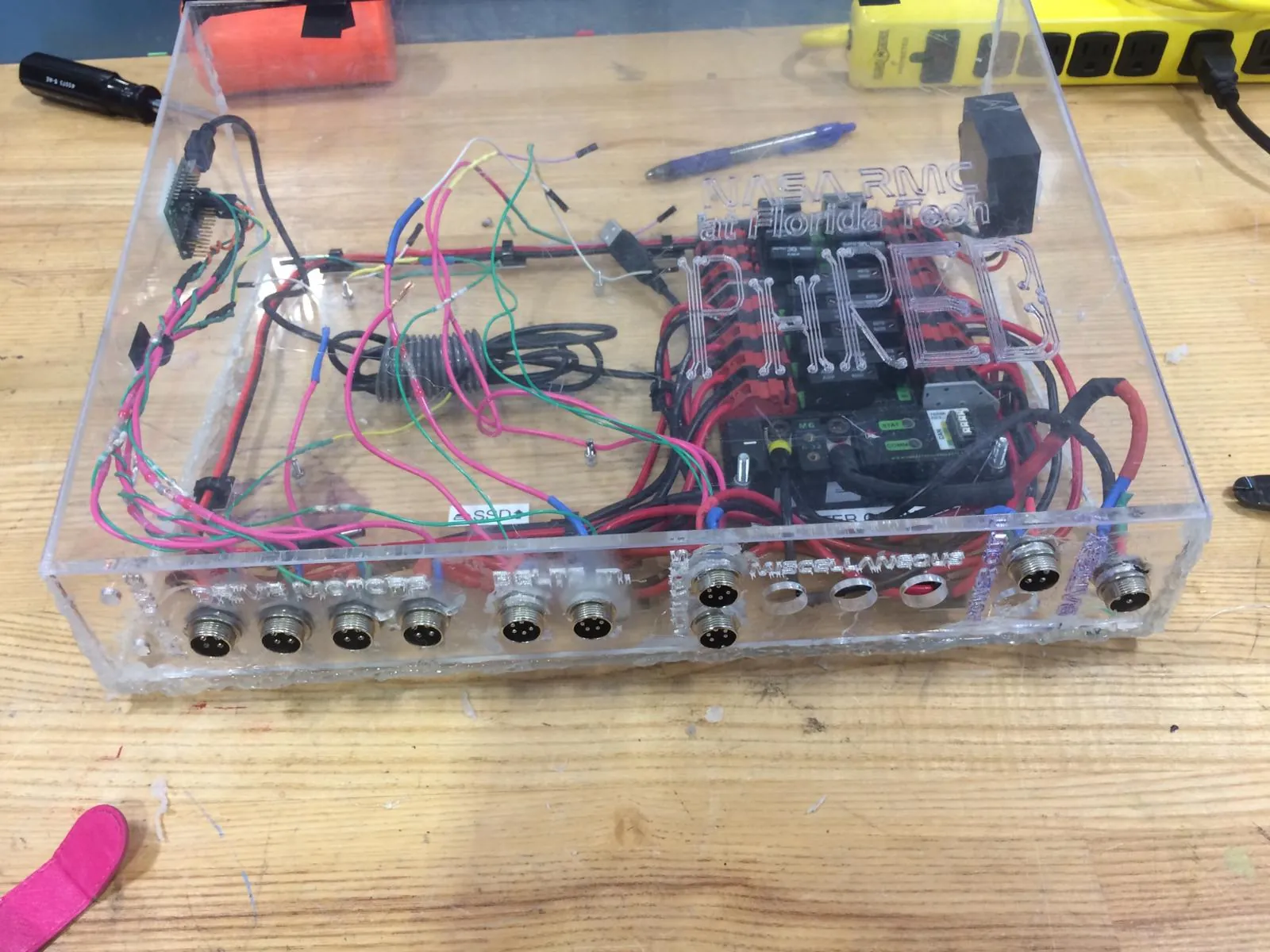
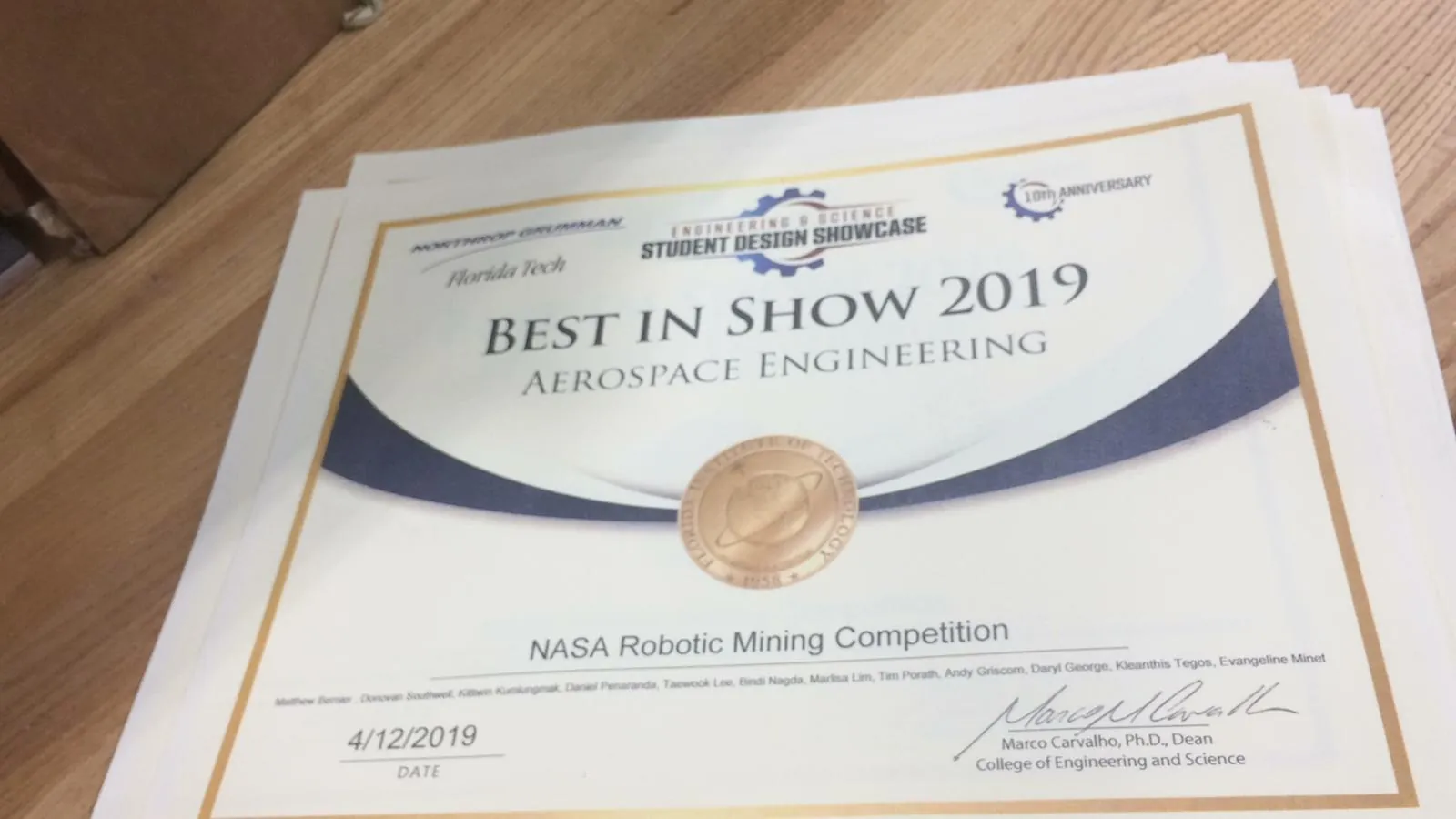
Florida Tech’s entry in NASA’s Robotic Mining Competition: PHRED, an excavation robot that digs regolith simulant with a bucket ladder and carries it in a hopper. I was the project manager for the 12-person team and ran the project end to end. PHRED was built for the 2020 competition, which NASA cancelled because of COVID-19.
PHRED diggingElectronics boxBest in Show 2019
Location-aware E-ink parking decal
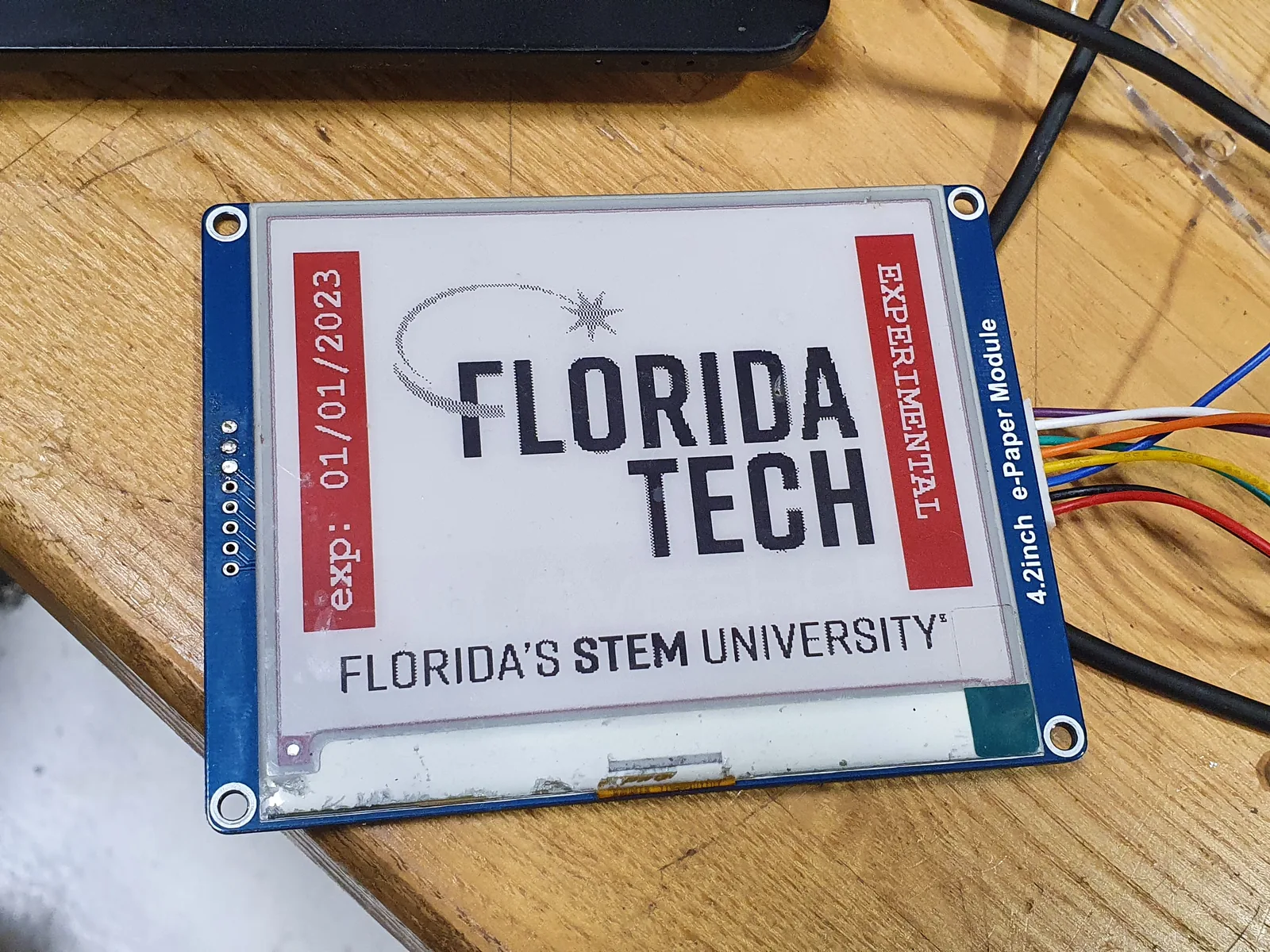
A 4.2-inch e-paper parking decal that changes what it shows based on my location. An ESP32 reads a GPS/GNSS receiver and switches the display to the permit for wherever the car is parked. The permit shown is expired.
E-ink decal prototype
Earlier embedded tools
A .NET library for writing Arduino code in C#, and a Raspberry Pi equipment logger in Python built for Florida Tech Video Productions.
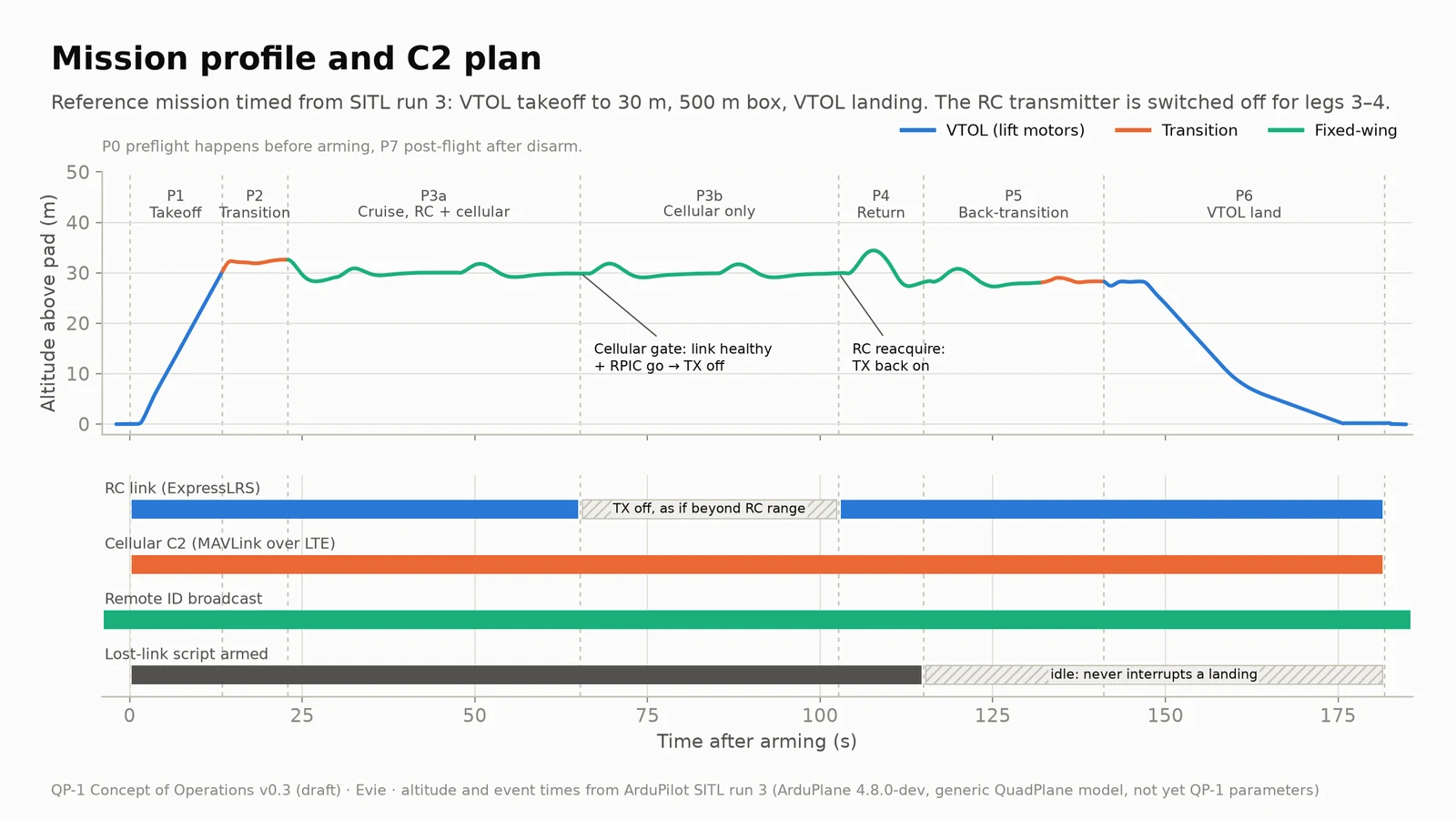
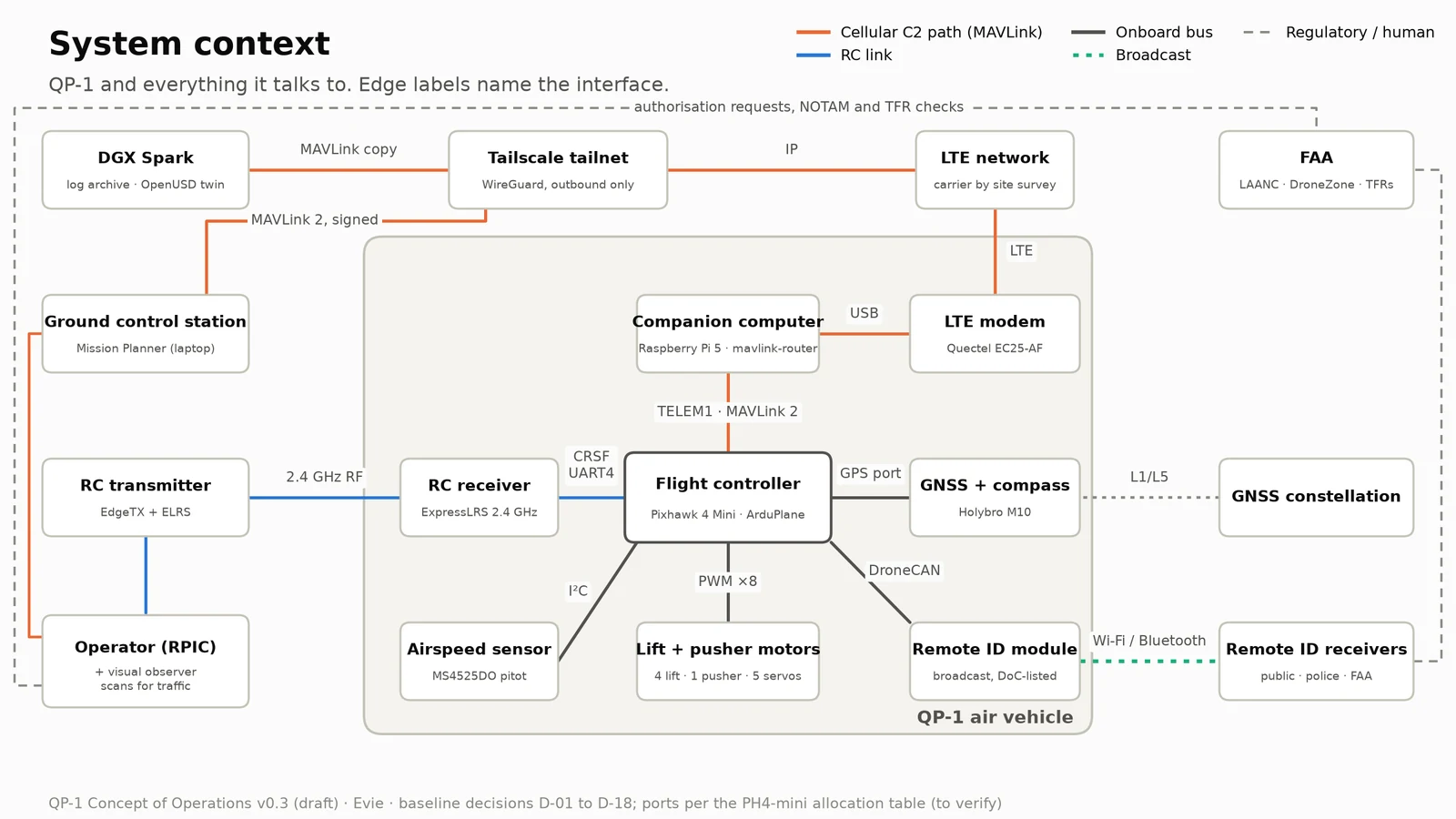
A QuadPlane (vertical takeoff, fixed-wing cruise) on a Holybro Pixhawk 4 Mini, with cellular command and control for flights beyond radio range and FAA Remote ID. I’m running it as a miniature flight-vehicle program with a public digital thread: concept of operations, system model, requirements, simulation, safety analysis, readiness review, then flight test. It is in design and build. Nothing here has flown yet, and every figure says whether its numbers come from analysis or simulation.
What exists
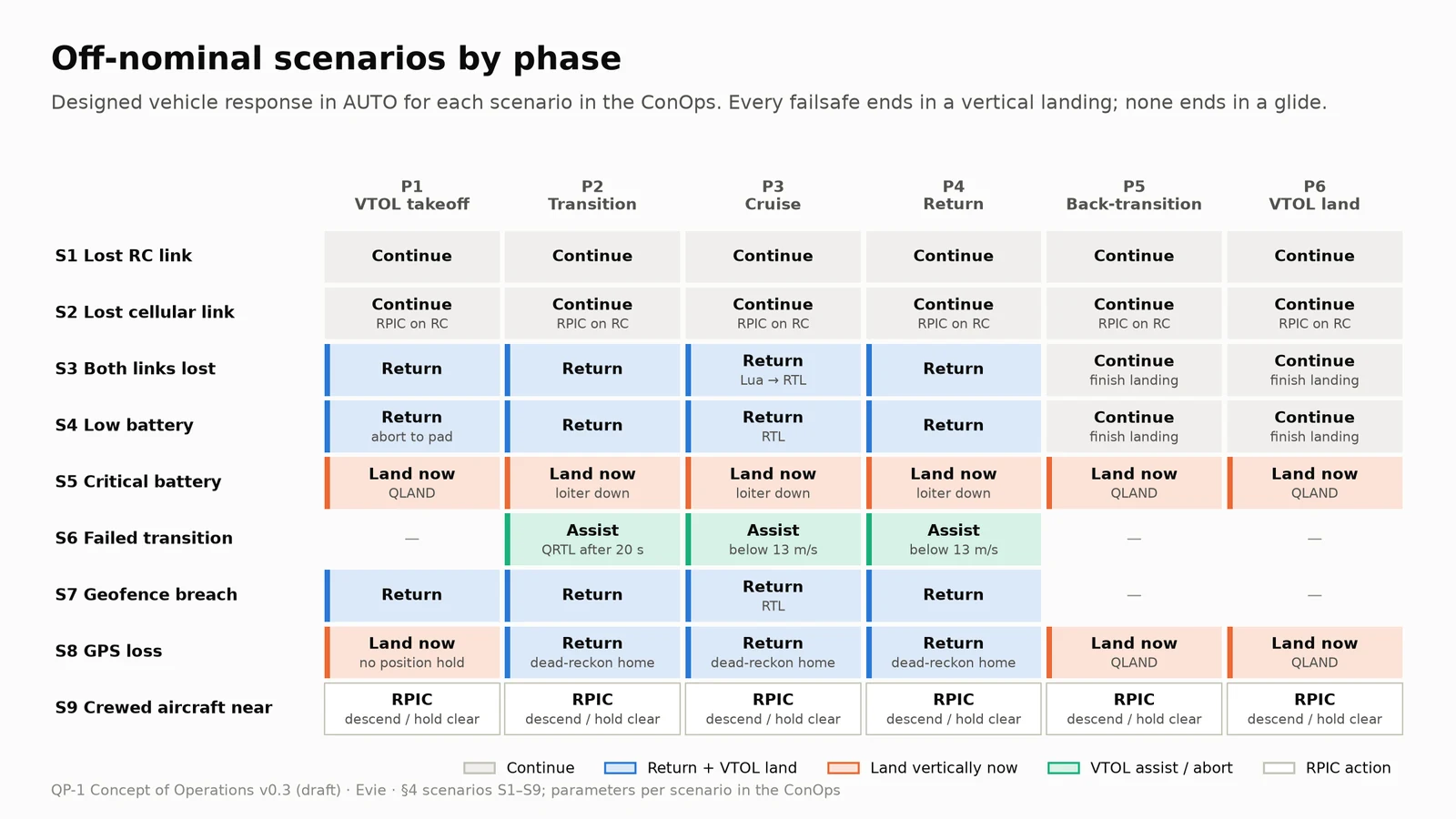
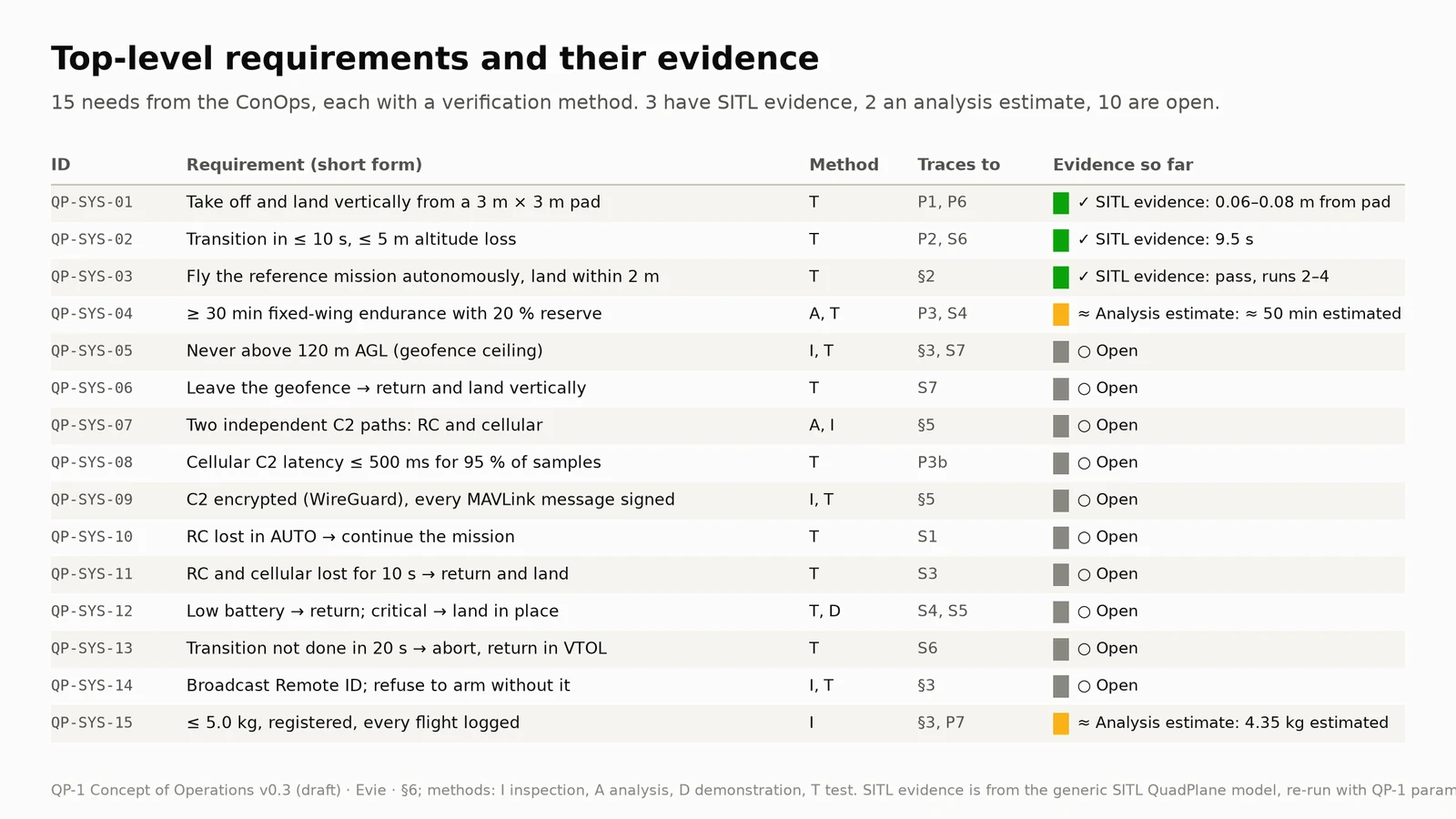
A concept of operations in INCOSE / NASA SE Handbook style: mission phases with entry and exit conditions, operating limits under FAA Part 107 and the airspace around the Space Coast (Melbourne’s Class C, the Cape’s restricted areas, launch TFRs), nine off-nominal scenarios each mapped to the ArduPilot failsafe parameters that implement it, 15 top-level requirements with a verification method each, and 18 recorded baseline decisions.
ArduPilot software-in-the-loop on a DGX Spark flying the reference mission end to end: VTOL takeoff to 30 m, transition, a 500 m box, return and a vertical landing. Transition takes 9.5 s, the aircraft lands 6 to 8 cm from the pad, and repeat runs agree to within 0.5 s.
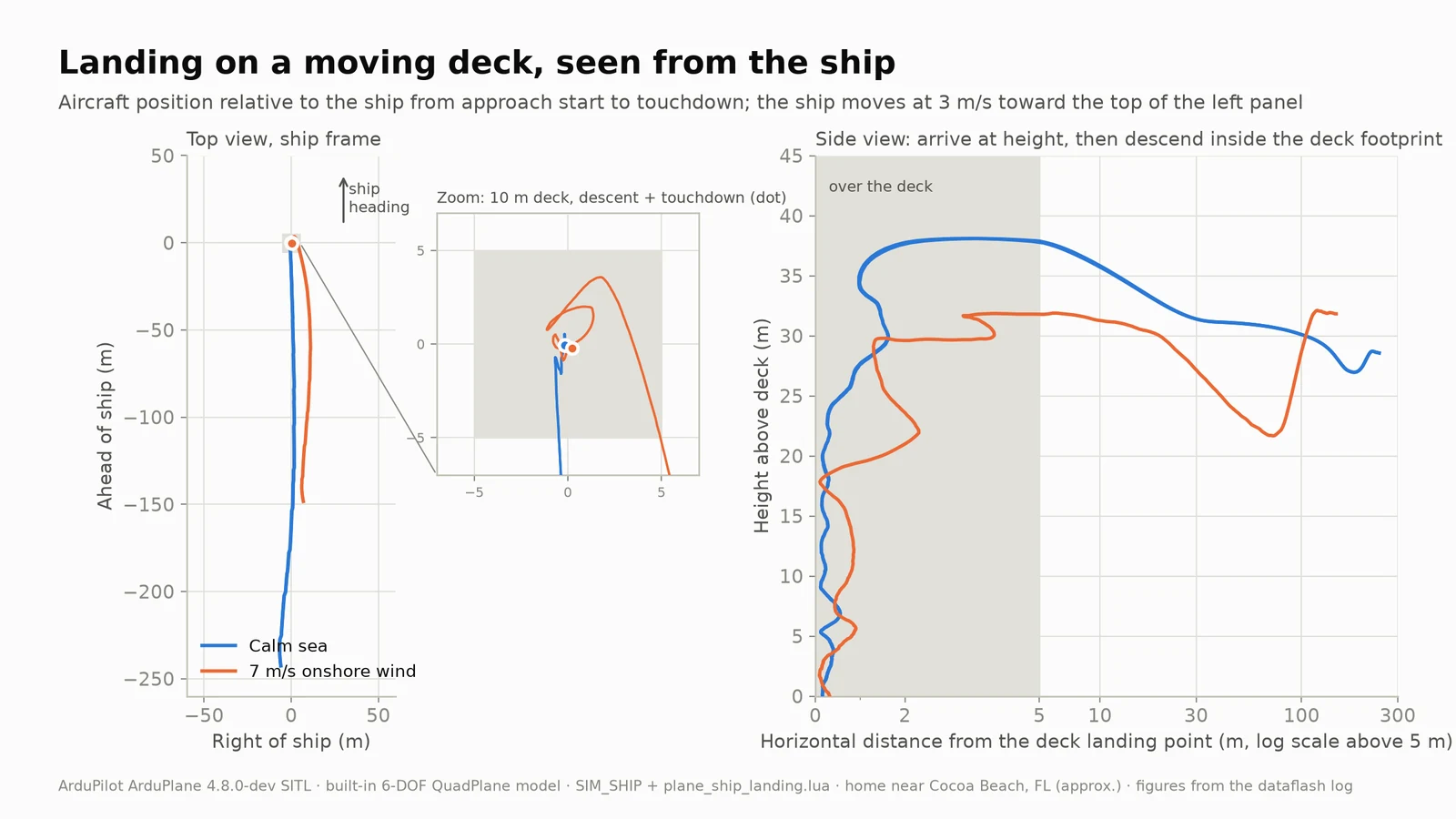
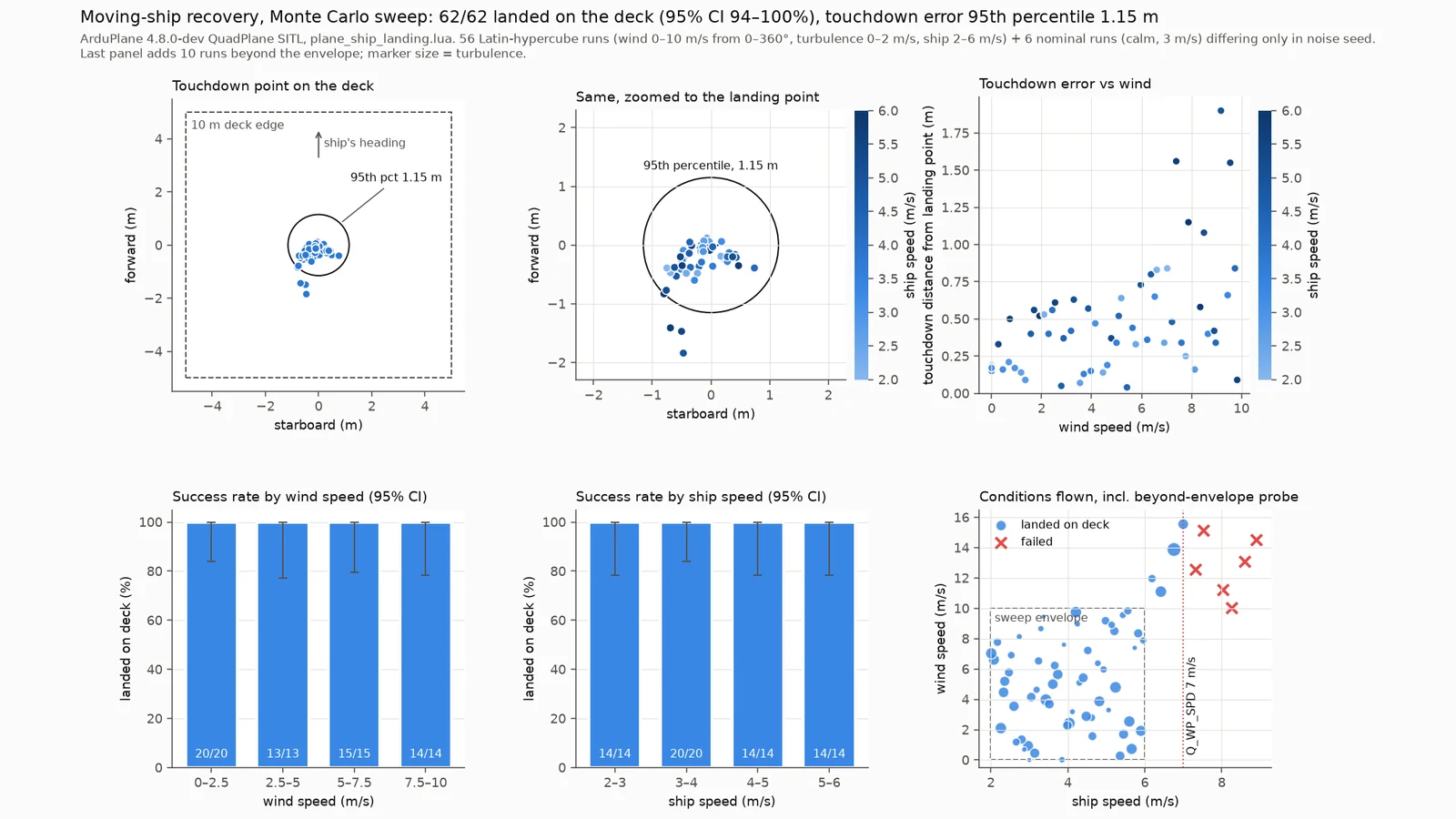
A simulated recovery in the shape of a New Glenn booster landing: launch from the shore, fly 1.2 km out to sea, then land on a 10 m deck on a moving uncrewed ship. It uses ArduPilot SITL’s ship simulator and the stock plane_ship_landing Lua applet, flown with ArduPilot’s generic built-in QuadPlane model, not QP-1’s own parameters. In a 62-run Monte Carlo sweep (wind 0 to 10 m/s from any direction, turbulence up to 2 m/s, ship speed 2 to 6 m/s, a different noise seed each run), all 62 landed on the deck (95 % confidence interval 94 to 100 %), and 95 % of them touched down within 1.15 m of the landing point. This is simulation only: the deck doesn’t pitch, roll or heave, and there is no ship airwake.
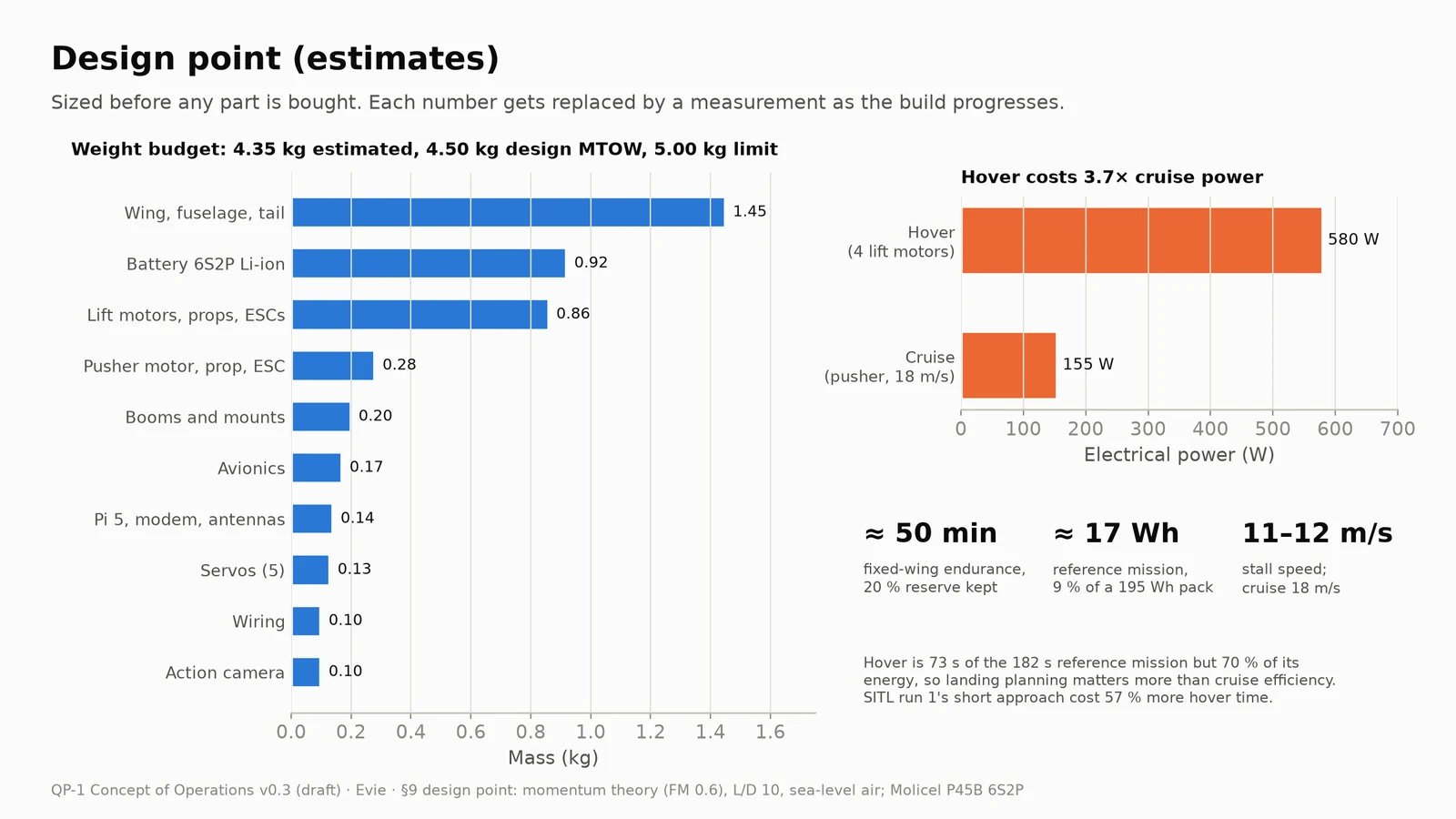
A design point sized before buying parts: 4.35 kg estimated against a 4.5 kg target, about 580 W to hover against 155 W to cruise, and about 50 minutes of estimated fixed-wing endurance.
What the analysis turned up
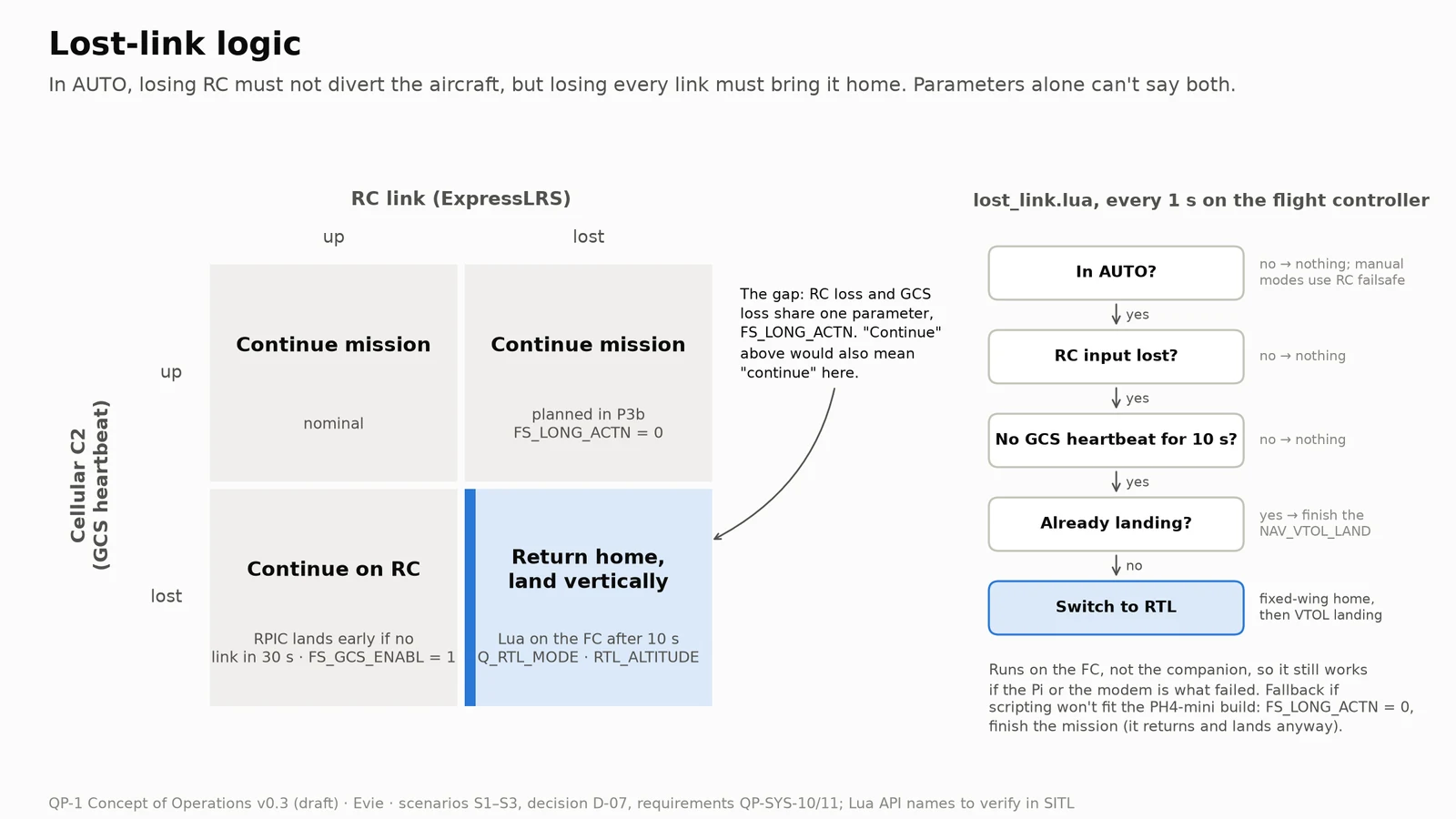
ArduPilot sets one action for both RC loss and ground-station loss. Beyond RC range the aircraft has to ignore a lost RC link, but it has to come home if every link is gone, and parameters alone can’t say both. A short Lua check on the flight controller does it, so it still works if the companion computer or the modem is what failed.
The first simulated landing overshot the pad because the final approach was too short, and it cost 57 % more hover time. Hover is 70 % of the reference mission’s energy, so approach length became a planning rule: at least 1.5× the stopping distance.
Ten more ship runs outside that envelope found a failure mode. Every run with the ship faster than the VTOL speed limit (Q_WP_SPD, 7 m/s) failed, six out of six. The aircraft either hovered behind the ship indefinitely or kept descending and landed in the sea astern, because the landing descent is cleared once and never re-checked. Raising the limit to 12 m/s landed all six on the deck. The rule is a speed limit above the fastest deck the mission allows, plus an abort-and-climb check that the stock landing script doesn’t have.
The Pixhawk 4 Mini’s serial ports are all taken by the companion computer, GPS and RC receiver. Remote ID went on the CAN bus, and a second GPS and ADS-B In are deferred until they can go there too.
Status
In design and build; no flights. Next: a SysML model of the vehicle, the requirements in a requirements-management tool, SITL re-flown with QP-1’s own parameters over an emulated cellular link, STPA and FMECA, and a flight-readiness review before the first hover.
ArduPilot QuadPlane · SITL · MAVLink · Lua · ExpressLRS · LTE · Tailscale · Remote ID · Part 107 · Python · matplotlibPersonal project. Figures show analysis and simulation, not flight data.
Personal projectsIn progress
Current builds
Field-engineering cyberdeck
A handheld built around a Raspberry Pi CM5, with three displays (a 4-inch OLED, an e-ink strip and an OLED activity strip), a split ortholinear keyboard, two isolated CAN FD ports, a battery tester using electrochemical impedance spectroscopy, and swappable expansion cartridges. Designed in EasyEDA Pro, boards made by JLCPCB.
VTOL drone
An ArduPilot QuadPlane (vertical takeoff, fixed-wing cruise) on a Holybro Pixhawk 4 Mini, with a cellular command link for flights beyond radio range, FAA Remote ID, and MAVLink routed between the flight controller, a companion computer and the ground. Details
BARK, a quadruped robot
A dog-sized four-legged robot built from scratch for dynamic-locomotion research, on off-the-shelf quasi-direct-drive actuators and a parts budget under $3,000. Early stage.
03
Experience
Apr 2025 – PresentMelbourne, FL
Integrated Solutions Engineer (Embedded Systems)
Contec Americas Inc.
Digital twin development. Develop Python-based digital twin models that connect system architecture, CAD geometry, and operational telemetry in a single traceable engineering repository.
Automation & APIs. Build automated data pipelines and REST API connectors linking engineering repositories, test data, and configuration management systems, replacing manual data reconciliation.
Requirements & traceability. Decompose system-level requirements into sub-system interfaces and verification criteria; maintain traceability matrices from requirements to design decisions, test cases, and acceptance evidence.
Cross-disciplinary integration. Work with mechanical, electrical, and software teams to define data contracts and interface specifications, and coordinate V&V planning across system boundaries.
Regulated release control. Designed, built and run the master control platform for hubs in seven countries that provision 200 to 1,000 medical-scanner laptops a month: releases, sync, monitoring, vulnerability scanning, and a change-control portal, shared with the customer, that blocks any release a country’s regulator hasn’t approved. Details
SBOM & security. Software bills of materials reconciled against customer change orders (CycloneDX 1.5), and daily vulnerability scans that report only new findings, for EU Cyber Resilience Act obligations.
Product security. Run the company’s PSIRT: wrote the operating policy (IEC 62443-4-1, CVSS/CWE ranking), registered on ENISA’s reporting platform for EU Cyber Resilience Act Article 14, and built a USB field kit that captures CycloneDX SBOMs from Contec products. Details
Edge AI products. Argus, edge AI dock monitoring and an OpenUSD digital twin of the company’s own warehouse; a CCTV inference server designed to a per-unit cost ceiling; a three-tier AI desktop line in Arena PLM; a seismic sensor node; KVM-over-IP with an AI agent. Details
AI engineering. Full-stack AI development, much of it research and development, from early prototypes to working software.
Configuration management. Manage engineering documentation, material submittals, and design revisions under configuration control.
Jun 2022 – Dec 2024North America
Founder & Electromotive Engineer
Phoenix Motors
Vehicle conversion engineering. Started a small business after graduation converting legacy vehicles to electric powertrains, across platforms from multiple manufacturers and decades: a 1990 Honda Transalp, a 1992 Jeep and a 2011 Volvo XC60.
Off-grid office trailer. Built an office into a trailer that runs on its own power: an under-floor battery bank, inverters, HVAC and a backup generator.
Systems integration. Defined electrical architecture, powertrain interface specifications, and compliance requirements for road-legal conversions; integrated battery systems, motor controllers, and vehicle CAN networks.
Test & verification. Wrote test procedures for powertrain validation and coordinated field testing to verify performance, safety, and compliance.
Jan 2014 – May 2020Melbourne, FL
Director of Technical Services
Florida Tech Video Productions
Set up, operated, and maintained audiovisual systems for campus events and classes; coordinated technical requirements with faculty, staff, and organizers.
Equipment check-out kiosk. Built pilog, a Raspberry Pi station in Python where members scanned their ID and then an item’s barcode to sign gear in or out, with automatic sign-out after inactivity.
Florida Tech Student Life named FITV Organization of the Year in 2017–2018 and 2019–2020.
Oct 2012 – Feb 2013Bangkok, Thailand
Aeronautical Rotorcraft Engineer (Intern)
Airbus Helicopters
Supported the rotorcraft engineering team during a five-month internship: component testing, technical documentation, and an introduction to aerospace design and certification practice.
EV powertrain integration · Battery systems & motor controllers · CAN networks · Test procedures
AI-assisted engineering
Claude Code, Codex, local models through Ollama: used to speed up automation and tooling, with outputs independently verified
How I work, with the evidence
Root cause
A fleet-wide outage traced from a drop in sync run time, 33 s to 1.4 s, to a boot race that overwrote DNS, then fixed for good (release control). A digital twin that segfaulted under load, traced to two threads touching the USD stage and fixed by design: 5,825 of 5,825 requests OK afterwards (Argus). A BMS balancing at 114.5 °C brought down to 69 °C, and a cracked power resistor turned into a derating rule for every power resistor in the charge path (motorcycle).
Candor
Checking a 5.5 GB customer release package found a web page shipped in place of a 3.27 GB installer, and the automated scan showed that the hand-built SBOM had undercounted. Both went into the report. A damage scorer that fired 678,044 false-positive incidents was muted rather than shipped (Argus). Every case on this page says what is built and what is not switched on yet.
Ownership
Ran a 12-person NASA Robotic Mining Competition team end to end (PHRED). Designed, built and run the release-control platform, and took the company’s product security from no policy to a released one with a registered reporting channel (PSIRT).
Builder
A fire-gutted motorcycle rebuilt into a registered EV with my own motor controller, BMS, charger and CAN network, down to the waterjet-cut busbars and labeled harness (motorcycle). A rocket firing stand and its controller, built with the students I mentor (mentoring).
05
Education & recognition
Education
B.S. Aerospace Engineering B.S. Aeronautical EngineeringFlorida Institute of Technology · May 2022Cheerleader and Pete the Panther, the university mascot
Baccalauréat Général, ScientifiqueLycée Français International de Bangkok · 2013Vice-president of the student council; head of the student representatives, elected to the school board
Awards
Best in Show 2019, Aerospace EngineeringNorthrop Grumman Student Design Showcase · NASA Robotic Mining Competition, project manager
Best in Show 2018, Aerospace EngineeringNorthrop Grumman Student Design Showcase · RotoCop, automation lead, built the ground station
Student of the Year, 2013Lycée Français International de Bangkok · awarded to one graduating student, comparable to valedictorian
Organization of the Year, 2017–2018 & 2019–2020Florida Tech Student Life honors for Florida Tech Video Productions (FITV), where I was Director of Technical Services
Olympiades académiques de mathématiques, 2012Honorable participation, Asia zone, French schools abroad (AEFE)
World champions, 2020 ICU University World CupFlorida Tech cheer, chosen by USA Cheer to represent the U.S.; 1st in Elite Small Coed Team Cheer · Florida Tech News ↗
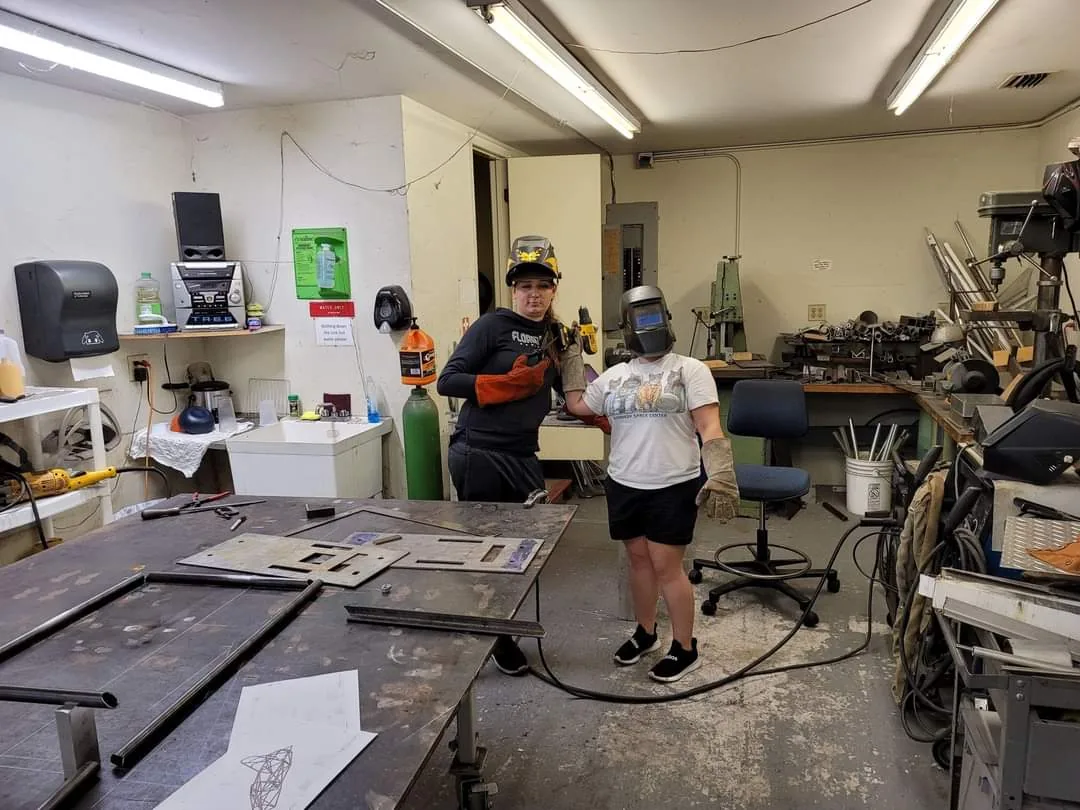
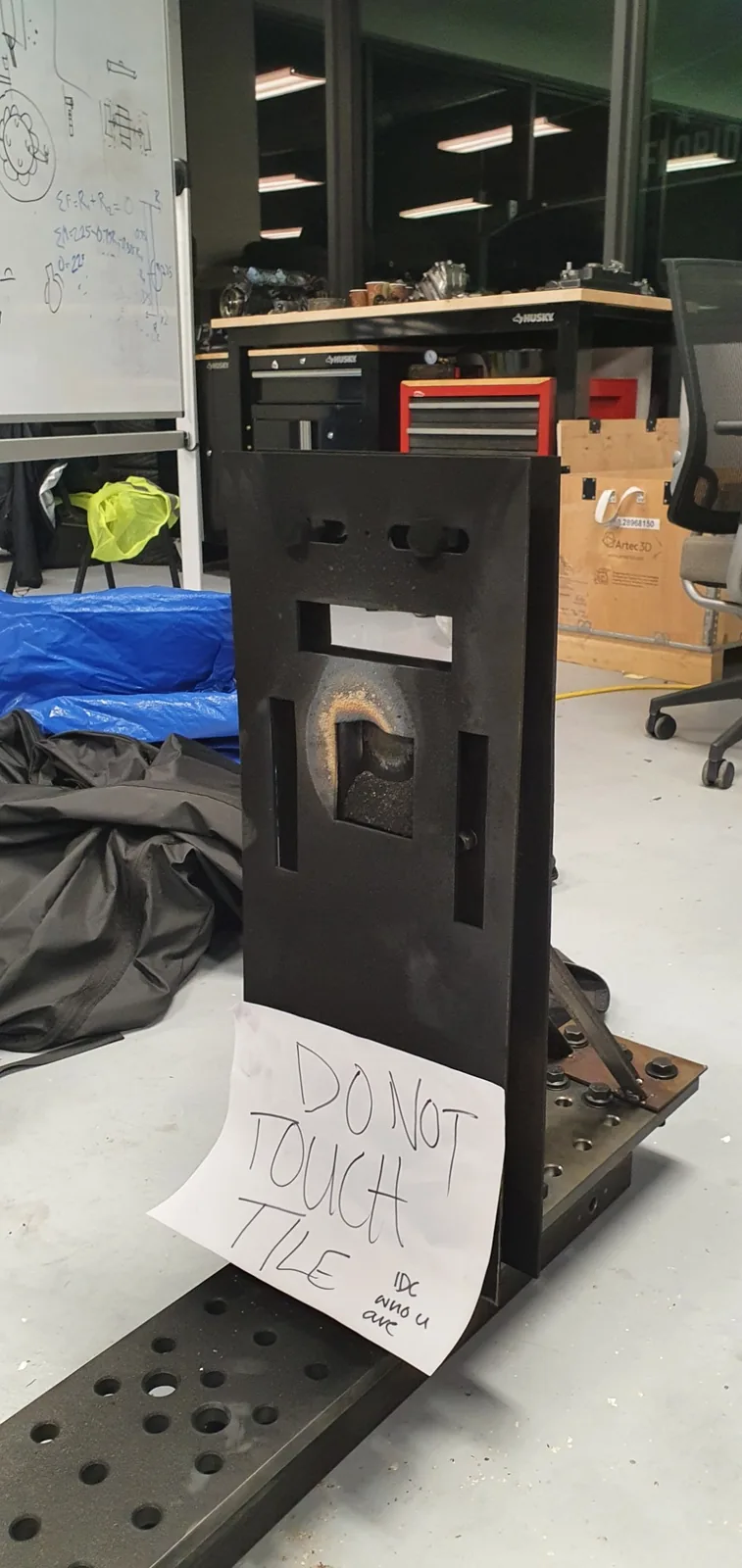
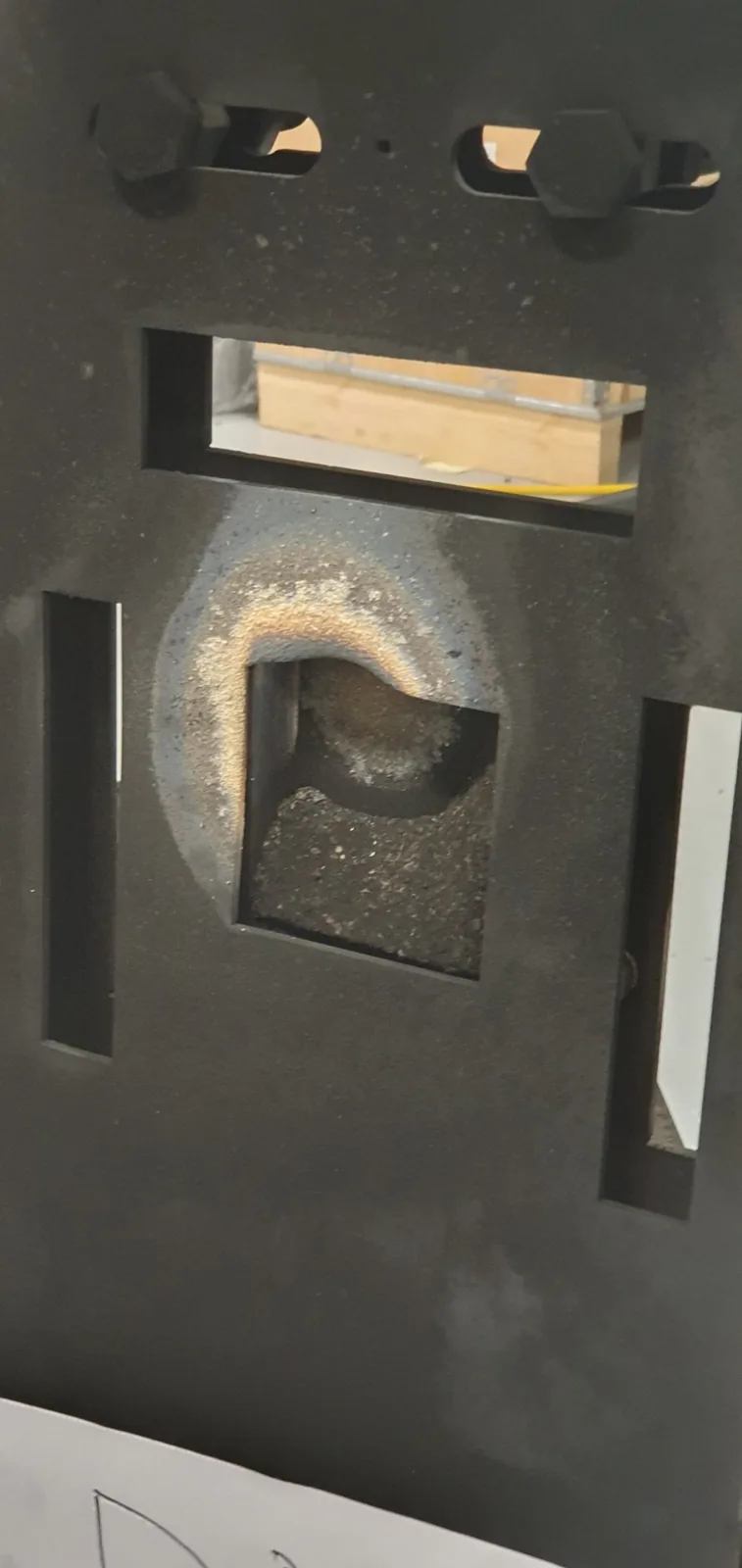
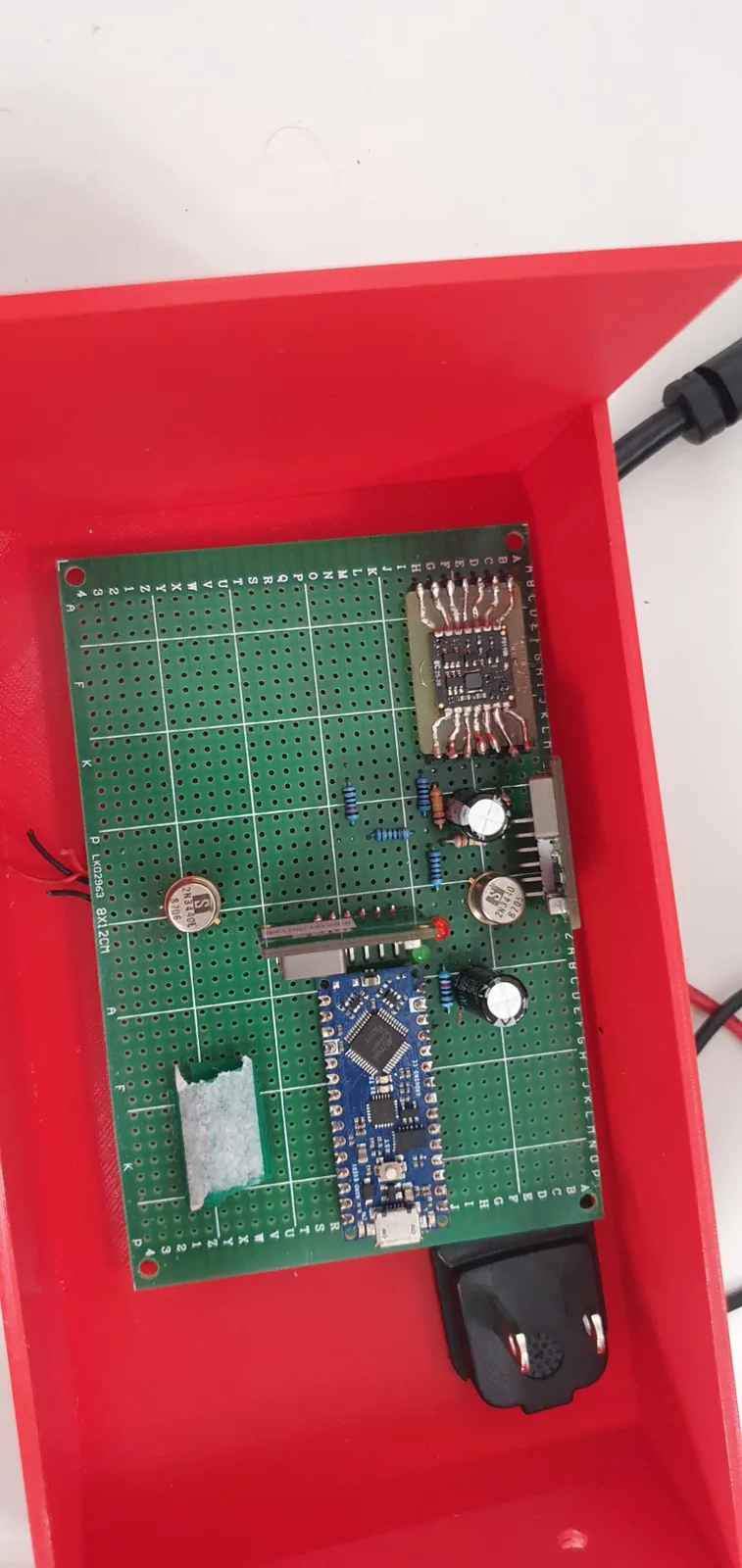
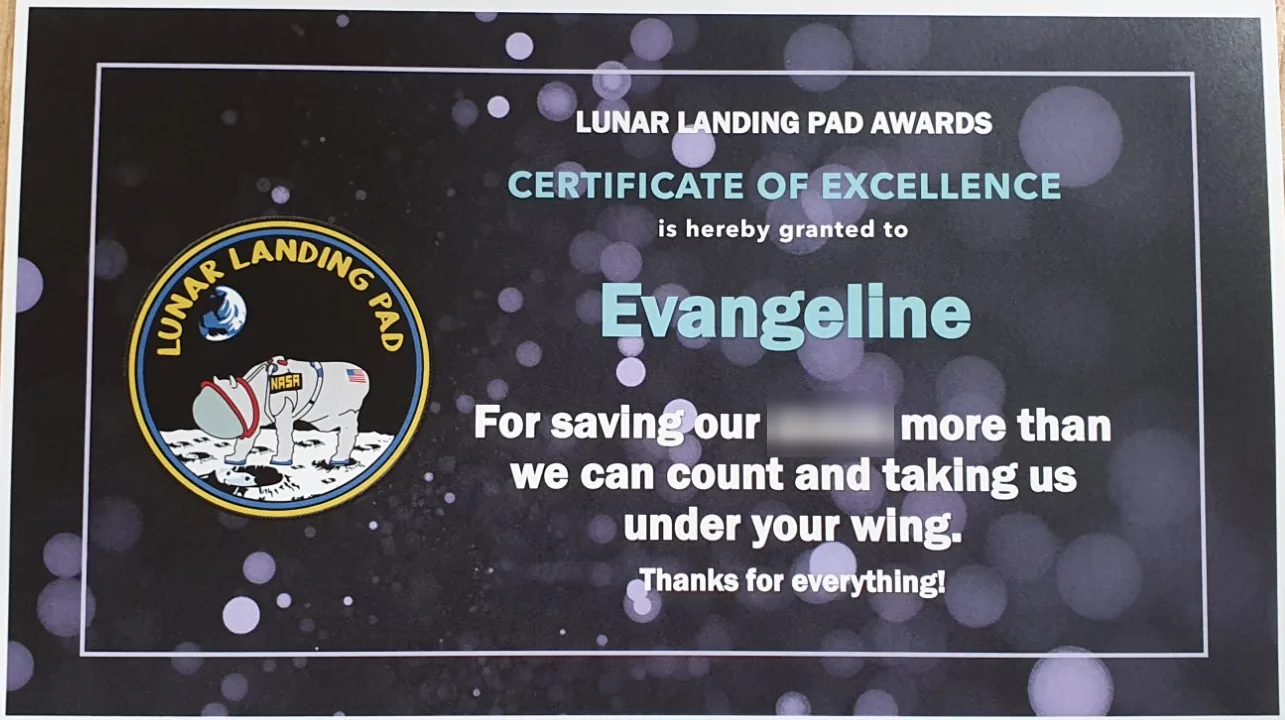
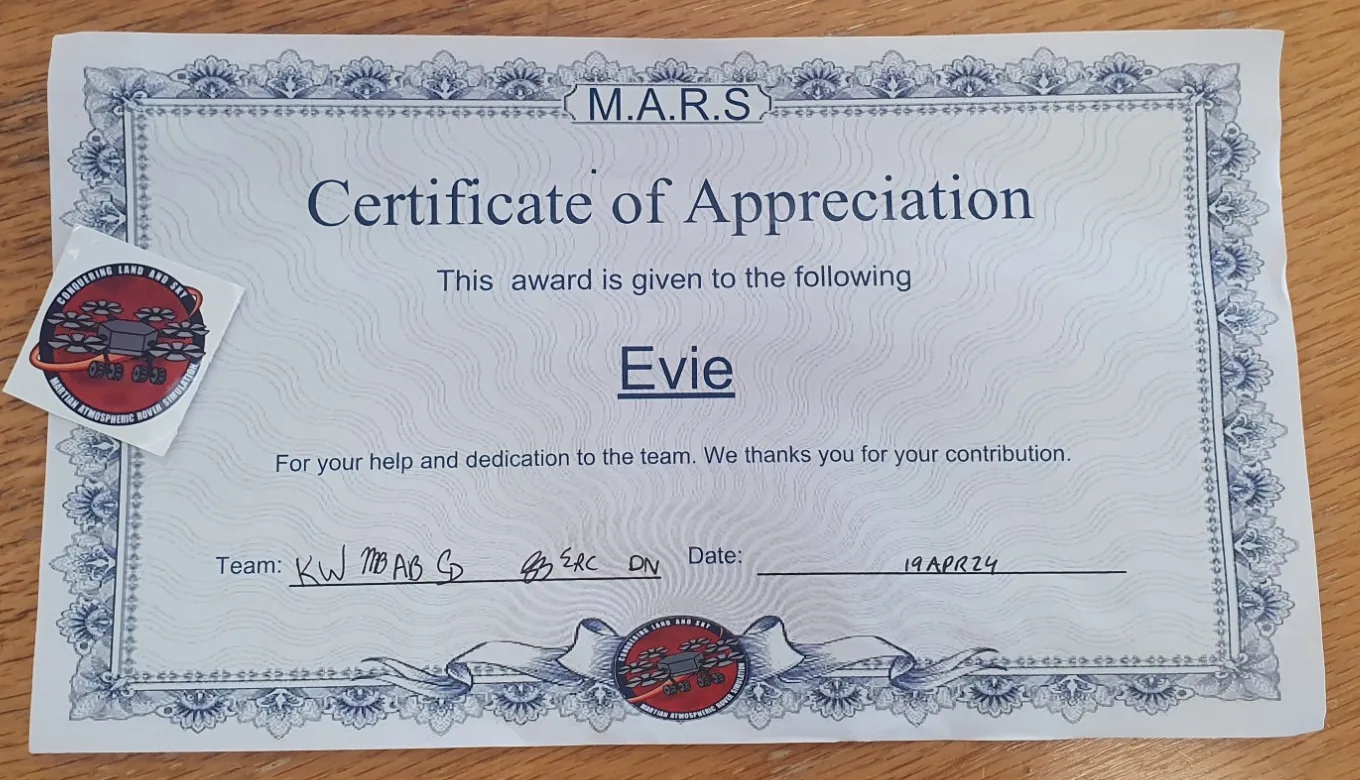
Volunteer mentor, senior designFlorida Tech L3Harris Student Design Center (HSDC), after graduating. I taught students to weld and to build electronics and custom PCBs, and together we built a rocket firing stand and its firing controller. Most of the students I mentored now work at SpaceX and Blue Origin. Teams thanked me with certificates, including Lunar Landing Pad (2023), who credited me with “taking us under your wing,” and M.A.R.S. (Martian Atmospheric Rover Simulation, 2024).
The Order of the EngineerTook the Obligation · Florida Tech, Link 281 · April 2021
“Evangeline has a command of analytic reasoning that places her in the top 1% of the students I have encountered here at Florida Institute of Technology. Her enthusiasm and energy are matched with a discipline that is remarkable.”
Teaching weldingThe firing standScorched after a firingFiring controllerLunar Landing Pad team, 2023M.A.R.S. team, 2024
Pete the Panther, my submission to UCA Mascot Nationals, 2017 (2 min)
Certifications
PTC Creo ParametricCertified User
Dassault Systèmes SolidWorksCertified User
High Power Rocketry, Level 1National Association of Rocketry (NAR)
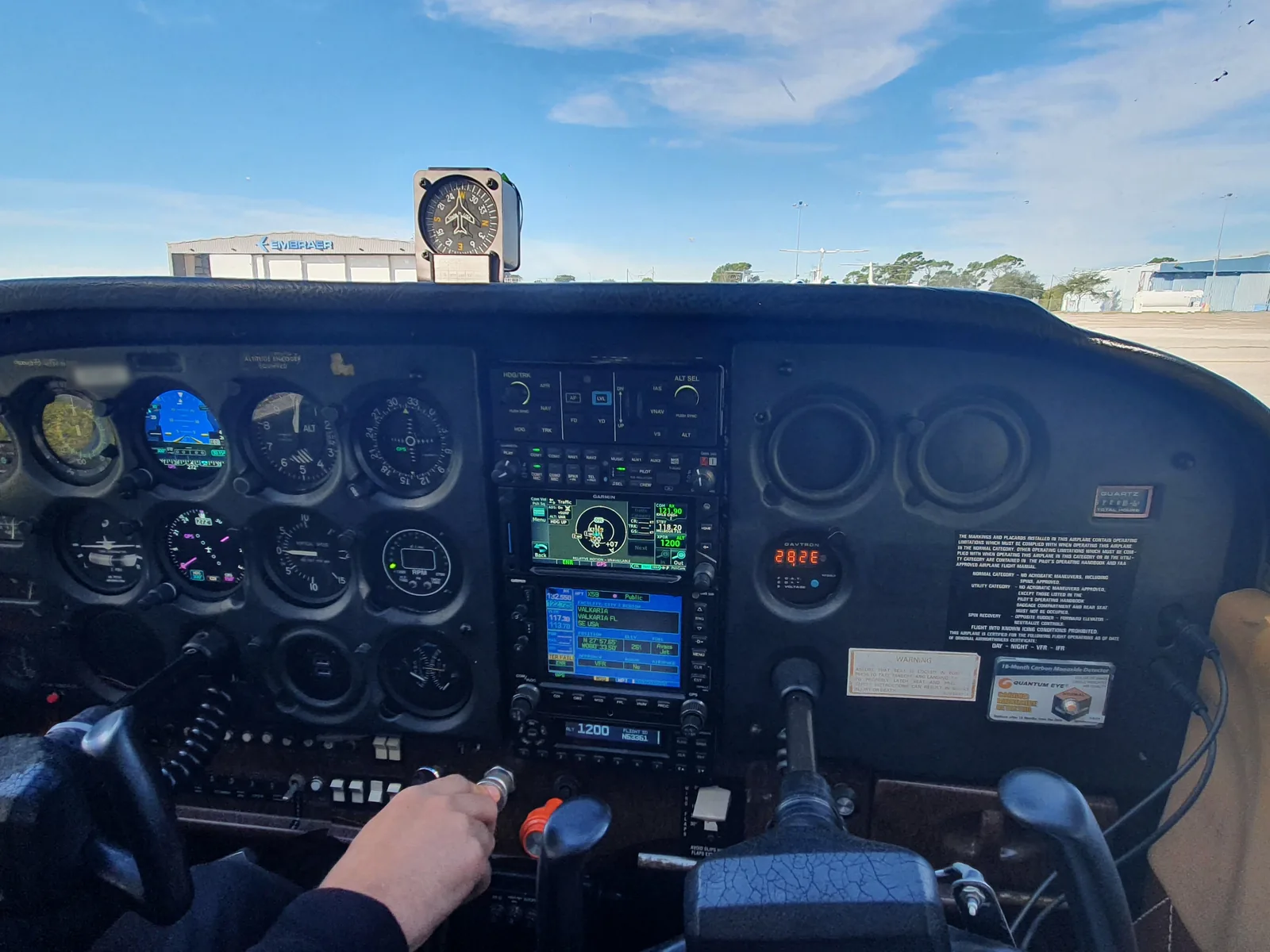
Private Pilot LicenceIn training
PPL training
Languages
English
Native
French
Native
Serbian
Native
Croatian
Full professional
Bosnian
Full professional
Spanish
Professional working
Thai
Limited working
Gaelic
Elementary
06
Contact
Open to systems engineering roles in launch, in-space and lunar programs. Based on Florida's Space Coast.